







March is National Colorectal Cancer Awareness Month, and for Grey’s Anatomy and Memory of a Killer’s Patrick Dempsey, who is no stranger to playing roles defined by health, creating an environment where we have the right supportive care for cancer patients (and fewer barriers to care in pre-screening for cancer) is a future that’s possible. And he’d like to use his verifiably McDreamy voice—and platform—to get us there (and examine his own health habits in the process).
Dempsey’s relationship to cancer is a personal one, and it’s helped shape the way he looks at the world. “One day in 1997, my mom, she wasn’t herself. She said she wasn’t feeling good, and she went to bed early. I got a call the next day from my sister, who said, ‘Mom has just been diagnosed with ovarian cancer. She had a tumor the size of a grapefruit, and they’re going to operate immediately.’ This was shocking news, just devastating news,” he shares with Prevention. She passed away in 2014, and by then, she’d had 12 reoccurrences of her cancer.
Dempsey founded the Dempsey Center in his hometown of Lewiston, Maine in 2008, partway through his family’s experience navigating chemo, and just around three years after his first appearance on Grey’s Anatomy. It’s a place where those impacted by cancer, including families, can find resources, support, and relief, and it removes some barriers for recovery, offering services at no cost. “I wanted to be able to do something more for cancer patients and their families. There was very little supportive care out there. You know, once you were released after your [cancer] treatment, you were on your own. And there was a real gap, and that’s how it started. We’ve been building out the program from there.”
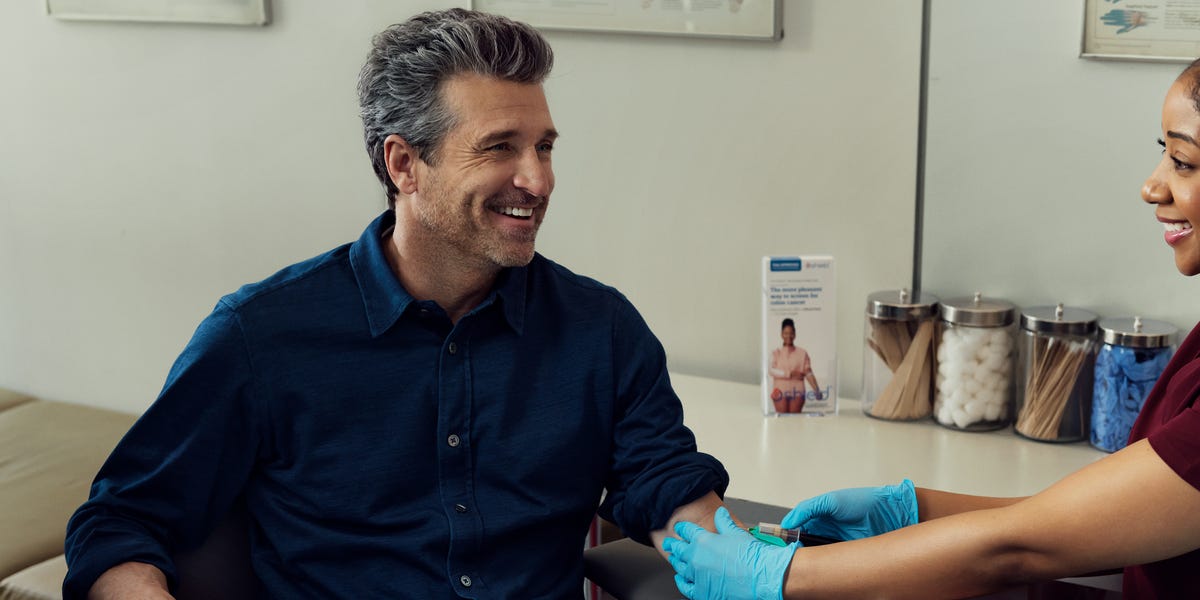
His mother’s cancer led him not only to advocate for wraparound care, but also preventative care for early detection. In Dempsey’s case, modeling good health habits includes a screening for colorectal cancer, which is one of the top three most common causes of cancer death in the United States. He recently led by example and got a screening done with Shield by Guardant Health, the only FDA-approved blood test for primary colorectal cancer screening (which is substantially less intimidating than a colonoscopy, and available to those 45+ through several major insurances). If more people knew to ask their doctor about minimally-invasive testing as a first line of defense, he feels it could open the door for a powerful change in early detection.
The American Cancer Society says colorectal cancer is the third most common cancer (and third leading cause of cancer-related death in men). Early detection could prevent more than 90% of colorectal cancer-related deaths, according to the New England Journal of Medicine. “Getting people through the door [for colorectal cancer screening] is very hard. The thought of getting a colonoscopy…people have to take time off for it. You need somebody to look out for you during that process. You’ve got the preparation ahead of time…it’s a pain in the ass, literally. These barriers stop people. And then there are others who have the thought, ‘Well, what if I have it?’ and might be in denial,” Dempsey shares.
After turning 60 in January, Dempsey continues to take a look at his health habits in general—though he says that turning 50 was a much “harder birthday.” “I remember when I saw the balloon and had just finished a full season of racing in the FIA World Endurance Championship. The recovery was much harder for me that year. My body was changing. I was on the road a lot, you know, I had achieved what I wanted to achieve. I was just thinking, I’m on the other side of the hill, the average life expectancy is around 76 for men. Now at 60, I am really clear on what I want to spend my time on, and what I don’t want to spend my time on. I’m wasting less time and I’m doing the things I want to do.”
This perspective shift, now in full swing, shapes how he maintains his health in the day-to-day. Dempsey stopped drinking in 2015. He’s eating less red meat and having more vegetables, paying attention to portions, and avoiding added sugars—and he admits that’s tough with a daughter who is a pastry chef. He’s also an early riser—though not always by choice. Dempsey sighs and laughs, “Yes, I have a dog that makes me get up early.”
When it comes to exercise and mindset, he feels both are important for longevity. He’s an avid cycler and racing enthusiast, and finds time for cardio and strength training, for the most part, even when he’s on set or traveling. “Having a trainer who is knowledgeable for the age bracket that you are in is important. It’s about staying consistent. I want to be able to move around and be functional, work on my flexibility, consider my bone density, and work on my balance.” Dempsey, like most people blessed with a dog, also goes for walks regularly.
To care for his mind and mental health, he meditates, listens to audiobooks, and leans into stoicism and vulnerability—ego is the enemy. “We’ve seen this whole toxic masculinity, and I think that the issue here is that our leadership and our older generation have been taught not to show vulnerability, but that doesn’t mean you have to break down and cry. It just means you have to have some empathy. When you’re seeing attack, cruelty, and defensiveness in leadership—that’s not healthy. Every great empire, they’ve all crashed and burned. I really [try to] embrace the moment I’m in right now and take it in, consider that, wow, I am living a part of history, and [focus on] doing something positive on a daily basis. We need to be of service, and when we are of service, life is far more fulfilling.”
Dempsey’s health habits follow the same attention he gives to supportive care and taking screenings seriously. Small, intentional changes in how you care for yourself can make all the difference in managing a health condition, or even preventing one.
Read the full article here


