







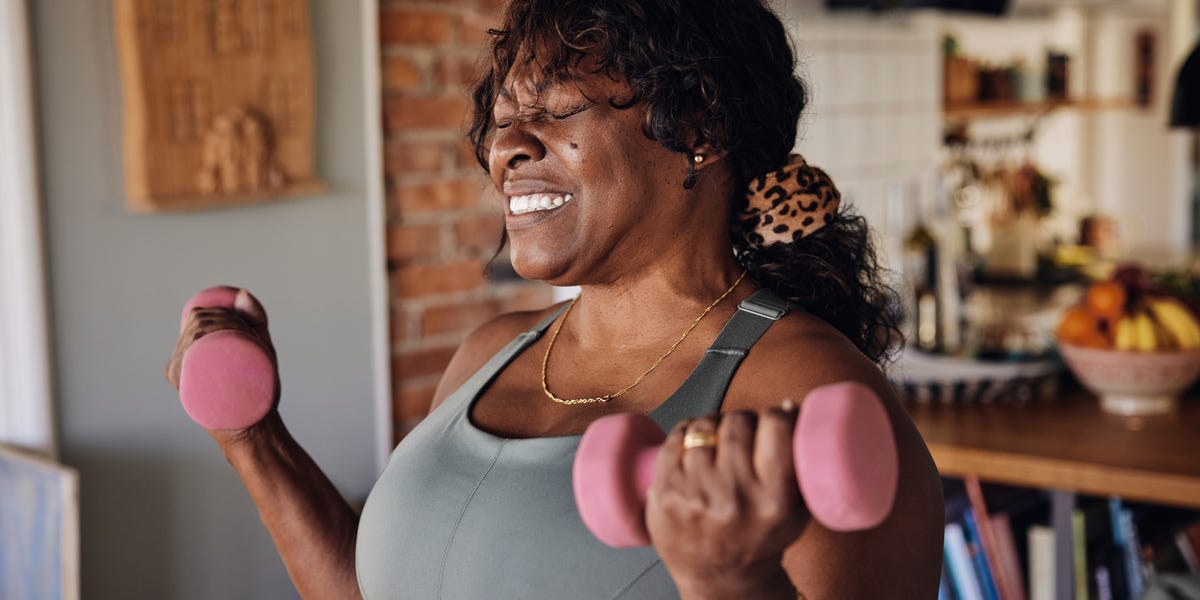
· Scientists explain how much strength training you need to build muscle, as set forth in new guidelines from the American College of Sports Medicine.
· Consistency is important, according to the guidance.
· Trainers weigh in on the new recommendations.
Strength training becomes more important with age—research shows that it may even add years to your life. While guidance on how much to do hasn’t changed in nearly two decades, the American College of Sports Medicine (ACSM) has now released updated recommendations on how much strength-training you need to gain muscle.
The guidance was based on 137 systematic reviews that cover more than 30,000 participants. “The evidence base has grown enormously since [the last guidelines],” says Stuart Phillips, Ph.D., study co-author, professor, and chair of the Department of Kinesiology at McMaster University. “We now have a much larger and better body of evidence on how resistance training affects strength, muscle growth, power, and physical function.”
Phillips stresses that the guidance is for everyone—not just serious athletes. “This update was needed to reflect the newer evidence and, importantly, to ask which variables truly matter and which probably matter less than many people think,” he says.
Dani Singer, C.P.T., founder of Fit2Go Personal Training, agrees. “We used to think of strength training as something strictly for bodybuilders, but the science now clearly shows it is the absolute foundation of healthy aging,” he says. “The new guidelines are needed to reflect this massive shift, emphasizing how to train safely and consistently for longevity, joint protection, and metabolic health.”
Meet the experts: Stuart Phillips, Ph.D., study co-author, professor, and chair of the Department of Kinesiology at McMaster University; Albert Matheny, R.D., C.S.C.S., co-founder of SoHo Strength Lab; Dani Singer, C.P.T., founder of Fit2Go Personal Training
The guidance is designed to get more people to strength train and to do it in a way that feels approachable for everyone. Here’s what it states, plus how trainers suggest putting this to work for you.
How much strength training do you need to build muscle?
The new guidance is the most evidence-based group of resistance training recommendations to date. After analyzing the data, researchers recommended that “healthy adults” do resistance training with high effort (with various weights and loads) at least twice a week, with all major muscle groups engaged.
Here’s what else to note:
- Voluntary strength (the maximum force you can exert) is enhanced by lifting heavier loads through a complete range of motion for two to three sets, across two or more sessions a week.
- Muscle gains are enhanced by doing 10 or more sets a week.
- Power(a combination of strength and speed) is enhanced by doing moderate loads for 24 or fewer repetitions or sets a week.
The guidance also backs off on the idea of training to failure, which means you do an exercise until your muscles are so tired you can’t do another rep. “I’ve always seen people get hurt while training to failure,” says Albert Matheny, R.D., C.S.C.S., co-founder of SoHo Strength Lab.
What else do the guidelines say?
The guidelines stress the importance of making resistance training approachable for all. That’s why it includes advice like this:
· You can start small. Going from having no resistance training to doing any regularly can make a big difference in the benefits you get.
· Consistency matters. You can adjust the load, amount of resistance training you do, and how often you do it, but the biggest priority for adults should be to create a routine you can follow consistently.
· You don’t need to visit a gym. The guidelines make a point to say that you can do effective resistance training outside the gym. Workouts that use elastic bands, bodyweight movements, or at-home routines can still lead to gains in strength, muscle size, and daily function. “The key is that the muscles have to be challenged,” Phillips says. “People do not need a perfect environment to benefit.”
· Athletes may need something slightly different. Specialized, sport-specific programs may still be needed for athletes and highly-trained people to get the most out of their resistance training. But the average person should choose something that works for them and stick to it.
The bottom line
Consistency is important because benefits from resistance training come from doing it repeatedly over time, not from one perfect workout, according to Phillips.
“Muscle is a classic ‘use it or lose it’ tissue,” Singer says. “When you are consistent, your body builds a reliable foundation of strength that protects your bones and joints day in and day out.”
If you haven’t done resistance training in the past and don’t have any equipment, Matheny points out that you can get started with bodyweight exercises like lunges, push-ups, and pull-ups. You can then ramp things up by holding cans of beans or containers of milk to add more weight to your moves.
Then, increase the intensity and speed to challenge yourself more. (You can also consider investing in tools like resistance bands and weights as you build strength.)
“Your muscles don’t know the difference between a fancy $5,000 gym machine and your own body weight,” Singer says. “You can create all the resistance your body needs right in your living room, which is what I do with all of my clients.” Simple tools like a pair of dumbbells, inexpensive resistance bands, or just bodyweight exercises are “incredibly effective for building strength,” Singer says.
Ultimately, Phillips says the new guidelines should feel approachable for everyone. “My biggest hope is that people stop thinking resistance training is only for athletes, bodybuilders, or people with gym memberships,” he says. As we age, all of us are at risk of being limited by loss of strength and power in daily life. Resistance training is one of the best ways to delay that limitation, or ideally, never experience it.”
Read the full article here


