







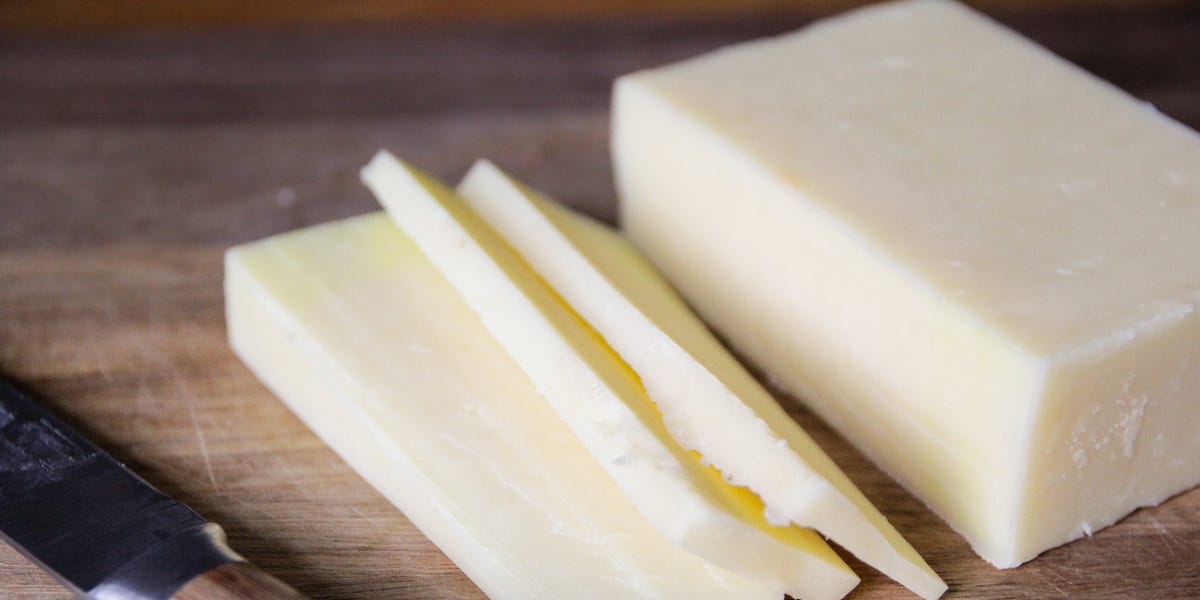
- The FDA has recommended that Raw Farm LLC remove its raw cheese products from the market due to an E.coli outbreak investigation.
- The company has declined.
- Food safety experts say this is dangerous for public health.
A multi-state E. coli outbreak tied to cheddar cheese has left two people in the hospital. While the Food and Drug Administration (FDA) has recommended that a cheese be removed from the market, the company behind the cheese has declined to do so.
“FDA has recommended that Raw Farm, LLC voluntarily remove their raw cheese products from the market, and the firm has declined,” reads an outbreak investigation report published on the FDA’s website.
According to the report, all of the people who became sick during this outbreak and were interviewed by state and local public health officials said they ate Raw Farm-brand raw cheddar cheese. But the cheese remains on shelves and is advertised on Raw Farm’s website.
Meet the experts: Francisco Diez-Gonzalez, Ph.D., the director of the Center for Food Safety at the University of Georgia; Darin Detwiler, L.P.D., an associate teaching professor of food policy at Northeastern University and author of Food Safety: Past, Present, and Predictions; Wade Syers, D.Soc.Sci., extension specialist for food safety at Michigan State University Extension; Ellen Shumaker, Ph.D., director of outreach for the Safe Plates program at North Carolina State University.
Food safety experts say this isn’t unheard of—and there are like a few reasons behind it. Here’s what you need to know.
What is happening with the market withdrawal request?
The FDA statement involves a multi-state outbreak of E. coli O157:H7 infections. As of March 14, seven confirmed infections have been reported across California, Texas, and Florida. The first known illness linked to the outbreak started September 1, 2025 and the most recent reported illness began on Feb. 13, 2026, per the FDA’s report.
Genome sequencing from the people who were sick suggests that these people share a common source of infection. Four out of the seven cases are in kids who are aged 3 or younger, and two patients have been hospitalized.
Based on patient interviews and epidemiological evidence, the investigation suggests that Raw Farm-brand raw cheddar cheese products are the “likely source” of the outbreak, per the FDA.
Raw milk is unpasteurized, which means it doesn’t undergo a heating process to kill off potential organisms that can make you sick. As a result, it can expose people to pathogens like campylobacter, cryptosporidium, E. coli, listeria, brucella, and salmonella, according to the Centers for Disease Control and Prevention (CDC).
As of pub time, no Raw Farm-brand cheddar cheese products have tested positive for E. coli, per the FDA and Raw Farm, but testing is ongoing.
A representative of Raw Farm shared the following with Prevention: “The FDA has no actual product evidence and no actual proof to their claim that connects ill people to our products or brand besides the fact that over a course of several months a small group of people across the nation all ate the same product (the product is still unknown) but happened to list our brand to their doctor as a product they loved to consume. There is NO ACTUAL LINK to our brand or products to associate our products to any outbreak. All our tests and the government’s tests are NEGATIVE for E. coli, and all of the other harmful bacteria we test for each milking. You are safe to consume ALL of our amazing products.”
Why is E. coli dangerous?
Escherichia coli (E. coli) is a type of bacteria that’s commonly found in the intestines of people and animals, according to the CDC. Most forms of E.coli are harmless, but some can make you very sick.
The form of E. coli in this outbreak—E. coli O157:H7—is dangerous.
E. coli infection can cause a range of symptoms, per the CDC, including:
- Diarrhea that can be bloody or watery
- Stomach cramps that can be severe
- Vomiting
- Low fever
While most people recover from an E.coli infection within a week, some develop a form of kidney failure called hemolytic uremic syndrome (HUS), which can lead to permanent health complications and death, according to the CDC.
“A contaminated product that has already been confirmed to be responsible for foodborne diseases poses a serious danger to the public,” says Francisco Diez-Gonzalez, Ph.D., the director of the Center for Food Safety at the University of Georgia. “If the food continues to be consumed, there is a high risk of more people getting sick and threatening their health. It is essential that public alerts reach as many people as possible.”
How can products involved in an investigation stay on shelves?
Until the Food Safety Modernization Act was passed in 2011, the FDA did not have the power to force food recalls, points out Wade Syers, D.Soc.Sci., extension specialist for food safety at Michigan State University Extension.
“They do now, but it requires following procedures that can take some time, and certain criteria have to be met,” Syers says. “In most cases where this happens, the companies dispute that their product is the cause of the illnesses.”
The delay in pulling a product from shelves can happen for a few reasons, according to Ellen Shumaker, Ph.D., director of outreach for the Safe Plates program at North Carolina State University. She points out that food producers should recall a product when the problem has been identified.
“It is their responsibility to clearly communicate that information downstream,” Shumaker says. “Responsibility also lies with the retailer to ensure that all of the product has been removed from the shelf and from storage in all of their stores.”
But Shumaker says that can get complicated with incomplete or confusing notices. Sometimes recalls occur in several stages, where only one batch is impacted but the recall later expands to others, Shumaker says.
This has happened before, according to Darin Detwiler, L.P.D., an associate teaching professor of food policy at Northeastern University and author of Food Safety: Past, Present, and Predictions.
He points to I.M. Healthy SoyNut Butter staying on shelves for months after a recall began in 2017 due to an E. coli outbreak. More recently, ByHeart infant formula stayed on shelves for weeks after it was recalled due to botulism concerns, Detwiler says.
While Detwiler says it’s not common for a food product linked to an outbreak to stay on shelves, it happens often enough. “The public tends to assume that once people start getting sick, the product is quickly identified and removed,” he says. “In reality, the process is slower, more cautious, and driven by evidence that takes time to build.”
What happens now?
The FDA’s investigation is ongoing, with the agency trying to determine the source of the contamination and if other products are linked to the illnesses.
Read the full article here


