






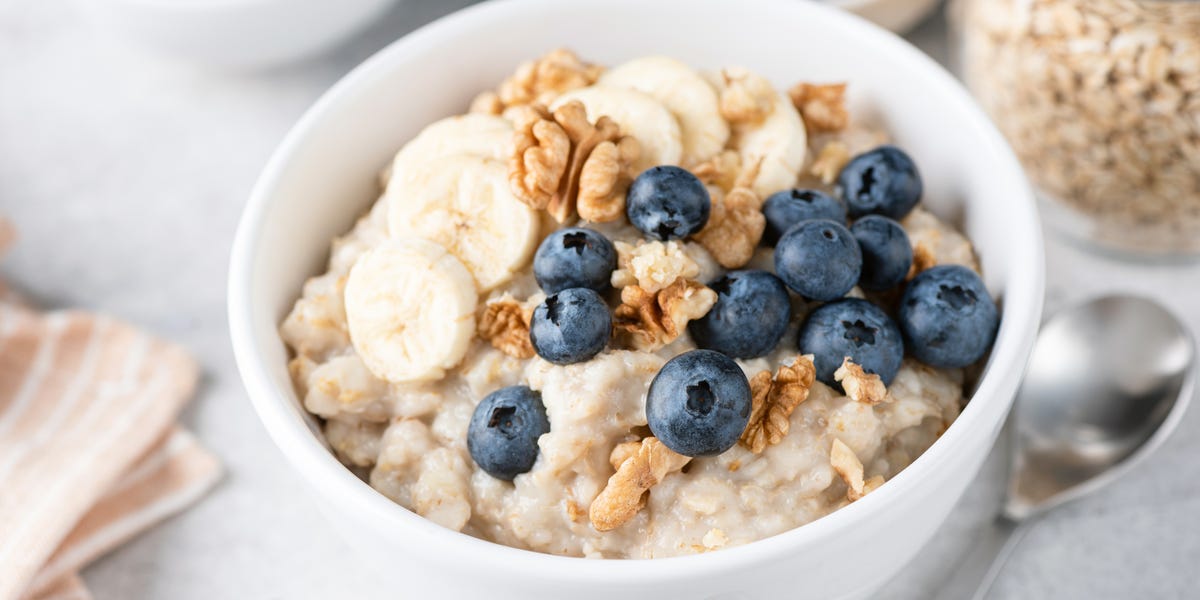
Oatmeal has long had a reputation as a healthy breakfast option, and in recent years, it’s only grown. Online, some are touting the grain’s utility as an aid for weight loss, even devising trends like the “Oatzempic” challenge. But is there any truth to these buzzy claims?
Ultimately, “it really depends,” says Jessica Cording, M.S., R.D., registered dietitian and author of The Little Book of Game-Changers. “Oatmeal can be a very healthy food, but there are a few things to consider with it.”
Ahead, nutrition experts explain oatmeal’s health benefits, whether it can help you lose belly fat, and any potential drawbacks of this breakfast staple.
Meet the experts: Jessica Cording, M.S., R.D., author of The Little Book of Game-Changers; Keri Gans, M.S., R.D., author of The Small Change Diet; Scott Keatley, R.D., of Keatley Medical Nutrition Therapy; Melissa Prest, D.C.N., R.D.N., national media spokesperson for the Academy of Nutrition and Dietetics and member of the Prevention Medical Review Board; Beth Warren, R.D., founder of Beth Warren Nutrition and author of Secrets of a Kosher Girl; Amy Lee, M.D., medical nutrition specialist; Kristen Nicolai, M.S., R.D., C.D.N., clinical nutrition coordinator at Mount Sinai; Catherine Perez, R.D.N., plant-based dietitian and author of Peaceful Kitchen.
What are the health benefits of oatmeal?
Oatmeal boasts a variety of health benefits. Here are some ways oatmeal may support your wellbeing, according to nutritionists.
It may help you feel fuller, longer
The soluble fiber in oatmeal can help fill you up, Cording says. “It interacts with fluid in your digestive tract and takes up space in the stomach, which can help with satiety,” she says. “It helps if you’re someone who finds that you get hungry shortly after eating.”
Kristen Nicolai, M.S., R.D., C.D.N., clinical nutrition coordinator at Mount Sinai, agrees. “A half cup serving of rolled oats provides about 4 grams of fiber and 5 grams of protein, which can help keep you feeling full for hours,” she says.
It may reduce the risk of heart disease
“Oatmeal is a 100% whole grain rich in soluble fiber which may help reduce the risk for heart disease, lower cholesterol levels, and maintain blood glucose levels,” says Keri Gans, M.S., R.D., author of The Small Change Diet.
It’s a super accessible, healthy grain
Oatmeal is “extremely available” and can be prepared quickly, says Scott Keatley, R.D., of Keatley Medical Nutrition Therapy. That, he says, raises the odds you’ll actually eat it, as opposed to pricier, more time-intensive options.
It may improve skin and boost immunity
Oatmeal contains vitamin E, “which is good for hair, skin, and nails, as well as a key player in the immune system,” Keatley says.
It could help balance your gut microbiome
Oatmeal is a prebiotic food, which means it feeds the probiotics, or healthy bacteria in your gut, creating a balanced microbiome. In fact, a 2021 review published in the Journal of Nutrition found eating oats to be associated with good gut health.
It can help control blood sugar and cholesterol
“Oats are high in a viscous or gel-forming fiber, which slows or delays stomach emptying,” Nicolai says. “As food moves through the digestive tract at a slower pace, it helps with lowering blood sugar and cholesterol.”

Add Prevention as a preferred source in your Google search results.
Use your Google account to add this to your settings.


Can oatmeal help with weight loss and losing belly fat?
“Oatmeal can be great for losing overall weight and perhaps even belly fat,” explains Amy Lee, M.D., medical nutrition specialist. “But we have to consider the types of oatmeals that are being eaten.”
There’s a difference between eating plain oatmeal, like old-fashioned or quick oats, and the instant flavored stuff, says Beth Warren, R.D., founder of Beth Warren Nutrition and author of Secrets of a Kosher Girl. “Be careful consuming oatmeal from the flavored packets as many brands can have a load of sugar,” she says. “Ideally, opt to create plain oatmeal with your added sources of flavor and ingredients such as fruit with a teaspoon of peanut butter.”
Cording says that oatmeal’s ability to help with weight loss really depends on what you eat it with. “You want to make sure you incorporate some protein and fat,” she says. That can mean making it with milk, adding a spoonful of seed or nut butter, or having it with an egg, she suggests. You can also toss in a handful of berries or shredded zucchini for added nutrients.
And just keep in mind: Nicolai cautions that oatmeal alone isn’t a magic bullet: “No single food can help reduce belly fat.”
Can I eat oatmeal every day to lose weight?
“Yes, you can eat oatmeal daily but also add things such as fresh fruits into it to get added phytochemicals, vitamins, and minerals,” says Amy Lee, M.D., medical nutrition specialist.
Are there any drawbacks to eating oatmeal?
On the whole, oatmeal is a nutritious choice. However, there are a few things to keep in mind when deciding how to prepare it and what to pair it with.
Oatmeal isn’t a complete meal, Keatley says, “but many people treat it as such.” That’s why it’s so important to add protein and fat to round out the nutrition you get from having a bowl, he says. (This is particularly true for people with diabetes and prediabetes, whose bodies are more sensitive to blood sugar spikes.)
Dr. Lee agrees—and has a special trick for maximizing protein. “My mother used to add eggs into the oatmeal as she cooks it over the stove for the extra protein,” she says.
One more thing to consider: For those with gluten allergies and intolerances, oatmeal can be tricky. “For those that have gluten allergies, I’d highly recommend either seeing if you tolerate gluten-free oatmeal or try a different gluten-free whole grain hot cereal from the breakfast aisle that can still provide that fiber benefit,” says Catherine Perez, R.D.N., plant-based dietitian and author of Peaceful Kitchen.
What is “Oatzempic,” and does it work?
With all of the buzz surrounding Ozempic and other GLP-1 agonists—drugs originally developed to treat type 2 diabetes, which now appear to have many applications, including weight loss—reports of natural “dupes” abound. Such is the case with “Oatzempic,” a recipe that blends about 1/2 cup of oats, one cup of water, and juice from a lime into a lower-calorie beverage.
“The idea is that oats are high in soluble fiber and can increase fullness while decreasing hunger,” Prest says. However, Prest notes that many people who have tried this trend have also limited their calorie intake, “so it is more likely that it is being in a calorie deficit rather than the oats on their own are contributing to weight loss,” she says.
Importantly, “Oatzempic” is not a replacement or true substitute for GLP-1 medications, such as Ozempic and Wegovy, Prest adds. Nicolai agrees: “The name is misleading, as oatmeal and a drug that influences hormones are not the same,” she says.
“Truthfully, [Oatzempic is] just another trend, luckily one that isn’t as harmful as others,” Perez says. “Can it help with weight loss? A lot of things can help most people with weight loss as long as you are maintaining a caloric deficit.”
Read the full article here


