







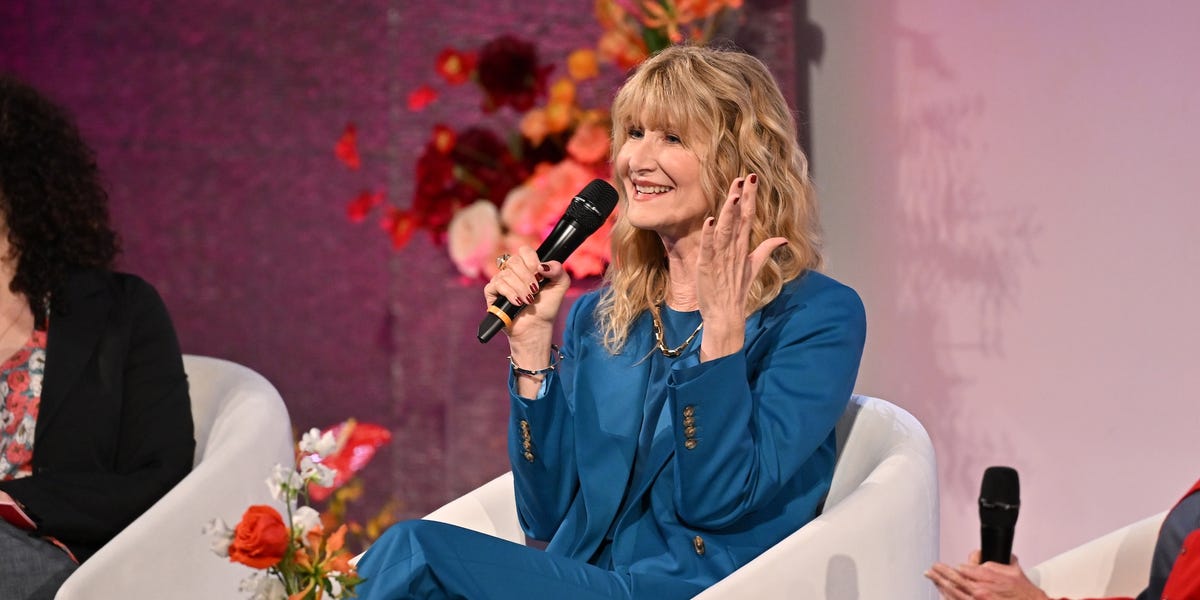
As an Academy Award-winning actress, Laura Dern has taken on many roles over the years. But perhaps none quite as challenging—or as rewarding—as that of her mother’s caregiver. As Prevention’s May 2026 cover star, Dern recently opened up about how she navigated caregiving after her mother, the late actress Diane Ladd, received a grim diagnosis of idiopathic pulmonary fibrosis (IPF), a common type of interstitial lung disease. Now, in a continuation of her conversation with Prevention Executive Editor Stephanie Dolgoff at the Women’s Health Lab, Dern is sharing the unexpected caregiving advice she learned.
For Dern, learning how to be a better advocate—both as a caregiver and someone potentially seeking care—was the biggest lesson. “Self-advocacy is our greatest lifesaver,” she says. “And champion caregivers are such an essential lifesaver.”
Ladd’s difficulty getting the right diagnosis particularly drove this home for Dern. “[my Mom] had been misdiagnosed for years…We were both terrified and didn’t have answers,” she explains. “Unfortunately, a pulmonologist without [an] empathetic bedside manner similarly came in and said, in front of my mother, to me: ‘Be gentle with your mother, she’ll be dead in six months’…and left us with no information, saying there’s nothing you can really do…Luckily for us, [my mother] demanded a second opinion.” Dern continued to stress the importance of advocating for yourself and demanding a doctor who will listen to you throughout the conversation.
Luckily, Ladd eventually found a different pulmonologist, who Dern praised as “joyful and hopeful and supportive of her living a long, full life. [That’s the lesson:] To advocate for yourself, seek second opinions, and to push back.” Pushing back had real, measurable consequences for Ladd, whose original three-to six-month prognosis ultimately transformed into seven and a half years until her death last November.
Dern doesn’t take those extra years for granted. Following advice from Ladd’s pulmonologist to use daily walks to help expand her lung capacity, Dern and Ladd found themselves engaging in important conversations that deepened their relationship in ways neither of them expected. “Getting her walking and talking was, yes, important literally in terms of the therapy, pulmonary rehab, as it were, but also giving her the purpose to share stories that I could share…with her grandchildren for her legacy. Things to heal our relationship that we’d never talked about in my childhood,” Dern says. “It continued to really promote incredible healing all the way around, and I do believe really added years to her life.”
Dern may not have expected to be thrust into the role of her mother’s caregiver the way she was. But now she has the perspective to help others who might find themselves in the same position, and knowing how to advocate for yourself and others remains her biggest takeaway. “All of us become [caregivers] in our lives,” she says. “It’s nothing we’re taught, and yet it is part of all of our stories. To have the awareness and confidence to give someone confidence is such a massive gift in caregiving, and if you don’t have the answers, you don’t know how to do that.”
Read our May cover story with Laura Dern
The 3rd annual Women’s Health Lab was hosted by Hearst Magazines in partnership with Northwell’s Katz Institute for Women’s Health. Lilly served as title sponsor, with additional sponsors including Altra, Bayer, Boehringer Ingelheim, Ipsen, L’Oreal Paris, Organic Valley, and WaterWipes.
To learn more about interstitial lung disease, visit BeyondTheScars.com.
Read the full article here


