







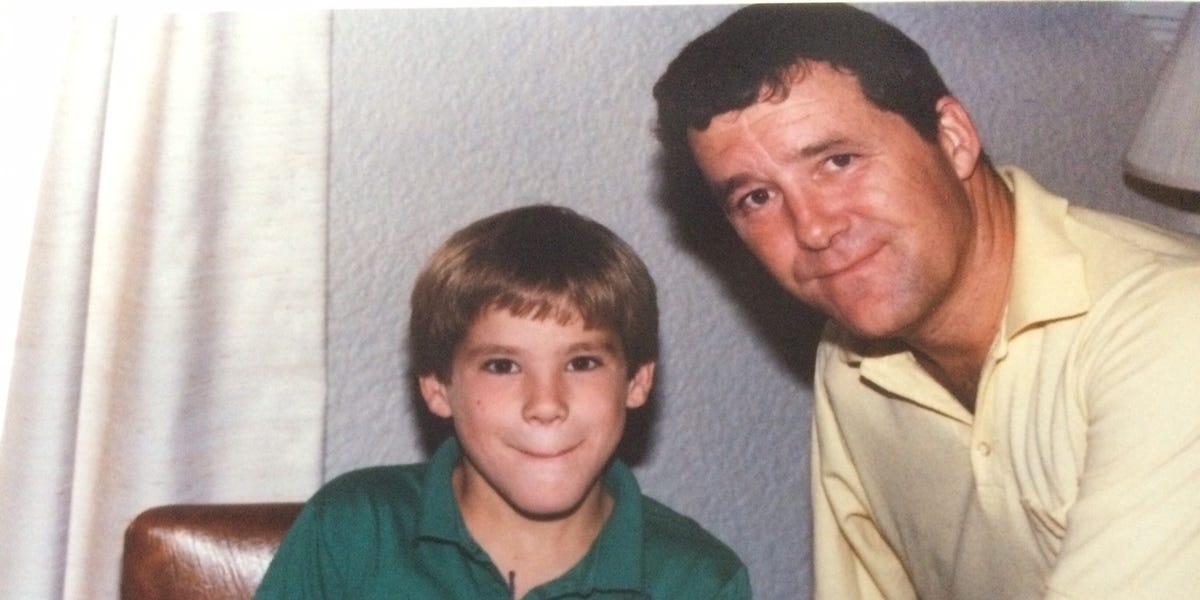
Actor Ryan Reynolds, 49, is the youngest of four boys, which means his mom, Tammy, was practiced at managing a dizzying level of chaos in their Vancouver home—way more than the sum of what each boy could generate on his own.
Then in 1993, when all her sons were grown—just when she might have had a little “her” time—her husband James was diagnosed with Parkinson’s at 52. Parkinson’s Disease (PD)—which actor Michael J. Fox has amplified in our collective conversation—is a nervous system disorder that gradually leads to tremors, body rigidity, slowed movement (called bradykinesia), gait changes, and balance issues, among other things. There are non-motor symptoms as well, such as a loss of a sense of smell, cognitive changes, and depression and anxiety, according to the Mayo Clinic.
But there was one aspect of PD that blindsided Tammy: About ten years after his diagnosis, James began seeing and hearing things that weren’t there and attaching complex narratives to these visions and ideas. No one had told the family that progressive hallucinations and/or delusions were PD symptoms, and that around half of people with PD have them.
“He’d say things like, ‘You know, the neighbor has got eyes on mom,’” the Marvel series star, now himself a father of four with wife Blake Lively, told me in an exclusive interview. “My dad would talk about the people in the back seat of the car [who didn’t exist.] Now imagine you’re my mom—she’s the passenger…I can’t even imagine the matrix of what she might have been feeling,” he says, eyes wide in disbelief. Tammy, now 81, “Is one of the smartest, sharpest people you’ll ever meet,” Ryan, also a producer and entrepreneur, adds. “But it was tough, and she was incredibly overwhelmed.”
It wasn’t dementia
The fact that James’s doctors chalked these visions and thoughts up to other things left Tammy—already his primary caregiver—with an even more stressful situation.
“I think the biggest chasm in our relationship—and I could see in it the relationship he had with my mom and three older brothers—was the period in which he became, to a certain degree, an unreliable narrator in his own life,” Ryan recalls, adding that nothing helped his dad as he appeared to be losing his mind. There weren’t great solutions at the time: the antipsychotic drugs sometimes prescribed were known to make the physical symptoms of PD worse, according to a review published in Medicines. (There are now treatments that don’t have this side effect.)
While some who have PD may have cognitive decline, James’s imaginary visions and narratives were not a sign of dementia, Ryan says. In PD, neurons in the brain slowly break down and die, affecting how the body moves and communicates with the brain. Hallucinations can occur because of PD itself alongside certain medications used to treat the physical symptoms, according to a study in Nature. Other factors, such as a sleep disorder and disruptions common to people with PD, research shows, are thought to play a role as well.
James died at 74 (Ryan’s eldest daughter, his namesake, was born not long before he passed), and Ryan has been working to raise awareness about PD, especially this symptom, for years. “There was a HUGE spike in my father’s sense of well-being when Michael started talking about his Parkinson’s,” says Ryan, who works with The Michael J. Fox Foundation and admires his friend for publicly demonstrating what a rich, full life with PD looks like. “There’s a Japanese term, koeki, that means you’re doing something that kind of benefits the world,” he says. “And I think that relaying our experience—the tough stuff, the good stuff, all of that—is something I have to do, not [only] want to do.”
The conversation below has been edited for length and clarity.

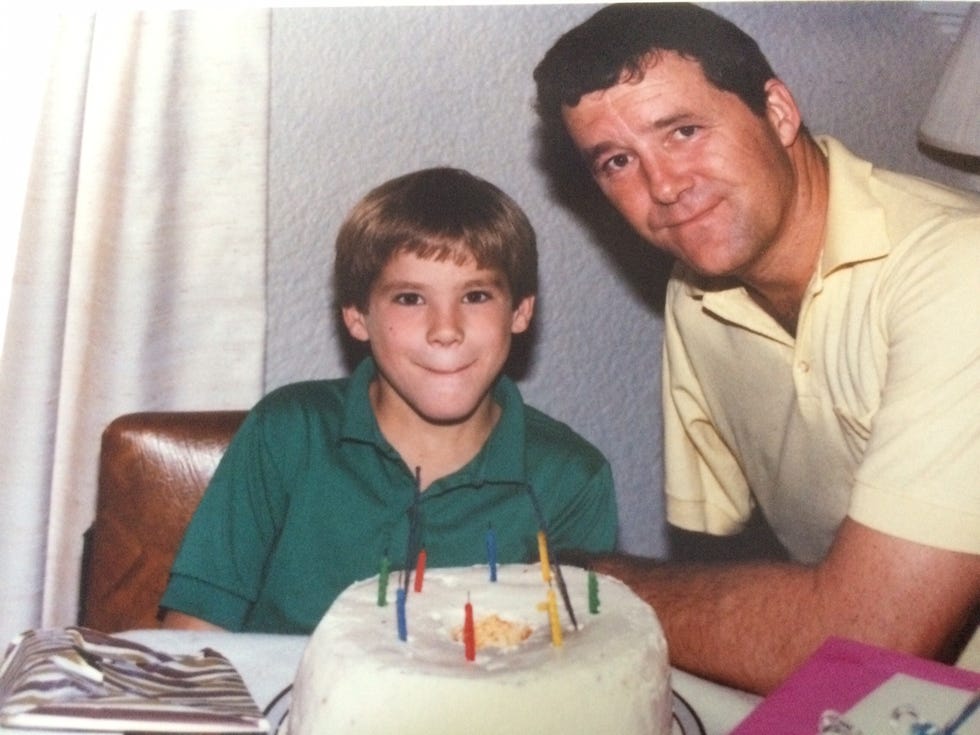
Ryan and dad James after the birthday candles were blown out.
Reynolds, who moved out of the family home at 16, had a complicated relationship with his father, a former police officer and food broker. He wasn’t surprised that James kept how he felt about his physical and emotional struggles with PD to himself.
My dad really struggled with vulnerability—that’s the easiest way to say it. And I understand why. A lot of guys of that generation did. It’s sort of like when you see a bully—you know that every bully has a bully. My dad was the strong, silent type, which is so romanticized for all the wrong reasons. My grandpa was that guy as well—he’d come home from work and mow the lawn, and he’d roll up his sleeves, and that’s about as casual as he got. He kept his tie on!
So my dad never talked about [his symptoms] if he could help it. You would think [a diagnosis] would bring you a sort of relief, but to him, it was treated as a source of shame. He said the word ‘Parkinson’s’ maybe three times in his life.
But I don’t want to paint him with only one brush. His whole life, my dad punched above his weight class. That is actually really admirable and really beautiful. But it can also be turned into something that’s a little bit darker and a bit more of a progenitor of hardship as he got older.
James’ hallucinations and delusions didn’t show up right away, and the family had no idea they could be part of PD. As they got progressively worse, Tammy handled them as best she could.
I think she would just pacify him, try to find a way to kind of softly get out of the danger of the situation. My father was such a domineering presence that I saw her minimize herself around him.
At the same time, I have a lot of empathy for my dad because he really didn’t need that. What he really needed, I think, was [to do] something proactive—a discussion or a dialogue about what he was going through. This disease has so many nuances to it, but around 50% of folks who have Parkinson’s experience hallucinations and/or delusions that nobody talks about. Which is actually kind of crazy!
Reynolds believes his dad was lonely in his inability to talk about what he was going through, and his reticence also made it hard for his family to support him as well as they might have.
The fact that [what my dad saw] was so complex—it must have felt so real to him. I would have loved to have known that this is something to expect because of how lonely my dad must have felt, with people around him saying, ‘Well, he’s an unreliable narrator of his own life, he’s lost his marbles,’ those kinds of things. How isolating and lonely!
You can’t just say [to someone who has delusions], “That’s not real.” It was real to him. If he’d been able to include us all in what he was feeling…man, we could have been a real source of empathy, and I think we would have had a tender grit he could have responded to really well. If we had known, it would have set us up for a more productive dialogue.
James’s delusions came and went, Ryan says.
Oh, he had moments that were wildly lucid, and just, you know, he was his old self. My dad had great sense of humor. He was very, very charming.
But charm is dangerous because it can really cover up a lot of things—it can pave over all those weird potholes that you have in life. Like, he’d seem fine, or like he’d make a joke. So charm hides a lot of things. But he was very alone and none of that was aided by the fact that I had a very complicated relationship with him, having nothing to do with his disease progression.

James Reynolds (holding baby Ryan) and two of his other three sons, circa 1977.
The four brothers came over frequently to help Tammy in any way they could.
All four of us just descended on the house. It was [close to] nervous breakdown time—she was in a very distressed place. My mom just really lost herself. You know [when you’re a caregiver] you’re basically saying, ‘Okay, but any of my wants, desires, hopes, for this short window we have on this great, green spinning wheel flying through space, I’m just gonna absolutely dissolve them. You don’t think about them anymore because there’s no room for it.
It’s a terrible tragedy to be in the position that she was in, and all too often it happens to women, more so than men. Our job was to reconnect my mom with her own dreams and wishes and hopes without disconnecting her from her husband.
We all also really made sure that my dad was as well cared for as we could, as he needed round-the-clock care at a certain point. We always kind of walked on eggshells around my father. So, [being at home with him] was just another few eggshells to walk on.
But it did increase dialogue between my brothers and me. We are all very close, but we’re all very different, and I love that because we’re offering different points of view. It’s not going to be just this unison kind of swan song that’s coming out of them when it comes to decisions. It’s very thoughtful.
While things weren’t resolved between Ryan and his dad before he died, he is glad he was able to show up in the way he did.
I have a great sadness that my kids never got to meet him. My oldest daughter James was born right before he died. He became very, very emotional toward the end. I wrote him a long, chronological list of all the greatest memories I had of us, as something he could look at each day and just kind of live in those moments. I described in great detail what happened that day, what we did, where we were.
Some of them were the tiniest things ever. One time, I got hurt at school, some kid was a bit of a bully—the normal stuff—and he just took me out to play catch. It was just this little tiny gesture that was so soothing.
I remember also we drank powdered milk and one time he bought a bunch of regular milk—to us that was like winning the lottery. We weren’t poverty-stricken or anything, but we were very much a working class, and four boys are expensive on one modest income. There were a lot of real shining moments. A couple of Solsbury Hill moments, if you know the Peter Gabriel song. I still to this day get sort of emotional about all these little things.
Reynolds wants every newly diagnosed person PD to hear about all the symptoms, including the cognitive ones, so they don’t feel so alone, as James did.
The physical symptoms are horrible, but so are the psychological ones. Those two are symbiotic, kind of like pieces of kelp under water—they sway with each other and need to move together in sync. If you could just talk to some of the people that do not talk about [their hallucinations], you’re gonna see a gigantic change in temperament and optimism and quality of life.
Please visit MoretoParkinsons.com to for more information.
Read the full article here


