






- A new study links xanthelasma—fatty, yellowish lesions that appear near the corner of the eye—to an increased risk of heart disease.
- The substance that makes up xanthelasma lesions is similar to the cholesterol that can clog your arteries.
- Doctors don’t want you to panic about xanthelasma, but you should check in with your doctor to see if they recommend further testing.
Heart disease can be sneaky: Some contributing factors, like high cholesterol, aren’t really apparent unless you get a blood test. However, according to a new study, your body may provide a surprising, visible warning sign of the condition—and of all places, it can appear around your eyes.
Meet the Experts: Cori Russell, M.D., a cardiologist and lipidologist at Henry Ford Health in Detroit; Nicholas Sibinga, M.D., a professor of cardiology at Albert Einstein College of Medicine in the Bronx, New York; and Adedapo Iluyomade, M.D., a preventive cardiologist and medical director of the cardiometabolic clinic at Miami Cardiac & Vascular Institute.
The study, which was published in the journal Atherosclerosis, linked xanthelasma—a condition marked by fatty, yellowish, cholesterol-rich lesions that appear on the skin near the inner corner of the eye—with increased cardiovascular risk. So, should you be concerned if you see a new bump in the mirror? Here’s what cardiologists want you to know about the findings.
What did the study find?
In the study, researchers analyzed electronic medical records from nearly 18,000 people with xanthelasma and compared them to the same number of folks who didn’t have the condition. They discovered that those with lesions had a two- to three-times higher risk of experiencing a cardiovascular event like a stroke or heart attack compared to those without the condition. The risk remained elevated after 10 years, though the overall risk of death during that time wasn’t different between the two groups.
The current study also builds on prior research, which linked xanthelasma lesions to higher levels of cholesterol—as well as greater chances of experiencing a major cardiac event.
Still, the study does have some limitations. While the study was significant in size, it was also observational, meaning researchers looked at what happened to the participants, but didn’t assign them a particular intervention or treatment. As a result, it can suggest a link or an association, but can’t prove cause and effect.
The researchers also did not take into account whether or not people had been treated for high cholesterol or for how long, notes Cori Russell, M.D., a cardiologist and lipidologist at Henry Ford Health in Detroit. It’s also possible people with xanthelasmas may simply handle and deposit cholesterol differently throughout the body. “Those are questions this study cannot answer, but they may be important areas for further research,” she says.
How xanthelasmas and heart health are connected

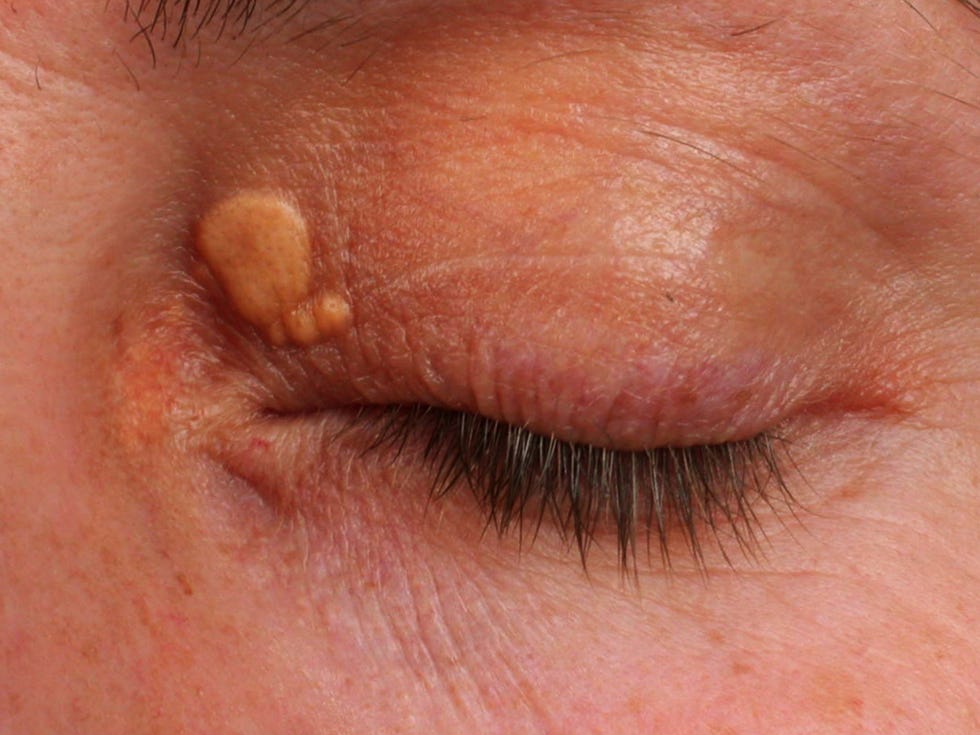
The fatty plaque substance that fills xanthelasma lesions is similar to the cholesterol that can clog your arteries and lead to a heart condition called atherosclerosis. “This suggests that xanthelasma and atherosclerosis may arise through similar metabolic and cellular processes,” notes Nicholas Sibinga, M.D., a professor of cardiology at Albert Einstein College of Medicine in the Bronx, New York.

Add Prevention as a preferred source in your Google search results.
Use your Google account to add this to your settings.


Xanthelasmas are seen in people with high cholesterol and in those with a hereditary disorder called familial hypercholesterolemia, notes Dr. Russell. In fact, some people end up being diagnosed with high cholesterol by a dermatologist whom they initially see for the lesions, she adds.
But it’s important to note that the presence of xanthelasmas doesn’t automatically guarantee cholesterol problems—they can just be benign. “You can absolutely have xanthelasma with relatively normal cholesterol levels,” Dr. Russell stresses. In that case, they are usually a cosmetic concern and can be removed by a dermatologist, notes Adedapo Iluyomade, M.D., a preventive cardiologist and medical director of the cardiometabolic clinic at Miami Cardiac & Vascular Institute. Even then, they may return and become permanent.
“I think of xanthelasma as a potential external clue to an internal risk profile, not as proof that someone has coronary artery disease,” Dr. Iluyomade says.
What to do if you notice an xanthelasma—and how to prevent them
“Definitely don’t panic about xanthelasmas, but don’t ignore them either,” says Dr. Russell. “Many patients have xanthelasmas and never develop heart disease, so they are certainly not destined to have a heart attack or stroke.”
At the same time, though, the yellowish bumps around your eyelids are a relatively easy physical finding to recognize, she says. She considers noticing the presence of one “an opportunity to make sure we haven’t missed cardiovascular risk factors that are potentially treatable.”
It’s also important to have xanthelasma formally diagnosed, as other eyelid lesions can look similar, according to Dr. Iluyomade. If you’ve got one, you may also want to get tested for abnormal thyroid or liver function, since those conditions can also contribute to xanthelasma formation, Dr. Sibinga says.
As for prevention, xanthelasmas are relatively uncommon, and there are no guaranteed ways to stop them from popping up, says Dr. Russell. “Rather than focusing specifically on preventing xanthelasmas, I would focus more broadly on protecting the entire cardiovascular system,” she notes.
The bottom line
Paying attention to potential physical health cues from your body is “extremely important,” says Dr. Iluyomade. “Someone presenting with xanthelasma deserves a thoughtful, comprehensive cardiovascular risk assessment,” he adds.
From there, your doctor can help you work on a lifestyle and potential treatment plan that is right for you, which, regardless of whether or not you have high cholesterol, will likely consist of the known things that prevent heart disease: regular exercise, avoiding smoking, controlling blood pressure and blood sugar, and eating a healthy, balanced diet.
Read the full article here


