







When I was a junior-high gymnast, I was super flexible. My friends and I did backbends, cartwheels, and splits at the drop of hat—not just at team practice, but in the hallway between classes, and any time we were on a lawn. These days, at 58, not so much. While I’m in good health and walk at least 7,000 steps almost every day, my legs, back, and shoulders still feel more stiff and sore than supple at the end of the day. Could a daily stretching routine be the key to not only feeling better but aging gracefully? I decided to find out.
What can stretching really do for you?
When I looked through the latest research, it became clear that the biggest benefit of a daily stretching routine is that it can help improve your range of motion—basically, how far you can move a specific joint in different directions. (A meta-analysis published last year showed that stretching between 4-10 minutes a day improves flexibility and range of motion in adults.)
Some examples of how range of motion is part of every move you make: It’s rotating through your shoulder to grab something off a high shelf, bending over to tie your shoes, or rotating your hip to the side to step out of a car easily. “This is particularly important with age, because muscle stiffness tends to increase as we age, and this may contribute to reduced mobility overall,” says Leada Malek, D.P.T., a sports physical therapist and author of Science of Stretch. She adds that stretching can also increase blood flow to muscles, reduce muscle tension, and improve overall mobility as you move on to a workout like running, dancing, or weight training.
Getting started
Before I started my routine at home, I decided to go for a complimentary session at a Stretch Zone studio not far from my home in Manhattan (memberships start around $119 per month, depending on location). I was greeted at the door by David Ganjei, the owner of the New York location, who asked me about my activity levels, overall health, injuries, and goals. Then as I lay back on a massage table that was outfitted with straps to gently help me stay in place, he tested out my flexibility and range of motion by pushing and pulling my legs in different directions, and pulling my arm across my body to stretch my back, asking each time to tell him, on a scale of 1 to 10, when if felt like a 3 (gentle stretch), a 5 (a moderate stretch), or a 7 (a challenge). I am happy to report that the stretching did not go beyond 7—there was no yelping or pain involved. Just a good, solid stretch.
I was also happy that Ganjei declared that, despite my retirement from the eighth-grade gymnastics team more than 40 years ago, I still have an excellent range of motion, but could definitely use some work on my hamstrings, upper back, and shoulders. As he said, stretching is crucial for athletes and for people who are recovering from injuries, but it can also help you maintain your independence as you get older, and help you work toward new fitness goals.
My 7-day stretching routine
While I enjoyed my session at Stretch Zone, I also wanted to be able to stretch every morning at home for a week to see if I noticed a difference. So I reached out to Malek, who suggested a routine that would work specifically on my legs, shoulders, and back (and fit my requirements of not needing any special equipment other than a yoga mat).

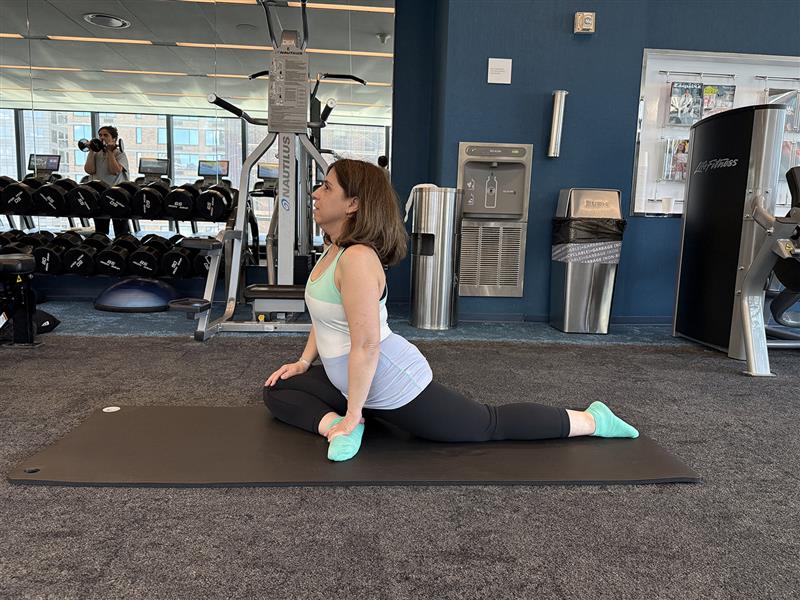
The author pretending she is a pigeon to stretch those glutes
She suggested I do at least 2-3 sets of 30 seconds per targeted muscle set per day with these moves (I stretched in the privacy of my own living room, but the photos here were taken in a gym with better light):
1. Thread the needle (for upper back mobility): Get on all fours on the mat; reach one arm up toward the ceiling and then slide it all the way under the opposite arm and hold for 30. Switch sides
2. Pigeon stretch (for hips and glutes): Starting on all fours, rest your right shin on the floor, with the right knee behind the right hand; slide your left leg behind you and hold. Switch sides.
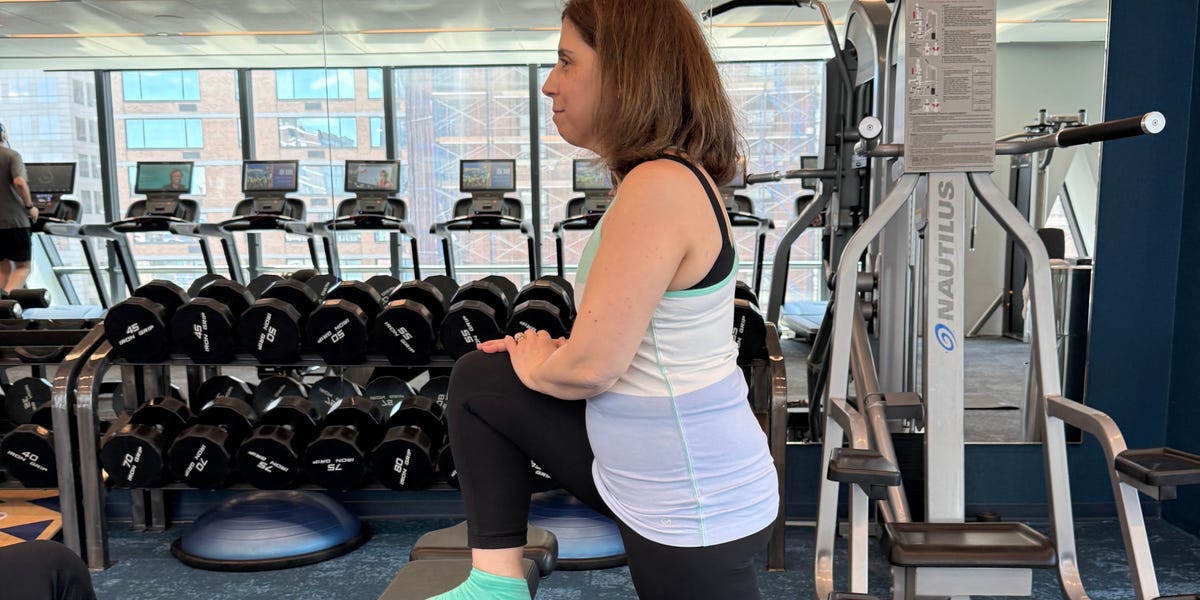
3. Chair hip flexor stretch: Facing a chair, put one foot up on the seat, then press forward with your hip while keeping your other foot flat on the floor. Switch sides.
4. Doorway pec stretch (for shoulders and chest): Standing in a doorframe, place your forearms against the frame and lean forward. Hold for 30.
5. Book openers (for spinal rotation, lower back, and pecs): Lie on your side with your top leg bent at the knee; extend both arms straight out in front of you. Then, lift your top arm and rotate it around to touch the back of your hand to the floor on the other side of you while leaving the bottom arm in place; repeat several times on each side.
6. Standing quad stretch: Standing up, with one hand on a wall or chair if needed, bend one knee back and grab the foot with your hand so it’s touching your bottom. Hold, then repeat on the other side.
7. Runner’s stretch (calves): Stand with one leg forward and one back; bend your front leg while keeping the back leg straight to stretch the upper calf muscle, then bend the back knee to stretch the lower calf. Switch sides.
How it felt to stretch for 7 days straight
The first day, it took me a little trial and error, and a lot of watching YouTube videos, to get the correct positions for all these stretches. And some of them (especially Thread the Needle and Pigeon Stretch) felt a little weird and uncomfortable at first, which I knew simply meant that I was challenging muscles that were used to being pretty lazy.
I could definitely feel the aftereffects that entire first day, a little twinge in my shoulder blade, a slight ache in my hip. But it certainly wasn’t as bad as the first day after I tried a new weight-training routine, when I couldn’t even walk down the stairs or sit on a chair without pain.
As the week went on, though, I felt more comfortable with each stretch and could hold it a little longer and stretch a little further. The biggest break came around Day 4, when I realized that instead of counting down the half-minute of holding each stretch, I forgot about the “one-Mississippi’s” and simply tried to hold each stretch as long as I could. As I dropped the counting, I paid more attention to my breathing, inhaling, and then stretching just a little bit further on each exhale.
At the end of the week, I was definitely feeling less pain with each move, and saw measurable progress in how far I could stretch and how long I could hold each position.
My favorites, by far, were the leg stretches, which felt so good that I found myself doing them in the middle of the day, even at work or in my dining room at home. As someone who has a fairly sedentary desk job, these really helped my legs feel less crampy and more energized.
My plan is to continue these stretches a few days a week, along with my walking routine, occasional weight workout, and beloved dance classes. I may not be turning cartwheels anytime soon, but if I can stay flexible and balanced enough to waltz gracefully into my 60s, then that sounds pretty awesome to me.
Read the full article here


