







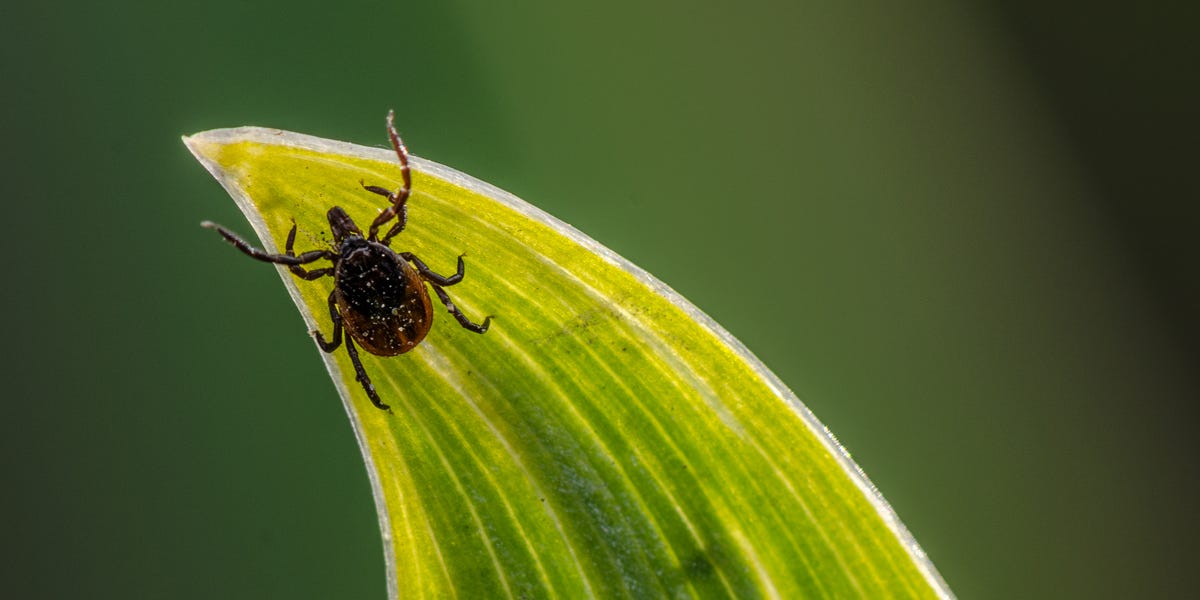
- Ticks can transmit several different infections, not just Lyme disease.
- Infectious disease specialists want you to have these six major tick-borne illnesses—including Rocky Mountain Spotted Fever, anaplasmosis, babesiosis, and Powassan virus—on your radar.
- Doctors recommend seeking immediate medical attention for fever, fatigue, or rash following tick exposure.
This summer, ticks have been making headlines. Not only are ER visits for tick bites at a 10-year high, according to the Centers for Disease Control (CDC), but the critters have been expanding into new territories for some time, bringing illness with them—and not just Lyme disease.
“The single most important thing for people to understand is that a tick bite delivers a whole menu of possible pathogens, not just one,” says infectious disease expert Amesh A. Adalja, M.D., an adjunct assistant professor at the Johns Hopkins Bloomberg School of Public Health. “A tick that’s attached for a while can transmit bacteria, parasites, or viruses depending on species and region, and the treatment is completely different for each … Lumping every tickborne illness together as ‘Lyme’ actually causes missed and mistreated cases.”
So, which pathogens should you be on the lookout for? According to William Schaffner, M.D., an infectious disease specialist and professor at the Vanderbilt University School of Medicine, the tickborne illnesses that you’re at risk of contracting depend a lot on where you live—and knowing which pathogens ticks carry in your area can go a long way toward helping you and your healthcare provider narrow the field if you happen to develop symptoms. “These can be fairly serious and sometimes even deadly if left untreated,” Dr. Schaffner says.
Meet the experts: William Schaffner, M.D., an infectious disease specialist and professor at the Vanderbilt University School of Medicine; and Amesh A. Adalja, M.D., an infectious disease expert and adjunct assistant professor at the Johns Hopkins Bloomberg School of Public Health
While it’s possible to contract a rarer tickborne infection, there are certain illnesses that infectious disease experts say should be on everyone’s radar. Below, learn more about these pathogens and their symptoms.
The Tickborne Infections Doctors Want You to Know About
Lyme disease
This tickborne disease is usually caused by the bacterium Borrelia burgdorferi, according to the Centers for Disease Control and Prevention (CDC). It’s transmitted to people through the bite of an infected blacklegged tick and is more common in the Northeast, per the CDC.
Symptoms typically show up anywhere from three to 30 days after a tick bite, and can include:
- Fever
- Chills
- Headache
- Fatigue
- Muscle and joint aches
- Swollen lymph nodes
- Erythema migrans rash (a.k.a. “bullseye rash”)
“Lyme disease is marked by the classic bullseye rash and flu-like symptoms within a week or two,” Dr. Adalja says. The infection is typically treated with antibiotics, per the CDC.
Rocky Mountain Spotted Fever
Rocky Mountain Spotted Fever is caused by the bacterium Rickettsia rickettsii, which is carried by American dog ticks, brown dog ticks, and Rocky Mountain wood ticks, according to the CDC. This infection is particularly dangerous. “It is a true medical emergency—it can be fatal within days if untreated,” Dr. Adalja says.
That’s why doctors in areas where Rocky Mountain Spotted Fever is more common—such as the Southeastern and South-Central U.S.—will often prescribe the antibiotic doxycycline before waiting on a rash or test result, Dr. Adalja says. “Delaying kills people,” he says.
Symptoms can include:
- Fever
- Headache
- Rash
- Nausea or vomiting
- Stomach pain
- Muscle pain
- Lack of appetite
A rash typically develops within two to four days after the fever begins, per the CDC.
Anaplasmosis and ehrlichiosis
These conditions are slightly different, but they’re often lumped together. “Anaplasmosis and ehrlichiosis are both bacterial infections that cause a flu-like illness—fever, chills, headache, muscle aches—without a rash most of the time,” Dr. Adalja says.

Add Prevention as a preferred source in your Google search results.
Use your Google account to add this to your settings.


Anaplasmosis is caused by the bacteria Anaplasma phagocytophilum, which is usually spread through black-legged tick bites, according to the CDC. It’s most common in the Northeastern and upper Midwest states.
Ehrlichiosis is caused by three types of bacteria spread by infected ticks: Ehrlichia chaffeensis, E. ewingii, or E. muris eauclairensis, according to the CDC. It’s contracted through bites from the lone star tick and the blacklegged tick, and most commonly shows up in the Southeastern, South-Central, and mid-Atlantic parts of the U.S.
Both conditions are treated with the antibiotic doxycycline.
Babesiosis
Babesiosis is a parasite that infects red blood cells, per the CDC. “It’s basically like malaria, transmitted by a tick instead of a mosquito,” Dr. Adalja says. “It can cause serious anemia, especially in older adults or people without a spleen.” It’s spread by the black-legged tick, and most common in the Northeastern and Upper Midwestern U.S.
Symptoms can include:
- Fever
- Chills
- Sweats
- Headache
- Body aches
- Loss of appetite
- Nausea
- Fatigue
For some people, babesiosis can become life-threatening. It’s typically treated with a combination of antiparasitic and antibiotic medications.
Alpha-gal syndrome
Technically, alpha-gal syndrome is not an infection—it’s an allergy. Still, doctors say it’s important to be aware of it. “This is an increasing problem,” Dr. Schaffner says.
Alpha-gal syndrome can develop following a lone star tick bite, Dr. Adalja explains. “It trains your immune system to attack a sugar molecule found in mammal meat,” he says. People with alpha-gal syndrome can’t eat meat and sometimes need to avoid dairy products, Dr. Schaffner says. “They will develop an allergic reaction, which can sometimes be quite serious,” he says. “This is increasingly being recognized. It’s very troublesome.”
There is no treatment of alpha-gal syndrome itself, but patients will often need to avoid meat and some other animal products, Dr. Schaffner says. Alpha-gal syndrome tends to get better over time, he adds.
Powassan virus
Powassan virus can cause severe illness, including inflammation of the brain or the membranes around the brain and spinal cord, according to the CDC. “Unlike Lyme, it can be transmitted in as little as 15 minutes of attachment,” Dr. Adalja says.
Symptoms can include:
- Fever
- Headache
- Vomiting
- Weakness
“It’s rare, but rising fast,” Dr. Adalja says. Most cases of Powassan virus happen in the Northeast and Great Lakes region of the U.S., per the CDC. Additionally, as it’s a virus, antibiotics can’t be used to treat Powassan virus, Dr. Adalja adds.
When to see a doctor
If you develop a fever, fatigue, headache, muscle aches, or a rash in the days or weeks after spending time outdoors in a tick habitat, Dr. Adalja recommends seeing your healthcare provider. “Explicitly mention the tick exposure or bite, even if you didn’t see the tick attached,” he says.
Dr. Schaffner points out that you can even pick up ticks in your yard, making it important to do regular tick checks at home—not just after a long hike or a day at the park.
Read the full article here


