







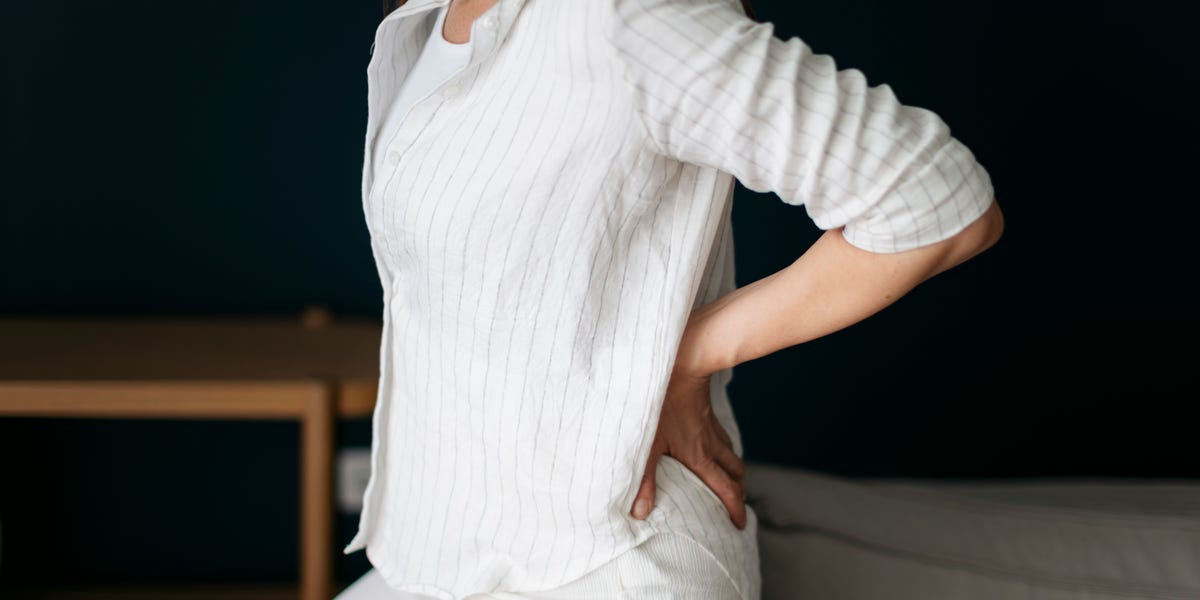
According to the World Health Organization (WHO), lower back pain is the single leading cause of disability worldwide. It’s also the condition for which the largest number of people could benefit from stretching, the organization says. But when you’re uncomfortable and hardly mobile, it’s hard to know where to start. That’s why we asked fitness experts to share the best stretches for lower back pain.
Meet the Experts: Jamie Costello M.S.C., the managing director at Bettr Life; Rami Hashish, Ph.D., D.P.T.; body performance and injury expert; Karen Litzy, P.T., D.P.T.; owner and physical therapist at Karen Litzy Physical Therapy; and Chad Shafer, P.T., Cert M.D.T., a physical therapist at Override Health.
Here, fitness experts and physical therapists share the best stretches to ease lower back pain that will help you feel free again, one micro-movement at a time. Interestingly, not all of the stretches focus exclusively on the back.
How to safely stretch your lower back
Firstly, it’s important to consult with a healthcare professional about your condition. Back pain has many different possible causes, some of which can benefit from stretching (like a sedentary lifestyle or poor posture) and some of which will not (like a urinary tract infection).
Here are some specific expert-backed tips for finding relief safely:
- Stretch your lower back carefully, especially if you have an existing injury or other health concerns, says Jamie Costello M.S.C., executive director at Bettr Life.
- Consider if you are flexion sensitive (leaning forward creates pain) or extension sensitive (arching backward creates pain), says Karen Litzy, P.T., D.P.T., owner and physical therapist at Karen Litzy Physical Therapy.
- Aim to hold each stretch for at least 10 seconds and preferably 30 seconds or longer, Costello recommends. The pain-relieving benefits will increase the longer you hold.
- Rather than rush through the moves, Costello encourages turning on soothing music and using stretching time as a chance to relax.
- Don’t forget to breathe! It may sound silly, but Costello says focusing on using your breath can help you cope with any feelings of discomfort.
Best stretches to ease lower back pain
Now, give these lower back stretches a try.
1. Child’s Pose

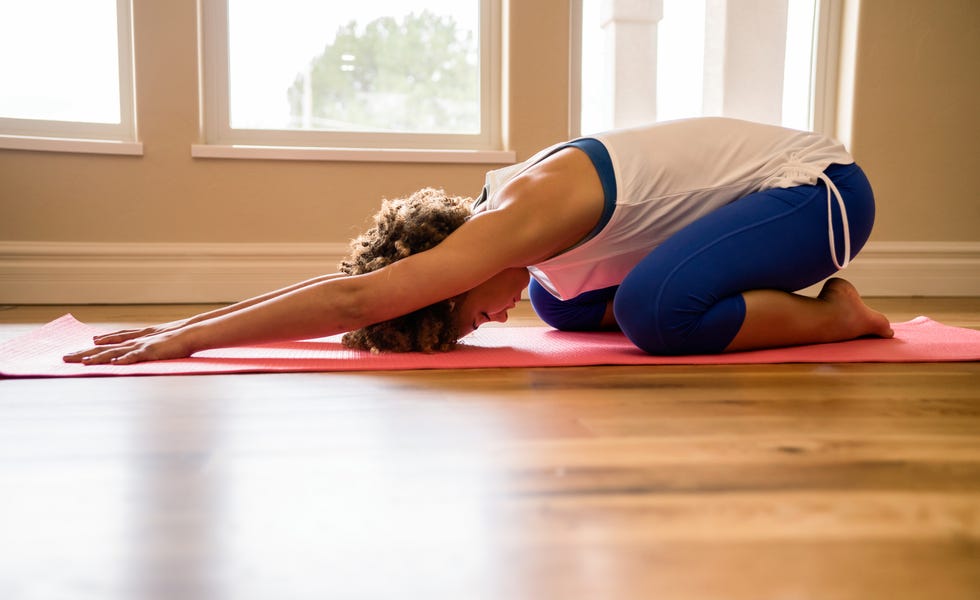
- Lower onto your hands and knees with your hands directly under your shoulders and knees under your hips.
- Stretch your arms long out in front of you, palms facing down.
- Hinge at the hips, send your bottom straight back toward your heels, and rest your stomach on your thighs.
- Drop your head and chest downward as your arms extend further.
- Hold for 20 to 30 seconds (or longer) and breathe.
Modifications
If you find you have issues with your hips, Litzy suggests bringing your knees wider apart and going as far as you comfortably can.
2. Cat/Cow Stretch

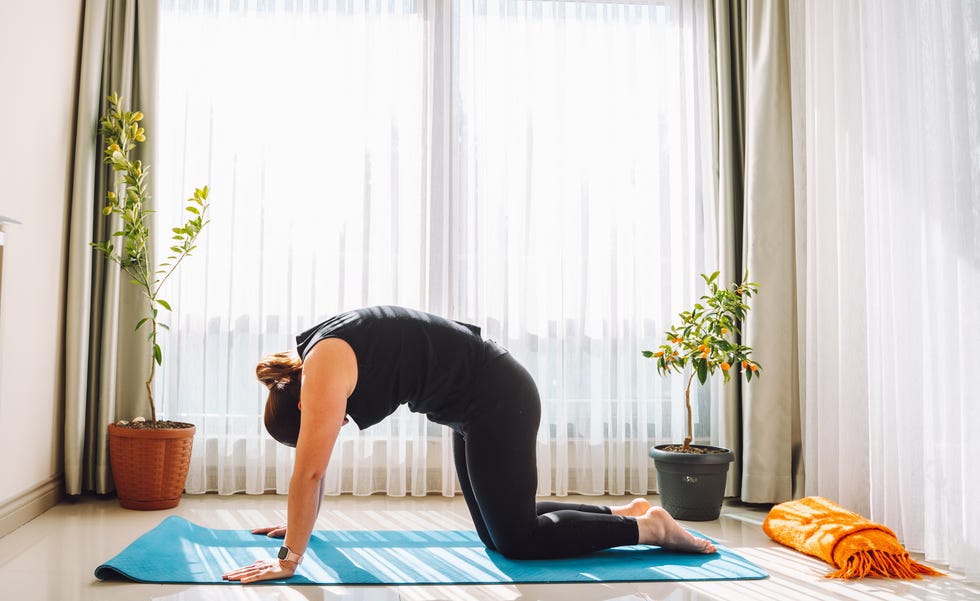
- Begin in a tabletop position on your hands and knees, with your hands directly under your shoulders and knees under your hips.
- Then, round your back, stretching your mid-back between your shoulder blades—similar to how a cat stretches by rounding its back. Hold for five seconds.
- Relax and let your stomach fall downward as you gently arch your low back and look up at the ceiling. Hold there for another five seconds.
- Repeat these movements for 30 seconds or longer.
This dynamic movement moves the low-back muscles in two directions and builds on the Child’s Pose to help lengthen contracted muscles and soothe soreness. It also can help increase core strength and overall balance, says Rami Hashish, Ph.D., D.P.T., a physical therapist and body performance and injury expert. Litzy adds to be sure you focus on your pelvis, acting as if you have a tail that you want to stick toward the ceiling or tuck under you.
3. Supine Twist

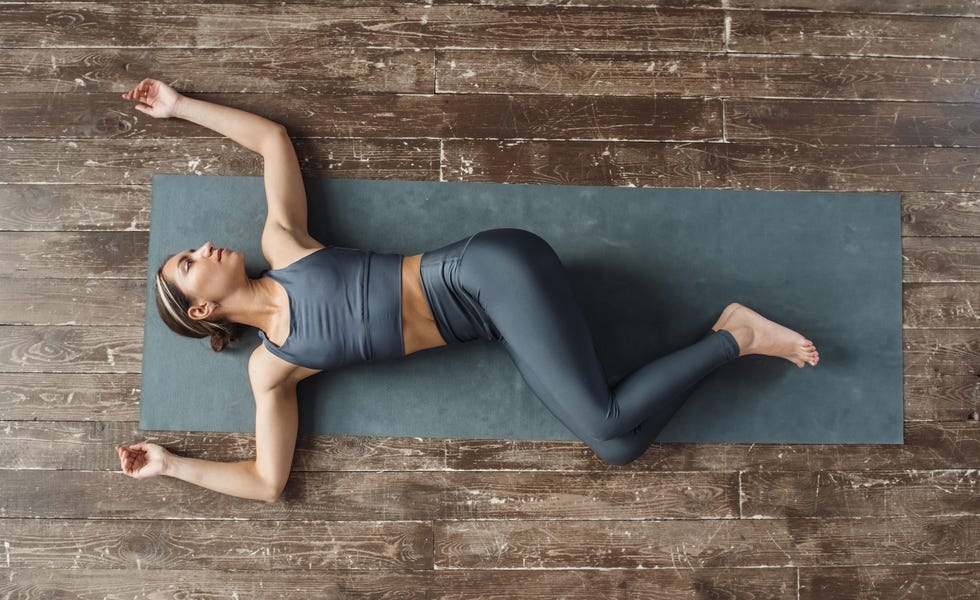
- Begin by lying on your back with your knees bent and feet flat on the floor.
- Extend your arms out to the sides in a “T” position.
- Keep your shoulders on the ground as you gently roll both knees to one side.
- Stay here 20 to 30 seconds.
- Return your knees to the center and repeat on the other side.
Modifications
If the stretch is too much for you, place a pillow or stack of blankets under your knees when you twist to each side.
This stretch not only helps to lengthen your lower back but also your glutes, which can tighten when you’re experiencing low back pain, ultimately causing more pain. It’s also effective in improving overall spinal flexibility, Hashish says.
4. Cobra Pose

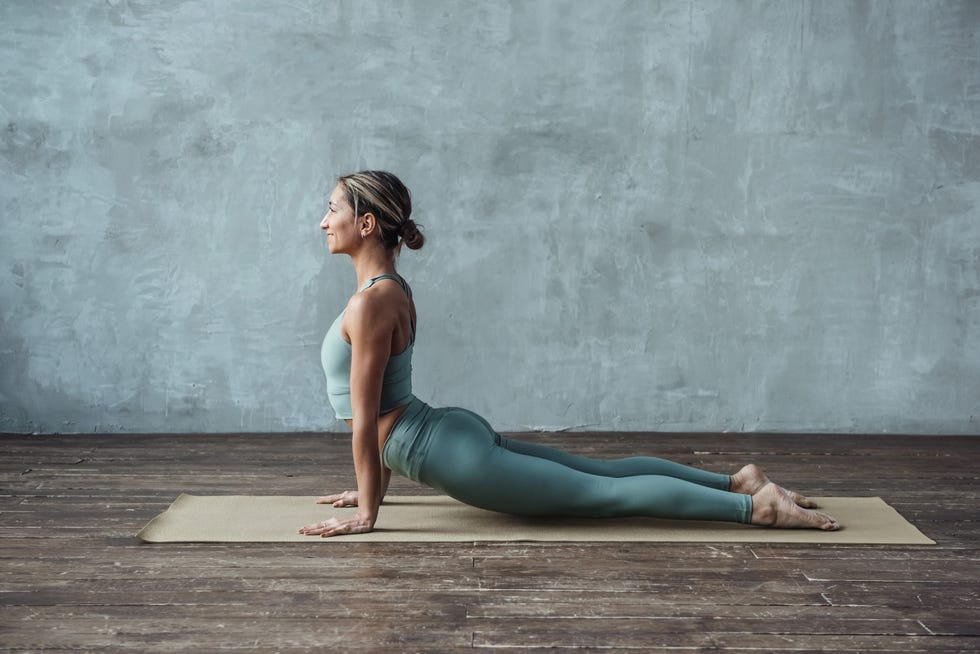
1. Lie on your belly, place your hands underneath the shoulders, and relax.
2. Slowly push the ground away, and inhale as your body or your spine comes up into a stretch of extension.
3. Pause for a moment, and then exhale very slowly while lowering back to the ground.
Modifications
Don’t feel the need to overextend or arch extremely. Only go up as high as feels comfortable, and also don’t forget to breathe.
“This allows the spine to start to get used to being in a position of what we call extension, which is the motion of the spine that allows us to stand up, walk, and pretty much do everything in life,” explains Chad Shafer, P.T., Cert M.D.T., a physical therapist at Override Health.

Add Prevention as a preferred source in your Google search results.
Use your Google account to add this to your settings.


5. Pelvic Tilt

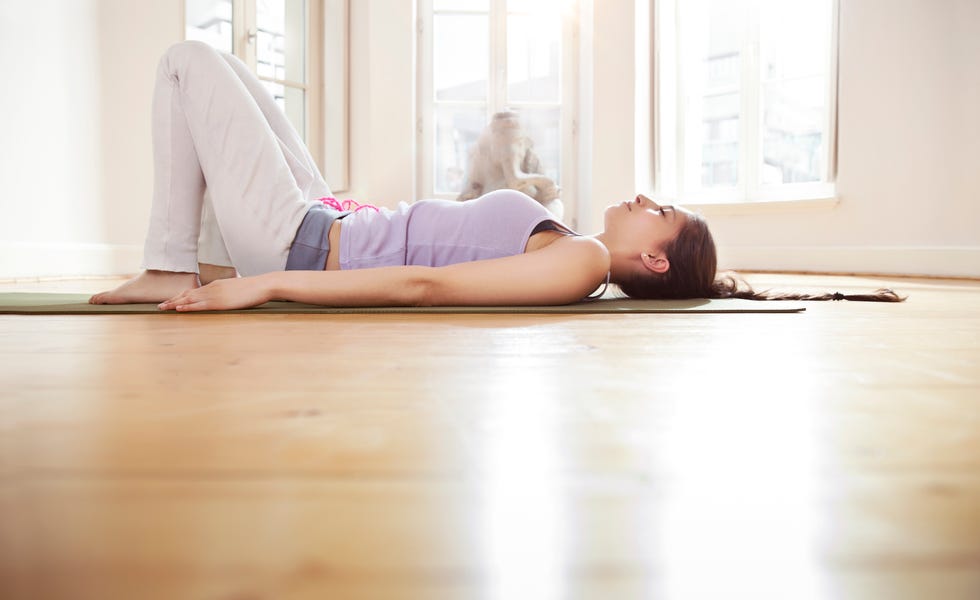
- Begin by lying on a yoga mat with your knees bent and feet flat on the floor.
- Try to relax your low back, keeping it in a neutral position (which means you should feel a slight curve in your low back if you place the top of your hand under your back).
- Activate your core muscles and then flatten your low back against the floor by slightly tilting your pelvis upward. Hold for a few seconds, then release.
- Repeat 12 to 15 times.
When you’re suffering from lower back pain, you might feel as if your entire pelvic area is immovable. This stretch can help you start to bring some movement back to it by relieving sciatica and strengthening abdominal muscles, Hashish says.
6. Sideline Hip Abduction


1. Lie on your side with your bottom knee bent and top leg straight.
2. Place your top hand on the top portion of your pelvis, push the pelvis forward, and take a breath in.
3. Exhale, then slowly lift the top leg straight up and slightly back, no higher than about 1.5 feet off the ground. “You’ll know that you’re doing the exercise correctly when the side of your hip muscles burn,” says Shafer.
Many people with lower back pain describe it as in the back or in the pelvis, and oftentimes in the buttocks or gluteus maximus area, Shafer explains. This move primarily targets the glutes, which, when underused, can be overstretched by things like prolonged sitting or crossing the legs for too long, which can generate pain.
7. Reclining Hand-to-Big Toe Stretch (Supta Padangusthasana)

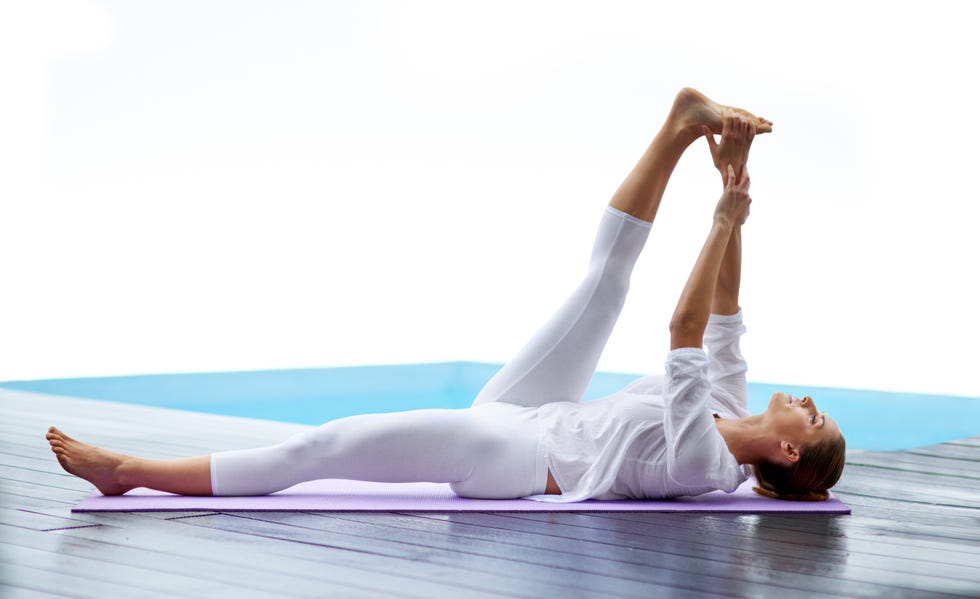
- Lie on your back and lift your right leg up towards your face, keeping your left leg flat on the ground.
- Interlace your hands behind your thigh or calf, depending on how tight your hamstrings feel.
- Keep your opposite leg active and your opposite hip grounded. Your head and shoulders should stay on the ground.
- Hold for 10 breaths.
- Now, still keeping your opposite hip grounded, let your right leg lower out to the right.
- Only lower the right leg out to the side so far as you can without the opposite hip lifting up.
- Bring your leg back to the starting position, then slowly release it down.
- Repeat on the other side.
Modifications
If this stretch is too difficult, you can bend your bottom leg and place your foot flat on the floor or skip the step of extending your leg out to the side.
This pose stretches things out by loosening up the back of the legs, ankles, calves, and hamstrings, which can all contribute to a tight lower back, Hashish says. If you find you have shooting pain down one leg, this stretch may put too much tension on the leg and should be avoided, Litzy adds.
8. Bridge Pose

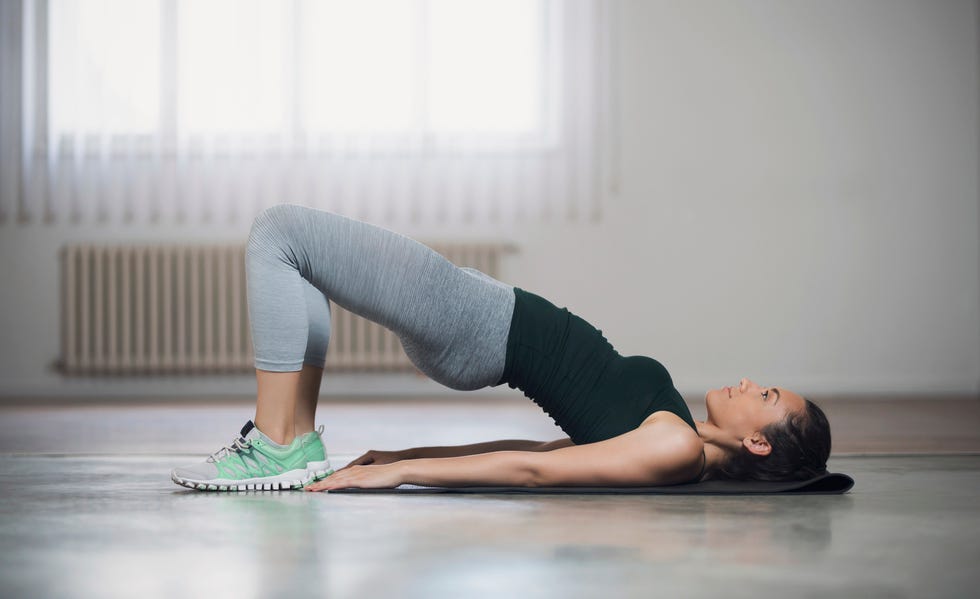
- Lying on your back, bend your knees and plant both feet on the ground. Be sure your feet are hip-width apart with your heels close to your glutes.
- Press into your feet to lift your hips.
- From here try to press your hips up to create length through your lower back and glutes.
- Hold for 30 seconds.
Lengthening through your glutes helps to activate and engage these strong muscles, which support your lower back. Hashish says that this is also an excellent stretch option for the chest and hips, all while strengthening the back, buttocks, and hamstrings.
9. Pigeon Pose

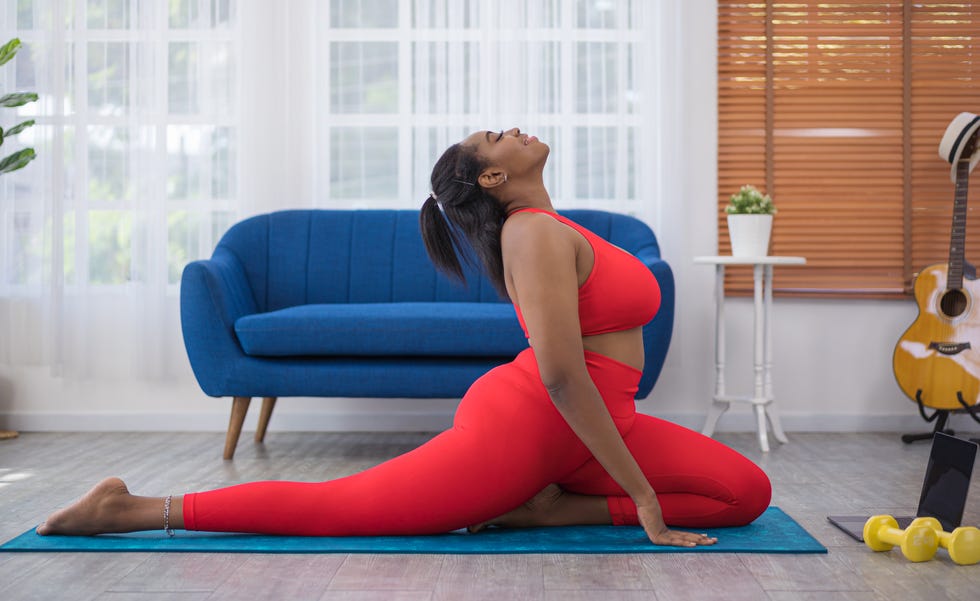
- Start on all fours.
- Lift your right leg up and behind you, then bend it to swing it forward and place your right knee on the ground near your right wrist.
- Lower your right shin so that it becomes parallel to the top of your mat (it may be at an angle depending on your hip flexibility, and that’s totally OK!).
- Gently slide your left leg back toward the end of your mat until your thigh is resting on the floor.
- Feel free to stay here, or bend your arms and lower your head onto the tops of your hands.
- Stay for seven to 10 breaths.
Tight hip flexors can lead to lower back pain, and one of the best ways to open up the hips is with an extended half-pigeon posture. Hashish noted it’s an effective mobility exercise and hip stretch, too.
Should I stretch my lower back when it hurts?
It depends. “Every case of lower back pain is different, and treatment needs to be individualized,” Shafer explains. “For many decades, we actually recommended bed rest and taking it easy for lower back pain recovery. Although this seems to make sense, it can actually delay recovery.”
Remaining stationary can cause muscle guarding that can potentially worsen an injury, he explains. But that doesn’t mean you need to go directly into shape-shifting pretzel mode. “Start with something simple: stand, walk around your home or office, go for a walk outside,” he suggests. “Walking allows the body to get compression and distraction into the lower back and the whole body.” Eventually, you can move into stretching. If you experience abnormal pain or it worsens, see a trained physical therapist who can help ensure your condition doesn’t worsen.
When to see a doctor about lower back pain
If your pain hasn’t gone away after more than two weeks, you experience extreme pain or pain at rest, have a loss of sensation, have difficulty walking or moving your legs, or experience a bowel or bladder dysfunction, Hashish suggests checking in with your doctor as soon as possible.
Read the full article here


