

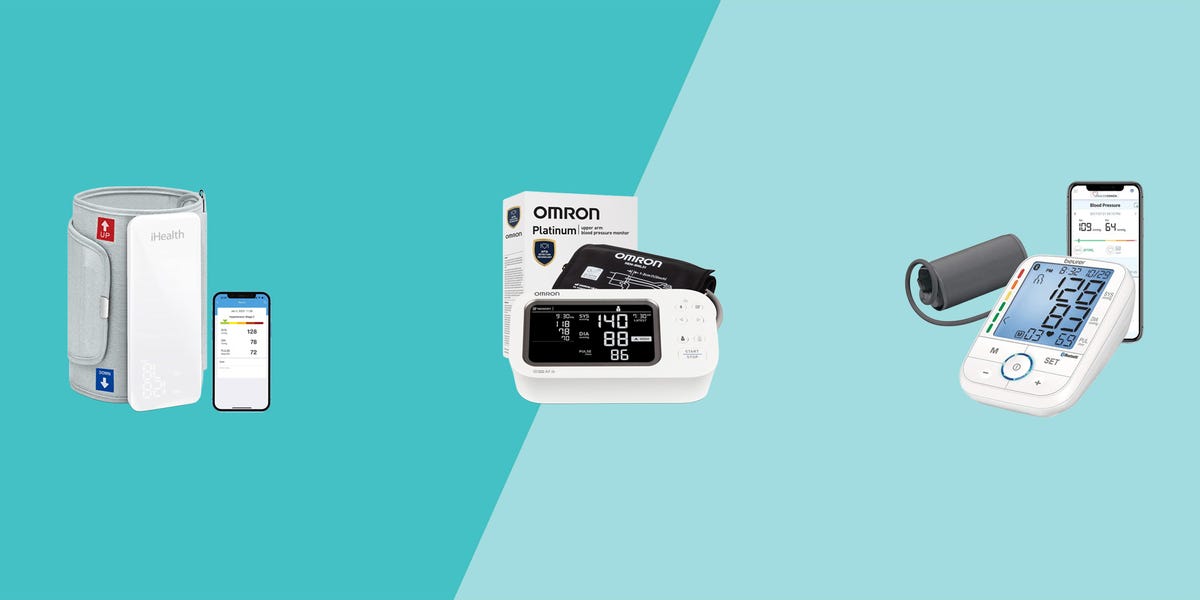
To understand blood pressure monitors, you have to understand blood pressure, which is “a measure of how hard your blood pushes against your artery walls as it circulates throughout your body,” explains Golden. A blood pressure reading includes two numbers: systolic pressure (the top number of a reading), and diastolic pressure (the bottom number).
The systolic pressure is the pressure in the arteries when the heart is pumping and blood is moving, she adds, and the diastolic pressure is the pressure in the arteries when the heart is relaxed and filling up with blood, which is why it’s always a lower number. “Think of it like a wave at the beach. The systolic pressure is like the wave crashing forward onto the shore,” Golden says. “The diastolic pressure is like the water receding back into the ocean to prepare for the next wave.”
Blood pressure monitors are pretty simple by design. An arm cuff is connected to an air pump, and “when the pump is activated, the cuff inflates until it can sense it has reached a high enough pressure to temporarily stop blood flow,” says Golden. “As the cuff deflates, it measures the pressure at which your blood starts flowing again (systolic pressure), and when the blood vessel remains open in between heartbeats (diastolic pressure).”
According to the American Heart Association, a normal reading for an average, healthy person is below 120/80, but that “normal” can vary from person to person, Golden adds, “depending on their other medical conditions and health status.”
Read the full article here