

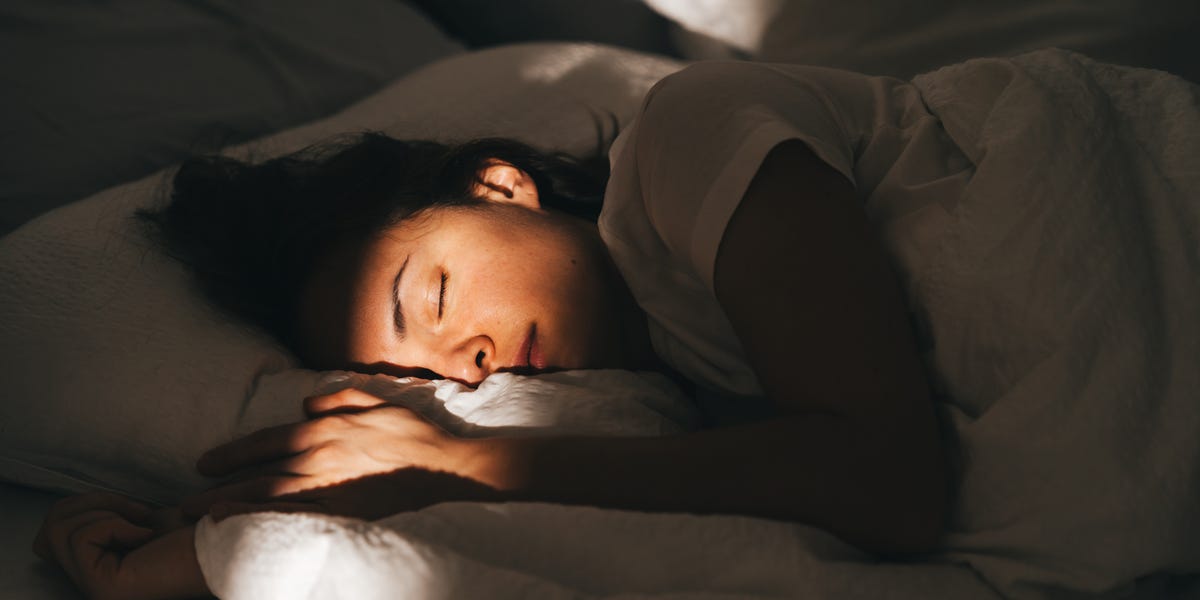
- New research suggests men and women experience sleep apnea differently, with women experiencing more severe symptoms.
- Doctors say there are likely a few reasons for this.
- If your current sleep apnea treatment isn’t working, discuss options with your healthcare provider.
About 30 million adults in the U.S. have obstructive sleep apnea, a potentially dangerous condition that causes breathing to stop and start during sleep. But they don’t all experience it in the same way: Some may have intense symptoms, while others may not even know they have the condition. Interestingly, new research suggests that sex might have something to do with how it manifests, as women may deal with more severe—and unusual—symptoms of obstructive sleep apnea than men.
The study, published in the journal Sleep, analyzed data from 407 men and women with moderate-to-severe obstructive sleep apnea. When asked to report their symptoms and rate their intensity, women described more severe symptoms, including those considered unusual. The symptoms women were more likely to experience were:
- Waking up at night
- Headaches
- Nightmares
- Sleep disturbances
- Sleep-related impairment
- Anxiety
- Anger
- Fatigue
- Cognitive function
- Dissatisfaction with social roles
The researchers didn’t find differences between the sexes when it came to symptoms like snoring, gasping at night, nasal congestion, reflux, or depression.
Meet the experts: Sanjay Patel, M.D., study co-author and director of the Center for Sleep and Cardiovascular Outcomes Research; Aarti Grover, M.D., medical director of the Center for Sleep Medicine at Tufts Medical Center; Christopher Winter, M.D., sleep medicine specialist, neurologist, and author of The Sleep Solution: Why Your Sleep Is Broken and How to Fix It; David Kent, M.D., director of sleep surgery in the Department of Otolaryngology–Head and Neck Surgery at Vanderbilt University Medical Center
These findings add to a growing body of evidence about how sleep apnea affects men and women. “Past studies have indicated that women with sleep apnea present with a different constellation of symptoms than men, but these studies have often been limited in that the severity of sleep apnea differed between men and women and the range of symptoms assessed was limited,” says Sanjay Patel, M.D., study co-author and director of the Center for Sleep and Cardiovascular Outcomes Research. This study, on the other hand, exclusively recruited participants with moderate-to-severe obstructive sleep apnea and collected data on a wide range of symptoms.
But why would women with sleep apnea present differently from men? Here’s what sleep medicine specialists want you to know.
Why do women experience sleep apnea differently from men?
There are likely a few factors at play, according to Dr. Patel. For one, “It may be that women have different experiences and susceptibilities to having their sleep disrupted from sleep apnea compared to men, and so suffer a broader range of symptoms than men,” he says.
Women’s sleep quality may also be more impacted during REM sleep (the phase of sleep linked to memory consolidation and emotional regulation) than it is in non-REM sleep, according to David Kent, M.D., director of sleep surgery in the Department of Otolaryngology–Head and Neck Surgery at Vanderbilt University Medical Center.
Aarti Grover, M.D., medical director of the Center for Sleep Medicine at Tufts Medical Center, says presenting with atypical symptoms could be a factor. “Instead of classic male patterns of loud snoring and witnessed gasping, women often experience fatigue, depression, and generalized daytime exhaustion, which frequently delays diagnosis,” she says. Because women tend to take longer to diagnose than men, their symptoms may get worse over time, Dr. Grover says—which could cause women to report more severe symptoms than men.
It’s also possible that these symptoms have nothing to do with sleep apnea and are due to something else. “Women are at higher risk for other common diseases such as migraines or depression than men,” Dr. Patel says. “Future studies treating these men and women for their sleep apnea and seeing which symptoms get better will be important to distinguish between these possibilities.”
“It suggests, at a minimum, that we as clinicians have to work harder to extract information about symptoms,” says Christopher Winter, M.D., a sleep medicine specialist, neurologist, and author of The Sleep Solution: Why Your Sleep Is Broken and How to Fix It. “We have to go into the interaction assuming pathology rather than assuming everything is okay, and then confirming our confirmation bias.”
What does this suggest about treating men vs. women?
Dr. Patel says it’s “too early” to know what this means for the future of sleep apnea treatment. “We need to see how women respond to treating their sleep apnea and see if the broader range of symptoms improves,” he says. “If these ‘non-classic’ symptoms improve, then it will mean that clinicians need to think about sleep apnea much more broadly in deciding whether to test and treat women for sleep apnea, rather than focusing solely on the symptoms that are commonly seen in men.”
Dr. Kent says the findings underscore the importance of discussing all of the symptoms you’re dealing with—and working with a healthcare provider who will listen. “It’s important for any clinician to meet patients where they are and focus on not just treating a number but managing the whole host of symptoms that a patient is struggling with,” he says.
Similarly, if you’re undergoing treatment for sleep apnea and things aren’t improving, it’s important to go back to your healthcare provider to talk about your symptoms, Dr. Kent says. There are multiple treatment options available, and it may simply be that you haven’t found the one that works for you yet.
While the CPAP machine—a device that delivers a steady stream of pressured air while you sleep—is considered the gold standard of care for moderate-to-severe sleep apnea, it may not fix everything, Dr. Winter says. “‘The CPAP works’ is not the same as ‘the CPAP completely got rid of all of my sleep apnea symptoms,’” he says.
Again, it’s also possible that something else is contributing to your symptoms. Dr. Grover recommends considering other causes for your sleep disturbances, including hormonal changes and underlying depression.
Read the full article here