

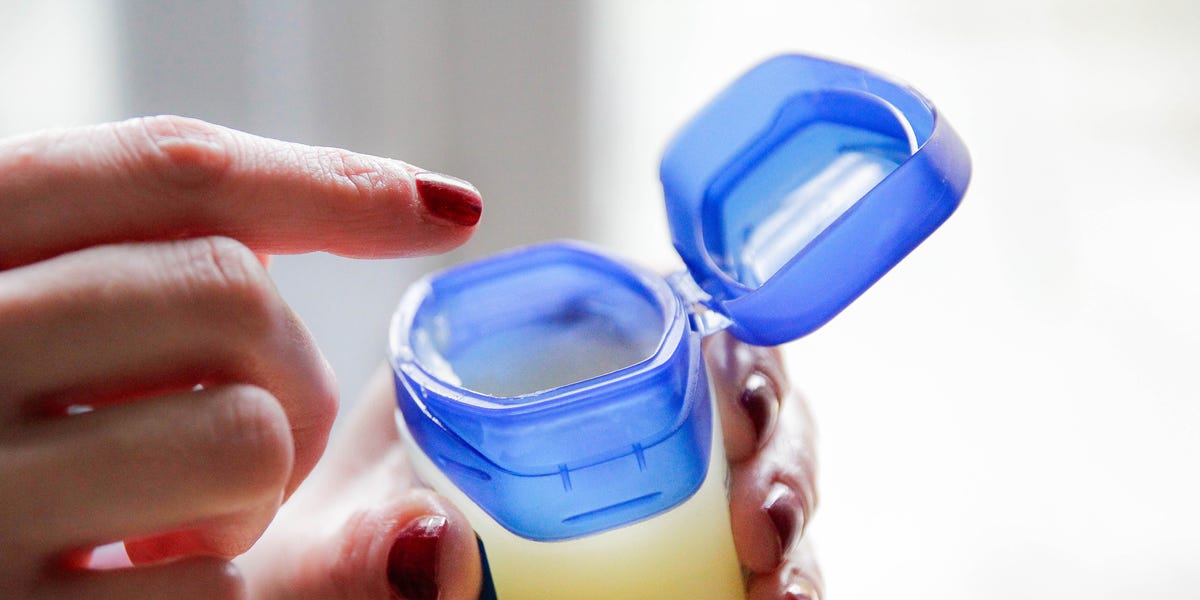
You probably have a tube or a tub of Vaseline or Aquaphor sitting in your medicine cabinet right now. These iconic drugstore products have been trusted skincare staples for decades. Each one is recommended by dermatologists, moms, and influencers alike, for everything from wound care to slugging, the skincare trend of moisturizing then slathering on one of these balms to seal in hydration overnight. You can use either one as a lip balm, a cuticle softener, or a dry skin healer. But are these barrier-repairing ointments interchangeable? While most people think they’re basically the same thing, the formulas are actually very different.
Aquaphor vs. Vaseline: Key Differences
What sets them apart comes down to the ingredients. While Vaseline has one single ingredient (100% white petrolatum), Aquaphor has a base of petrolatum and contains other moisturizers like mineral oil, lanolin, and glycerin. “I use both Vaseline and Aquaphor all the time, every day in my office post-procedure after a laser treatment or chemical peel,” says Mona Gohara, M.D., a board-certified dermatologist in Connecticut and an associate clinical professor of dermatology at Yale School of Medicine. “They are both excellent occlusives that reduce water loss, support barrier repair, and create an ideal environment for healing by protecting injured skin from germs or potential irritants.”
Aquaphor vs. Vaseline: Similarities
These water-, preservative-, and fragrance-free ointments work by forming an occlusive, protective layer on the surface of your skin that seals in moisture. Both petroleum-jelly-based formulas are non-comedogenic, meaning that they don’t clog pores. “Both are also true multitaskers that share the same core strength: protecting and repairing the skin barrier. They perform similarly, and beautifully, for wound care on cuts, scrapes, and burns because the main ingredient in both—petrolatum—does the heavy lifting,” says Dr. Gohara.
Meet the Experts: Mona Gohara, M.D., a board-certified dermatologist in Connecticut and an associate clinical professor of dermatology at Yale School of Medicine; Joshua Zeichner, M.D., director of cosmetic and clinical research at Mount Sinai Hospital in New York City.
What ingredients are in Vaseline Healing Jelly?
“Vaseline has one single ingredient: triple purified petroleum jelly, or white petrolatum,” says Joshua Zeichner, M.D., director of cosmetic and clinical research at Mount Sinai Hospital in New York City. “This medical-grade petrolatum effectively forms an occlusive seal over the skin, and is one of the most studied and reliable barrier-protecting ingredients we have.” For Dr. Zeichner, this is a good spot fix for healing and protecting abrasions, irritations, and burns, as opposed to applying all over the face. “While it is non-comedogenic, I am cautious about recommending it for people who have oily or acne-prone skin because it can feel heavy and greasy.” The texture is a little bit thicker and richer than Aquaphor, adds Dr. Gohara, making it especially effective for maximum protection and healing of dry, cracked, chafed, inflamed and irritated skin. “The formula is intentionally minimal and as simple as it gets,” says Dr. Gohara, which is why it’s such a tried-and-true, straightforward sealing and healing skin protectant.”
What ingredients are in Aquaphor Healing Ointment?
This formula is a blend of 41% petrolatum plus mineral oil (a derivative of petrolatum), ceresin (a natural wax thickener), lanolin alcohol, moisturizing panthenol, hydrating glycerin, and anti-inflammatory bisabolol derived from chamomile. “Aquaphor creates a semi-permeable barrier over the skin that helps with wound healing and hydration. The texture is a little lighter and less greasy than Vaseline, and it also tends to be more expensive than Vaseline because of the added ingredients and technology required to formulate the product,” says Dr. Zeichner.
“Lanolin, derived from sheep’s wool, is a waxy emollient, and lanolin alcohol in Aquaphor is a more refined, lower-sensitizing form,” says Dr. Gohara. For some people who may be allergic to lanolin, this could cause a reaction, but for most skin types Aquaphor’s combination of moisturizing ingredients is widely recommended to moisturize eczema and compromised, dry skin, she adds.
Aquaphor vs. Vaseline: Which is better for sensitive skin?
Most dermatologists will tell you that fewer ingredients in a skincare formula means less chance of irritation. For that reason alone, Vaseline may be a better choice as a barrier-protecting balm due to the purity of its single-ingredient formula.
The bottom line
Ultimately, it’s a matter of personal preference, since both function as skin barrier protecting ointments that can be used to protect wounds, prevent scarring, and seal in moisture to help keep the protective skin barrier intact. Because Vaseline is made of 100% petroleum jelly with no added ingredients, it’s a safer bet for sensitive skin types. Aquaphor can be a better comprehensive, one-and-done moisturizer for dry areas of skin (like heels, elbows, chapped lips, and cuticles) or for people with eczema or atopic dermatitis because of its added anti-inflammatory and hydrating ingredients.

is an editor, copywriter, and professional skincare junkie. Her work has been featured in Cosmopolitan, Harper’s Bazaar, Oprah Daily, Allure, Marie Claire, and more. Follow Gina on Instagram.
Read the full article here