

If you want to get your body in shape, doing squats every day isn’t going to be enough. You need a well-rounded approach that involves full-body strength-training, cardio, and changes in the kitchen. The same goes for improving your memory and cognition. According to experts and research, the best brain exercises for memory are a combination of physical and mental training strategies that work together to help you stay sharp.
Meet the Experts: Dave Rabin, M.D., Ph.D., a neuroscientist, psychiatrist, and co-founder of Apollo Neuroscience, Ryan Glatt, C.P.T., senior brain health coach and director of the FitBrain Program at Pacific Neuroscience Institute in Santa Monica, CA, and Steven K. Malin, Ph.D., a professor in the Department of Kinesiology and Health at Rutgers University.
“Memory works through practice,” said Dave Rabin, M.D., Ph.D., a neuroscientist, psychiatrist, and co-founder of Apollo Neuroscience. “The more we practice doing anything, as humans, the better our brain functions at a higher level.” Here, learn how both physical and mental exercises can help sharpen your memory, plus the best ones to incorporate into your routine on a regular basis.
How physical exercise can boost memory
A 2023 study published in the Journal of Epidemiology & Community Health found that just 10 minutes of physical activity per day can improve cognition over time. The researchers also discovered that people who did moderate and vigorous exercise had much higher cognition scores than people who spent most of their time sitting, sleeping, or doing gentle activities. (Vigorous exercise generally includes things like running, swimming, biking up an incline, and dancing, according to the Centers for Disease Control and Prevention; moderate exercise includes brisk walking and anything that gets your heart beating faster.)
The researchers specifically found that people who did these workouts had better working memory (the small amount of information that can be held in your mind and used in the execution of cognitive tasks) and that the biggest impact was on executive processes like planning and organization.
Dr. Rabin’s recommendations align with the study’s findings. “Physical exercise contributes to a healthy memory because it creates a way for us to physically train the health and resilience of our bodies, which is important,” he said. “It’s a process that we call hormesis, which means to put the body under stress, like intense exercise or hot and cold plunges.” These intense, but controlled experiences that don’t pose a threat, he explained, build up the body’s resilience. “And because the mind and the body are connected, it also trains our mental and emotional resilience,” he continued. “And we’re less restless, less anxious as a result.”
This clarity bred by exercise can eliminate the mental noise that often interrupts memory storage and recollection. “The two main factors in memory retention are where we put our attention and how much stress and anxiety we’re under at the time,” Dr. Rabin explained. “Stress and anxiety oppose new memory storage.”
Just light exercise—10 or 20 minutes of walking a day—can be enough to take the edge off. The Centers for Disease Control and Prevention (CDC) also specifically states that physical activity can help improve your cognitive health, improving memory, emotional balance, and problem-solving.
Other reasons working out provides a brain boost? Ryan Glatt, C.P.T., senior brain health coach and director of the FitBrain Program at Pacific Neuroscience Institute in Santa Monica, CA said previous research suggests that “it is possible that different levels of activity may affect brain blood flow and cognition.” Meaning, exercising at a harder clip can stimulate blood flow to your brain and enhance your ability to think well in the process.
“It could [also] relate to a variety of factors related to brain growth and skeletal muscle,” said Steven K. Malin, Ph.D., a professor in the Department of Kinesiology and Health at Rutgers University. “Often, studies show the more aerobically fit individuals are, the more dense brain tissue is, suggesting better connectivity of tissue and health.”
Exercise also activates skeletal muscles (the muscles that connect to your bones). These muscles are thought to release hormones that communicate with your brain to influence the health and function of your neurons, i.e. cells that act as information messengers, Malin explained. “This could, in turn, promote growth and regeneration of brain cells that assist with memory and cognition,” he added.
The best physical exercises to improve your memory
Currently, the CDC recommends that most adults get at least 150 minutes a week of moderate-intensity exercise. Overall, the CDC suggests doing the following to squeeze more exercise into your life to enhance your brain health:
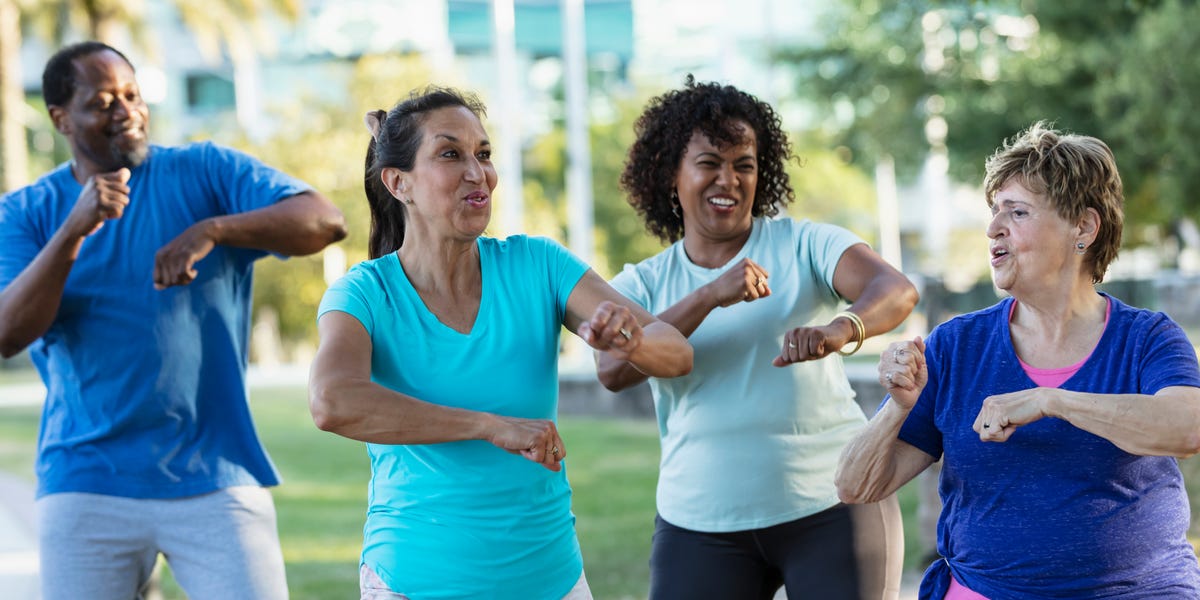
- Dance: Whether it’s attending a cardio dance class or rehearsing a viral TikTok dance, getting your heart rate up to music and memorizing a few steps is great for the mind-body connection.
- Do squats or march in place while watching TV: The multi-tasking component of getting your heart rate up and taking in new information is more impactful than you might realize.
- Start a walking routine: Dr. Rabin said taking walks is great for memory. Stroll around the neighborhood and take note of your route. Memorize said route, and when you feel good about it, establish another. Rotate through your routes every few weeks to keep your memory and your exercise regimen fresh.
- Use the stairs: If you find it difficult to make time for movement, work it into your day by opting for the stairs instead of the elevator when possible.
- Walk your dog, if you have one: According to the American Heart Association, dog owners are 34% more likely to get at least 150 minutes of movement per week than people who don’t own dogs.
If you want to do more vigorous movement, like the above study suggests, you can try some heart-pumping workouts like:
- HIIT workouts: This interval training is sure to make you break a sweat, and it challenges your memory by repeating a circuit of movements that you can improve on over time.
- Running: Running gets the heart rate up relatively quickly, and can help with emotional balance, and therefore memory, per the CDC.
- Jogging: Jogging is a great option if you’d like to run it out but might struggle with joint pain. With enough distance, it still increases the heart rate and blood flow, which is ideal for brain health.
- Swimming: Studies find swimming improves memory, cognitive function and mood.
- Biking on an incline: Amping up a regular bike ride with some inclined terrain—be that outside or on a spin bike—is a surefire way to get the heart pumping.
Malin’s advice: “Take breaks in sitting throughout the day by doing activity ‘snacks.’” That could mean doing a minute or two of jumping jacks, climbing stairs at a brisk pace, or doing air squats or push-ups to try to replace about six to 10 minutes of sedentary behavior a day. “Alternatively, trying to get walks in for about 10 minutes could go a long way,” he said.
The best mental exercises to boost your memory
As important as breaking a sweat for memory is consistently challenging yourself to remember things, be that in the form of driving home without the use of Google Maps or playing mobile memory games in bed.
“Mental exercises are the most important for memory because the more we practice remembering things like phone numbers, addresses, people’s names, faces, music, titles, driving directions, the better our memory gets,” said Dr. Rabin. “So it’s important that we train ourselves to not be reliant on technology for these things forever, but to use the technology to teach us how to expand our memory capacity on our own.”
Another crucial exercise for memory is simply breathing. “Breathing kind of crosses the barrier between mental and physical exercises,” Dr. Rabin explained. “Practicing breathing intentionally, which is a form of meditation, is extremely helpful for our memory and memory practice.” One study published in the journal Healthcare found that people who did deep breathing exercises after learning a new cognitive skill performed the skill better 24 hours later than those who didn’t complete the breathing exercise.
The bottom line
Using brain games and mental exercises are incredibly important for keeping your memory strong as you get older, but research suggests that physical exercise can play an equally powerful role. Incorporating both into your routine is the best strategy for staying sharp as you age.
Read the full article here