






Wildfires have always been around, but thanks to climate change, they’re becoming even more of a threat: Carbon emissions from wildfires grew 60% between 2001 and 2023, and the area burned by wildfires nearly doubled between 1984 and 2015.
Smoke from wildfires can travel thousands of miles from the actual source, meaning huge areas can be impacted—leaving lots of folks dealing with the effects of breathing it in.
Now, researchers are beginning to get a clearer picture of just how much wildfires affect our health. Two new studies from lead author Min Zhang, Ph.D., postdoctoral fellow in the Department of Environmental Medicine at the Icahn School of Medicine at Mount Sinai, draw a troubling picture.
Both zero in on the effects of PM2.5, or particles in the air that are 2.5 micrometers or smaller in diameter, which are found in wildfire smoke. “Because they are so small, they can travel deep into the lungs when we breathe them in,” Zhang says. This can cause annoying symptoms like cough, sneezing, or eye and throat irritation, but it also has the potential to lead to more serious complications. “Some particles or their components can also enter the bloodstream and affect organs throughout the body,” particularly contributing to cardiovascular and respiratory problems, Zhang adds.
The first study, published in The Lancet Oncology, found that older adults with lung cancer suffered higher rates of mortality after long-term exposure to wildfire-related PM2.5 than those exposed to PM2.5 from other sources. The second study, published in Nature Communications, found that people with cardiopulmonary conditions (e.g., COPD, asthma, hypertension, heart failure) were significantly more likely to be hospitalized after exposure to wildfire-related PM2.5 than those exposed to PM2.5 from other sources.
“Together, these findings suggest that wildfire smoke deserves greater attention as a source of harmful air pollution, particularly as wildfire activity continues to increase,” Zhang says.
So, what is it that makes wildfire smoke more harmful than other sources of particulate pollution? And with the threat of wildfires increasing, what can you do to protect yourself? Ahead, experts break it down.
Meet the Experts: Min Zhang, lead study author and postdoctoral fellow in the Department of Environmental Medicine at the Icahn School of Medicine at Mount Sinai; Joan A. Casey, Ph.D., associate professor at the University of Washington School of Public Health; John R. Balmes, M.D., professor of medicine at the University of California, San Francisco, professor of environmental health sciences at the School of Public Health, University of California, Berkeley, and spokesperson for the American Lung Association.
Why is wildfire smoke so harmful—even compared to other sources of pollution?
Experts can’t say for sure why wildfire-related pollution is more dangerous than that from other sources—in part because the makeup of wildfire smoke changes based on what’s burning, making it difficult to study in a lab, says John R. Balmes, M.D., professor of medicine at the University of California, San Francisco, professor of environmental health sciences at the School of Public Health, University of California, Berkeley, and spokesperson for the American Lung Association.
Still, there are a few theories. Wildfire-specific PM2.5 “tends to contain a higher proportion of ultrafine particles, as well as elevated concentrations of oxidative and pro-inflammatory substances, such as PAHs [polycyclic aromatic hydrocarbons], compared to typical ambient non-wildfire PM2.5 from traffic and power plants,” Balmes says.

Add Prevention as a preferred source in your Google search results.
Use your Google account to add this to your settings.


Joan A. Casey, Ph.D., associate professor at the University of Washington School of Public Health, points out additional possible explanations. Because wildfires can burn infrastructure, cars, and buildings, they can contain elevated levels of heavy metals in the smoke that you breathe in, which can be particularly toxic. Then, because the particulate matter in wildfire smoke can be so small, it’s able to penetrate deeper into the lungs and cause more damage, she explains. “Lastly, the way people are exposed to smoke—often in bursts of extreme exposure—can result in worse health outcomes,” Casey adds.
Who is particularly susceptible to the hazards of wildfire smoke?
Generally, it’s the same populations who are “most susceptible to air pollution exposures generally,” Casey says. That includes children, pregnant people, older adults, those who work outdoors, and those with preexisting heart and lung conditions.
Zhang adds that in her second study, the data showed that among those with preexisting cardiopulmonary conditions, “racial and ethnic minority groups, people living in metropolitan areas, people living in communities with lower educational attainment or greater socioeconomic deprivation, and people with co-existing obesity or diabetes” were more likely to be hospitalized.
When should you start taking precautions?
Keep an eye on the air quality index (AQI), Casey says, which you can check yourself with this nifty link. Most people should take precautions “once the AQI exceeds 151,” she says. “However, certain populations, like pregnant individuals, should change behavior once the AQI reaches 101.”
What precautions should you take?
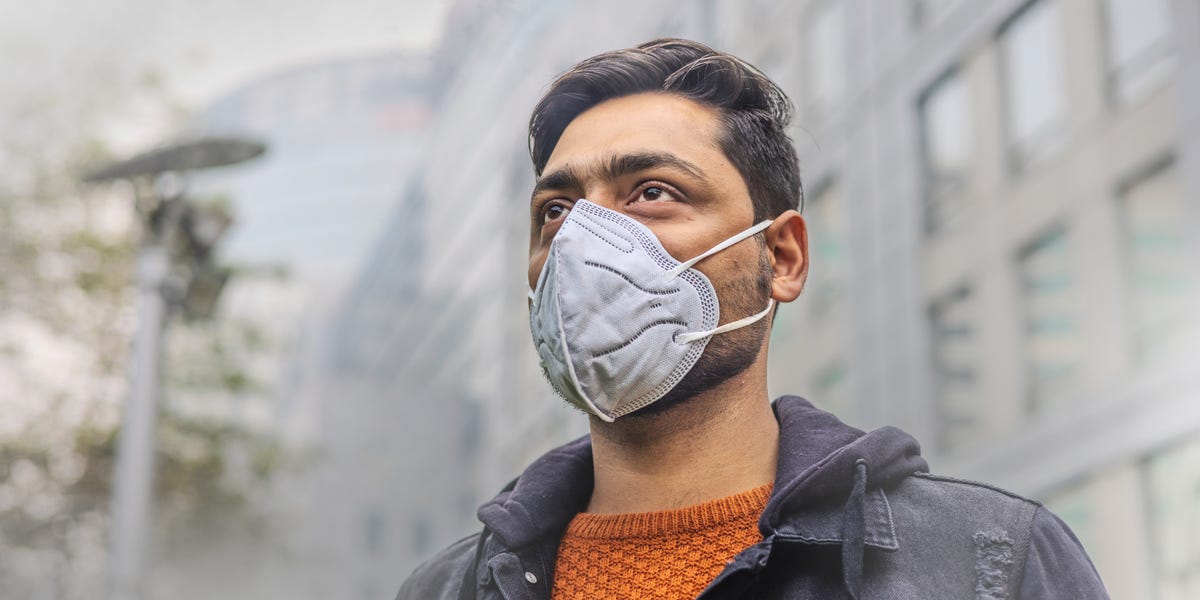
Try to stay indoors as much as possible—but if you need to be outdoors, wear an N95 or KN95 mask, which can filter out the small particles before you breathe them in.
And there are several things you can do to improve the air quality indoors, too:
- Close doors and windows
- Use portable air filters (ideally HEPA filters, though the Environmental Protection Agency (EPA) offers instructions on how to build DIY filters in a pinch)
- Install a MERV 13 filter in your central ventilation system
Read the full article here


