

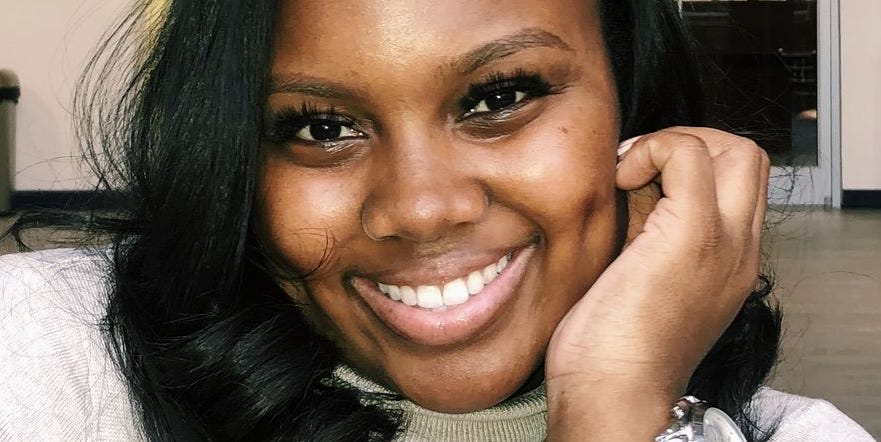
One day in 2012, when I was a sophomore in high school, I looked in the mirror and was surprised to see light patches on my cheeks that hadn’t been there before. I thought, “Oh my god, what is this?”
When I was a child I was diagnosed with eczema on my hands, but that was scaly itchiness—not light-colored spots on my pecan-brown skin. I had never experienced anything like it before, so my mom took me to a dermatologist near Hampton, Virginia, where I still live.
The long search for a diagnosis
The first doctor I saw (an older white woman) looked at my face and, without doing a physical exam or running any tests, said it was vitiligo, a condition that causes skin and hair to lose its color. It can happen to anyone, but it’s more noticeable in people of color. I was familiar with the condition and wasn’t convinced I had it since my patches didn’t look as white as vitiligo. So I pressed her.
Finally, she said it could be pityriasis alba, a condition that presents with scaly light-colored patches and is more noticeable on darker skin (although it seems to affect people of all racial backgrounds equally). She told me there was no treatment for it and didn’t give me any cream or ointment to help lessen the symptoms (even though research suggests some may help). I was told I would just have to live with it. So live with it I did, for another two years.
By the spring of 2014, the spots had spread from my face to other parts of my body so I went to another dermatologist (this time a woman of color), who took two biopsies from my arm and my thigh. She diagnosed me with progressive macular hypomelanosis, a poorly understood skin disorder that results in patches of skin that have less pigment than surrounding areas and spreads over time.
It’s another condition without a cure, but she suggested UV light therapy to treat it. I tried that for awhile and didn’t see results so I stopped and just used the topical steroids she prescribed. That helped the spots on my face heal temporarily, but they would come right back; the patches on my arms and legs didn’t get better at all.
At this point, I was in college working on my undergraduate degree. I tried my best not to let the condition take my entire focus but it was difficult. I worried people would look at me in disgust and wonder what was wrong with my skin so I covered myself up with long sleeve shirts and pants. I felt like I wasn’t normal because my skin didn’t look like everyone else’s. In essence, I was hiding a part of who I was because I didn’t want people to see me. I continued to struggle for the next few years until the pandemic hit and I finally got some answers.

How the mystery of my skin was finally solved
In the spring of 2020, I was finishing up grad school and under immense stress as everyone transitioned to working and schooling from home. I still had some spots on my face, but it wasn’t nearly as bad as what was on my arms, legs, and back.
I finally said enough was enough and Googled “best dermatologist” in my area. The first name to come up was Valerie Harvey, M.D., M.P.H., FAAD in Newport News, Virginia, a town about 15 minutes away. Not only were her reviews great, but I saw she was a woman of color and figured she could identify with me. Right now, she’s actually President-elect of the Skin of Color Society, an organization dedicated to raising awareness of issues related to dermatology in people of color.
My grandmother, who is a real woman of faith and is always by my side encouraging me, came with me to my first appointment in March last year. I explained to Dr. Harvey what was going on, and she looked at me and said she knew exactly what it was: mycosis fungoides, also known as cutaneous T-cell lymphoma. She took two biopsies, which confirmed the diagnosis.
Mycosis fungoides results in cancerous lesions when it involves the skin—and it’s extremely rare. Research shows that mycosis fungoides affects only 6.1 people out of a million African Americans and 4 people out of a million white folks. On lighter skin, mycosis fungoides can look like a red rash or a scaly patch, but for people who have skin of color, it can present as light spots. Dr. Harvey had seen patients with it before and was able to identify it on me. She also said the cause of mycosis fungoides is unknown—genetic, environmental, and immunologic factors have all been investigated.
When I first heard the diagnosis, the only thing I was concerned about was whether it could be treated and if my skin was ever going to clear up. Dr. Harvey assured us that yes, with UV light therapy the cancer could be addressed and my skin could even out. I was so relieved. Finally, I had found a doctor who knew what she saw and knew how to treat it.
Feeling hopeful with the right treatment plan
I’ve been doing UV light treatments three times a week since October, and the protocol has worked so well! The way Dr. Harvey explains it, phototherapy may work by directly inhibiting cancerous T-cells and/or by decreasing the body’s immune response to fight against the abnormal cells (essentially reducing inflammation).
It’s not the same as sitting out in the sun—specific ultraviolet wavelengths are used in a controlled environment. For each treatment, I remove my clothes and step inside a lightbox (similar to a standing tanning bed), close my eyes, and stay there for 8 to 10 minutes. Dr. Harvey says there are numerous studies investigating other treatments to help patients with mycosis fungoides, too.
Today, my skin has improved so much—it’s been a complete 180-degree change. In fact, it’s gotten so much better that Dr. Harvey recently told me I can reduce my treatments to just two times a week and my prognosis is excellent. Recent bloodwork showed no evidence of the cancer in my blood or organs. I’m lucky—if this condition gets to more advanced stages, it can spread internally.
Despite all the struggles I had with my skin over the years, it never crossed my mind that the root cause might be cancer. I’m not going to say it was meant to be, but it was God’s will for me to experience this particular form of cancer because I was able to get through it and now I can help empower and inspire other people who may suffer with similar issues.
Why did it take so long for me to get a proper diagnosis?
According to Dr. Harvey, mycosis fungoides is difficult to diagnose—both clinically and under a microscope—so it often goes misdiagnosed for years. It can take multiple biopsies for the cancer to show up in a sample, which explains why the cancer wasn’t confirmed in the biopsy my second dermatologist did.
There are also biases in our society to consider. As much as I’d like to believe that the color of my skin (and my doctor’s) didn’t play a role, research shows that racial disparities persist in the field of dermatology. In fact, one study found that people of color with psoriasis are more likely to go undiagnosed than white people with psoriasis. Another found that only 4.5% of images in medical textbooks feature dark-colored skin, which makes it difficult for doctors to learn how to diagnose people of all skin tones.
While working on my Masters in Humanities and certificates in Diversity Studies and Women and Gender Studies, I’ve become more aware of these systemic disparities and realized the importance of advocating on behalf of marginalized communities. In the case of skin cancer, there’s a higher rate of mortality among people of color, which researchers think could be due to a combination of lower awareness, diagnosis at more advanced stages, and socioeconomic factors that make it harder to access high-quality care.
It’s important for those of us in Black and Brown communities to stand up and say, “This isn’t right. I know what I’m talking about. Please don’t lessen the severity of what I’m experiencing.” We have value, and we should be taken seriously and treated with dignity and respect so that we all can survive and thrive.
Physicians are revered as the experts who know everything so it can be terrifying to stand up for yourself—but it can also be a matter of life or death. If you don’t think your doctor is doing a good job, find another one. That can be tough if you live in a rural area, but telemedicine is changing the field of health care—including dermatology—and provides a means for more people to get proper treatment. Don’t stop until you get the answers that you feel you deserve.
Search online for physicians and then seek out reviews. The American Academy of Dermatology has a tool for looking up doctors who specialize in certain conditions and the Skin of Color Society maintains a database of doctors who have experience in treating people of color.
I’m fortunate that even though I was dealing with skin problems for a decade, the cancer didn’t spread beyond my skin. I was able to get a hold on it, but not everyone is able to do that. As an educated Black woman in this society, I believe I must do my due diligence to raise awareness of the forms of oppression that continue to perpetuate among marginalized communities and use my knowledge to raise the voices of those that have gone unheard.
Read the full article here