

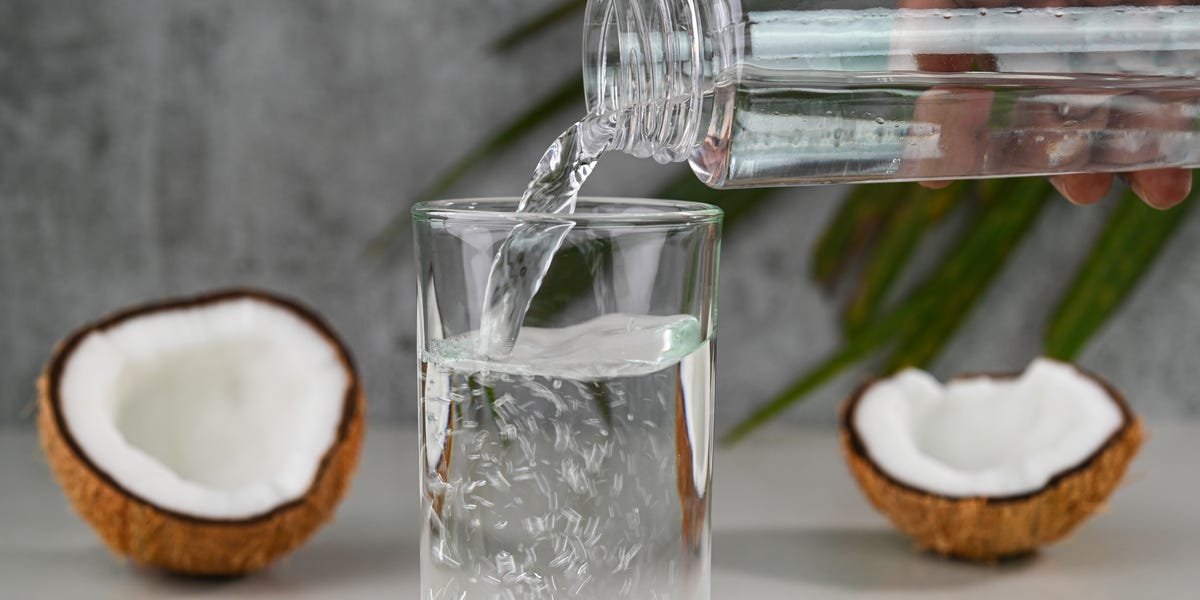
Often hailed as nature’s sports drink, the tropical beverage is lauded for its health perks. But is coconut water good for you, and how does it stack up in terms of nutrition?
It turns out that the ultra-hydrating and naturally sweet beverage is packed with a slew of nutrients, including ones people often don’t get enough of in their typical diets. But are the health benefits of coconut water plentiful enough that you should drink it in place of good old-fashioned H2O?
Meet the Experts: Jennifer Christman, R.D.N., L.D.N., C.P.T., director of clinical nutrition at Optavia; Keri Gans, M.S., R.D., registered dietitian and author of The Small Change Diet; Joanna Gregg, R.D., a MyFitnessPal registered dietitian; Megan Meyer, Ph.D., a nutrition, immunology, and science communication expert; Sarah Olszewski, M.S., R.D.N., C.D.N., a registered dietitian; Melissa Prest, D.C.N., R.D.N., spokesperson for the Academy of Nutrition and Dietetics
We asked dietitians to share everything they want you to know about the thirst-quenching beverage, from its many health benefits to how to enjoy it. Plus, when to avoid coconut water.
Health benefits of coconut water
Coconut water is most well-known for its electrolytes (which we’ll go over later), but that’s not its only asset:
It’s ultra-hydrating
Like regular water, coconut water’s main benefit is hydration, says Keri Gans, M.S., R.D., registered dietitian and author of The Small Change Diet. “Hydration helps keep our joints lubricated, delivers nutrients to our cells, and regulates our body temperature.” Due to sweating and electrolyte loss during exercise, coconut water may be beneficial for rehydration after exercise; however, its sodium content is lower than that of a sports drink, so it may not be as efficient, she points out.
Drinking enough water on a daily basis is one of the best things you can do for your health. In fact, the Academy of Nutrition and Dietetics recommends that women and men drink about nine and 13 cups per day, respectively, says Megan Meyer, Ph.D., a nutrition, immunology, and science communication expert. “Coconut water can help people meet their hydration needs, since it is about 95% water,” she adds.
It’s plentiful in key nutrients
“Depending on the brand, 8 oz of store-bought coconut water has around 500 milligrams (mg) of potassium, 30 to 40 mg of sodium, and 4% of the recommended daily value for magnesium and calcium,” explains Joanna Gregg, R.D., a MyFitnessPal registered dietitian. “If your diet is lacking in any of these nutrients, coconut water may be beneficial for reaching your daily needs.”
It’s a natural source of electrolytes
Electrolytes are minerals not found in water that help maintain various important bodily functions, including hydration, muscle function, and a balanced blood pH, per the National Library of Medicine. When you sweat, you lose electrolytes, and while sports drinks may help replenish them after a good workout, they often come with chemicals and added sugars. Pure coconut water, on the other hand, does not, and one cup contains more than double the amount of electrolytes than the same yield of a traditional sports drink.
It’s high in potassium
Meyer puts special emphasis on coconut water’s potassium content, an electrolyte that supports muscle function, among other processes. “The U.S. Dietary Guidelines for Americans have identified potassium as one of the four nutrients of concern for Americans,” she explains. “Insufficient potassium intake can elevate blood pressure, deplete calcium in bones, and increase the risk of kidney stones.” As previously mentioned, a cup of coconut water delivers 500 mg of the nutrient.
It may support heart health
On the topic of potassium, getting an extra boost of it via coconut water may benefit your heart. That’s because potassium may “help relax blood vessels in order to promote healthy blood flow and regulate blood pressure levels,” says Sarah Olszewski, M.S., R.D.N., C.D.N., a registered dietitian and Cure nutrition advisor. This is especially the case if you overdo it on sodium, which tends to raise blood pressure—having a dose of potassium can counteract those effects, according to the American Heart Association (AHA).
It’s low in calories
It’s natural to wonder if coconut water is a good drink for weight loss—and because it’s a tasty beverage that’s lower in calories than alternatives like juice and soda, experts give it a thumbs up. However, it will never be as good for losing weight as plain ol’ water.
“Substituting high-calorie beverages with coconut water can be a healthier choice for individuals looking to manage their weight,” says Olszewski. “However, some packaged coconut water products may contain added sugars and higher calorie content, which may not be conducive to weight loss. It’s crucial to read labels and opt for pure, unsweetened coconut water when possible.”
It can be a powerful antioxidant
“Coconut water contains antioxidants that may help neutralize harmful free radicals in the body and protect cells from oxidative stress,” explains Olszewski. Animal-based studies have explored this theory with positive results, but more research is warranted in humans to determine how powerful its preventive effects really are.
Nutritional breakdown of coconut water
Coconut water contains 94% water and very little fat. It should not be confused with coconut milk, which is made by adding water to grated coconut meat. Coconut milk contains about 50% water and is quite high in fat.
Coconut water is low in calories, provides vitamin C, and many electrolytes, including potassium, sodium, calcium, and magnesium, says Gans. Per the U.S. Department of Agriculture (USDA), one cup (240 ml) contains 60 calories, as well as:
- Carbs: 15 g
- Sugar: 8 g
- Calcium: 4% of the daily value (DV)
- Magnesium: 4% of the DV
- Phosphorus: 2% of the DV
- Potassium: 15% of the DV
Should anyone avoid drinking coconut water?
Coconut water’s naturally high potassium content may be beneficial for some, but others should proceed with caution, according to Melissa Prest, D.C.N., R.D.N., a spokesperson for the Academy of Nutrition and Dietetics. “For example, individuals with chronic kidney disease are often advised to monitor or limit potassium intake because their kidneys may not efficiently remove excess potassium,” she explains. “People taking certain potassium-retaining medications, such as some blood pressure medications, may also need to be mindful of potassium intake. In these situations, it’s best to discuss the appropriate amount of potassium with your physician, pharmacist, or registered dietitian nutritionist.”
Can I drink coconut water every day?
Drinking coconut water daily may be a part of a healthy diet, especially for those who live in especially hot climates and work out a lot, says Olszewski. However, as with any major change to your diet, it’s recommended you consult your doctor before adding coconut water to your daily routine, especially if you have specific health conditions like kidney disease or take certain medications.
Prest also warns against consuming large amounts of coconut water as it may cause some to experience bloating or mild stomach upset. “Another consideration is food safety. Fresh or unpasteurized coconut water can support the growth of foodborne pathogens such as Listeria monocytogenes,” she says. So if you do drink coconut water daily, “choosing pasteurized products or properly handled fresh coconut water can reduce that risk.”
At the end of the day, regular water is probably still your best bet for hydration, says Gans.
What’s the best way to consume coconut water?
The simplest way is to pour it into a glass, drink it, and enjoy, says Gans. “Because of its mineral content, limit yourself to one to two cups daily.” It can also be added to smoothies instead of regular water or juice, she suggests. You may also use coconut water as a base for chia seed pudding, vinaigrette dressing, or as a substitute for plain water whenever you want a bit of natural sweetener.
But before you start reaping the benefits of nature’s sports drink, Jennifer Christman, R.D.N., L.D.N., C.P.T., director of clinical nutrition at Optavia, recommends checking nutritional labels first. “Stick with options that are 100% coconut water and free of unnecessary additives, like sugars,” she says.
Read the full article here