

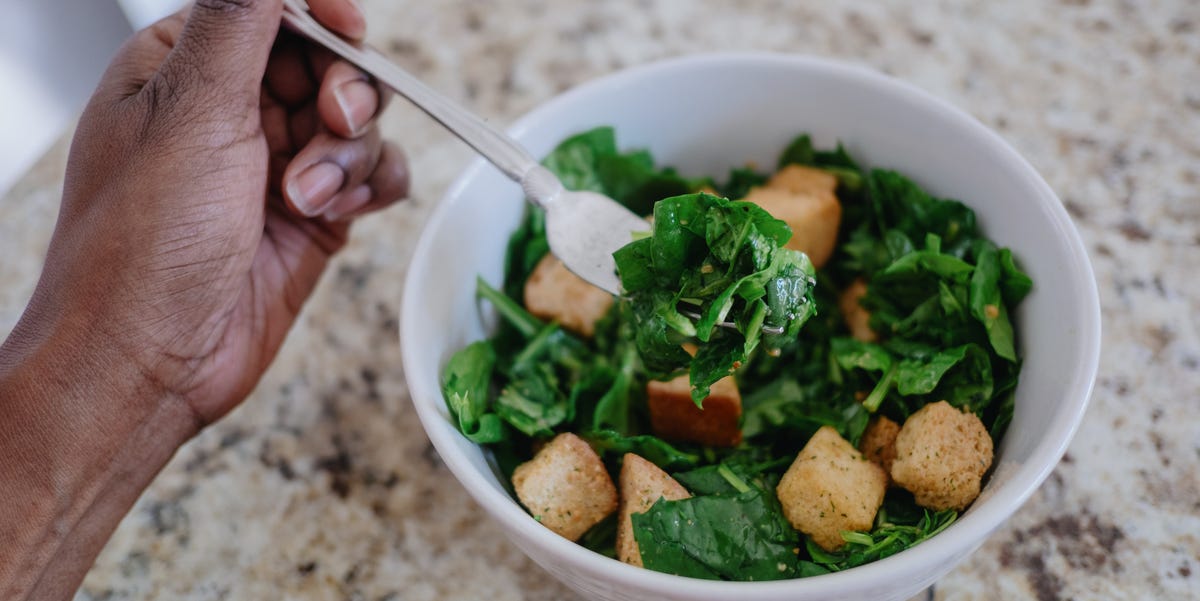
Spinach is one of those foods that’s both wildly healthy and easy to add to a variety of meals. You can throw it into a smoothie, fold it into eggs, toss it into pasta, or use it to create a classic salad base. It’s low in calories, loaded with micronutrients, and shows up on basically every best vegetables for overall health list for a reason. But when it comes to raw vs. cooked spinach, is one better for you?
Meet the experts: Avery Zenker, R.D., at MyHealthTeam; and Jennifer Pallian, R.D., at Foodess Creative In.
Some would automatically jump to assuming raw vegetables always win, but the answer is more complicated when it comes to spinach. Each option has its strengths and drawbacks, so we tapped dietitians to share which is best.
Health benefits of spinach
Whether you cook it or eat it raw, spinach has a lot to offer. It’s filled with antioxidants, which help neutralize free radicals—unstable molecules that damage cells. Studies suggest that eating spinach may also offer benefits ranging from lowered blood pressure to better eye health.
“Spinach is a source of vitamin A, vitamin C, vitamin K, B vitamins, magnesium, calcium, and iron,” Avery Zenker, R.D., tells Prevention. In other words, it’s a nutrient powerhouse. But some nutrients are more abundant (or more absorbable) depending on how you prepare the green.
Raw vs. cooked spinach: Which is better for you?
“Raw and cooked spinach differ mainly in oxalate content and in the measured amounts of certain micronutrients per 100 g,” says Jennifer Pallian, R.D. “[Both] have the same calories per 100 g…but cooked spinach contains more calcium, iron, magnesium, zinc, copper, and vitamin K per 100 g, while raw spinach contains more vitamin C and folate per 100 g.”
The reason raw and cooked spinach differ in nutrients and other components has to do with how they break down when heat and water are introduced. Heat can disrupt plant cell walls, which can change how easily certain compounds are released and absorbed. This includes reducing how much oxalate—an antinutrient that is associated with kidney stones and other related issues—is present in spinach.
Zenker suggests that “lightly cooked” spinach may actually be the best way to get the most nutrients. “Spinach is high in oxalates, which can bind to minerals like calcium and iron, blocking their absorption,” she explains. “Cooking spinach reduces oxalate content, making its calcium and iron more bioavailable. Cooking helps increase beta carotene (vitamin A) and iron availability in spinach.”
However, she also points out that while boiling spinach makes certain nutrients more bioavailable, it does increase the loss of others, like vitamin C.
Nutrient breakdown
According to the U.S. Department of Agriculture (USDA), some highlights of the nutrients found in raw spinach include the following per 100g:
- Vitamin A (RAE): 469mcg
- Vitamin B-6: 0.195mg
- Vitamin C: 28.1mg
- Vitamin K: 483mcg
- Calcium: 99mg
- Iron: 2.71mg
- Magnesium: 79mg
- Fiber: 2.2g
- Potassium: 558mg
For cooked spinach—specifically boiled and drained—many of those numbers clearly shift:
- Vitamin A (RAE): 524mcg
- Vitamin B-6: 0.242mg
- Vitamin C: 9.8mg
- Vitamin K: 494mcg
- Calcium: 136mg
- Iron: 3.57mg
- Magnesium: 87mg
- Fiber: 2.4g
- Potassium: 466mg
The bottom line
The good news is you don’t have to choose between only eating the leaves raw or cooked. But which one you want to prioritize blending into your existing meal habits depends on your personal needs.
“Specific situations where preparation choice matters most are those who have a risk of developing a kidney stone and conditions where oxalate absorption is elevated,” Pallian advises. “People predisposed to calcium oxalate stones are often advised to limit high-oxalate foods like spinach or choose preparation methods that reduce soluble oxalate. In that group, boiling spinach is a practical strategy because it can substantially reduce soluble oxalate via leaching into cooking water.”
In terms of pure numbers, boiling spinach has some clear advantages. It tends to be higher in vitamin A, vitamin B-6, calcium, iron, and magnesium. The amount of vitamin K and fiber remains pretty similar whether spinach is raw or cooked. Meanwhile, raw spinach wins out when it comes to vitamin C and potassium. It’s also a good source of the antioxidant lutein.
And then there’s the practical aspect. “You might get more nutrients from cooked spinach since it cooks down to such a small volume that you might end up eating more spinach in total,” Zenker points out. “One cup of cooked spinach is equal to several cups of raw spinach, so you get more nutrients per serving volume.”
Whichever option you choose, adding spinach to your diet provides a bevvy of nutrients.
Read the full article here