

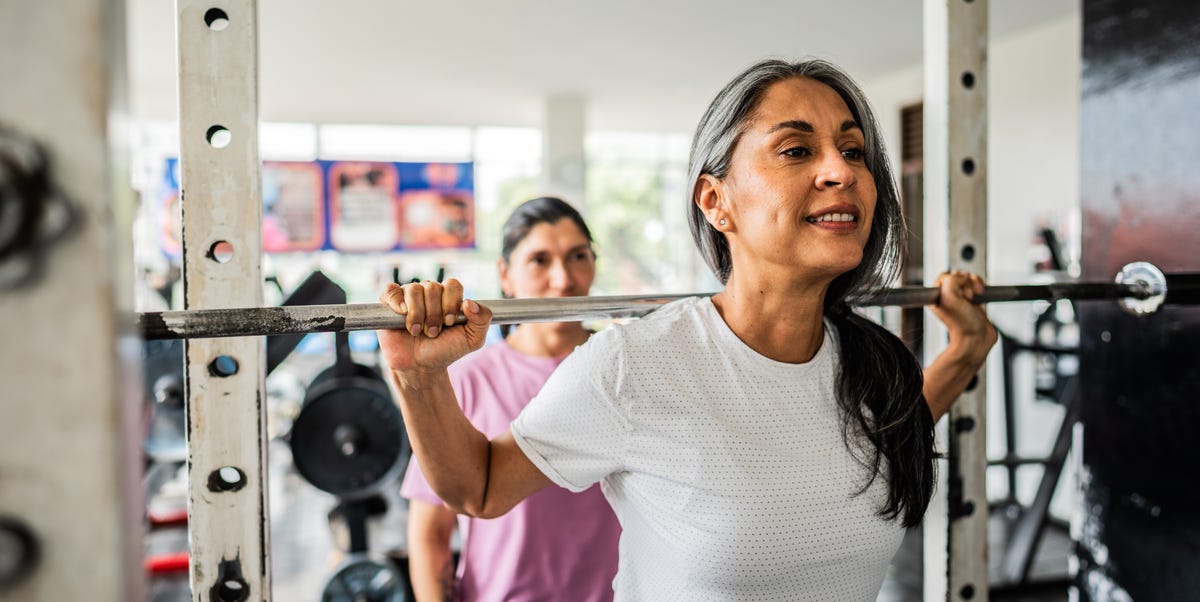
- According to one study, lifting weights for 30 minutes twice a week leads to muscle growth.
- The researchers found that all participants saw results, even when they weren’t pushing themselves to failure.
- Experts share the best exercises to get started with a new strength-training regimen.
There are numerous benefits of strength-training, especially for women over 50. But if you’ve ever worried that you don’t have time in your schedule to fit in strength workouts, a September 2025 study is here to alleviate your worries. The research suggests that just 30 minutes of weight training twice a week is enough to build muscle, which will support a steadier metabolism and better mobility as you age.
Meet the experts: Albert Matheny, R.D., C.S.C.S., co-founder of SoHo Strength Lab; Brad Schoenfeld, Ph.D., study co-author and a professor in exercise science at Lehman College in the Bronx, NY; Luke Pryor, Ph.D., C.S.C.S., clinical associate professor in the Department of Exercise and Nutrition Sciences at the University at Buffalo.
The small study, published in Medicine & Science in Sports & Exercise, consisted of 42 healthy people following a lifting program with one set of eight to 10 reps for each exercise. The participants were separated into two groups: One group was pushing themselves until they couldn’t do any more reps with the right form (train to failure), while the other pushed themselves but still had energy to do more (leaving reps in reserve).
The participants went through nine exercises that addressed major muscle groups twice a week for eight weeks. Each session was 30 minutes. Afterward, the researchers analyzed participants for changes in muscle thickness in select areas of the body, as well as measures of muscle strength, power, and endurance.
They found that all of the participants experienced an increase in strength and muscle growth, regardless of whether they were training to failure or leaving a few reps in the tank. “In our study, the workouts were sufficiently hard to challenge the participants’ muscles beyond their present capacity,” said Brad Schoenfeld, Ph.D., study co-author and a professor in exercise science at Lehman College in the Bronx, NY. “This is key to making continued muscular gains.”
Still, the fact that everyone saw results is impressive—and inspiring. The idea of squeezing in two 30-minute lifting sessions a week seems doable, and it is, according to Albert Matheny, R.D., CSCS, co-founder of SoHo Strength Lab. “I repeat this often: It doesn’t have to be the most to have a benefit,” he said. “There is a law of diminishing returns.”
How do 30-minute sessions deliver benefits? There’s a lot that happens in your body when you lift, including the release of hormones, metabolic stress (which disrupts the muscle’s usual state and can cause it to grow), muscle strain, and molecular signaling in the muscle, explained Luke Pryor, Ph.D., C.S.C.S., clinical associate professor in the Department of Exercise and Nutrition Sciences at the University at Buffalo. Even shorter sessions will tap into all of these. Shorter sessions also tend to have less recovery time between sets, noted Pryor. “By shortening the recovery time, it drives up metabolic stress,” he said. Cue the muscle growth.
Pryor added that the study was done on people who already did resistance training, which suggests that even people who are already strong may gain muscle from this approach. “These shorter sessions are really effective for those who are sedentary, but this shows that even in folks who have been exercising for a number of years, you can still maintain or even grow skeletal muscle in these shorter sessions,” he said.
Benefits of strength-training
There are a lot of perks to strength-training beyond looking fit. Not only will it make you physically stronger, but research also suggests that lifting will help increase bone density, an important area of health to focus on as get older.
“There are also links to longevity and hormonal improvements,” Matheny said. Strength training can even increase your metabolism, he pointed out.
“Resistance training has a plethora of benefits for almost all organ systems,” Schoenfeld said. “This includes improved ability to carry out tasks of everyday living, enhanced metabolic function, better cardiovascular health, better mental health, and greater injury resistance, among others.”
How to get started with weight-training
If you’re interested in starting a lifting routine, Matheny suggested giving yourself a little extra time at first to figure out what you’re doing. “You have to work a bit to figure out the right weight to get the most out of each exercise,” he said. If it’s available, consider scheduling a session with a personal trainer who can instruct you on proper form before setting out on your own.
In the study, participants used exercises that mostly targeted just one muscle at a time, but Matheny recommended focusing on exercises that use multiple muscle groups. Pryor agreed: “You want to do exercises that recruit a lot of muscle.”
Matheny recommended focusing on moves like these that target several muscle groups at once to get the biggest results:
- Push-ups
- Squats
- Lunges
- Deadlifts
- Pull-ups
Schoenfeld also suggested keeping the time between sets to under two minutes to make the most of your time. But he recommended picking exercises that will help you reach your goals. “Ultimately, personal choice should dictate which exercises you select,” he said.
Of course, doing any strength-training is better than none, and you may not even need to set aside 30 minutes. As long as you’re challenging yourself, “you can even get results with 20-minute sessions,” Pryor said.
Read the full article here