







We’ve all been there—you feel great after powering through a Pilates class or strength training session only to struggle taking the stairs or brushing your hair the next day. Delayed onset muscle soreness, or DOMS, can be a normal consequence of exercise, particularly after you really push yourself, but that doesn’t mean it’s fun to deal with. Luckily, there are plenty of remedies for sore muscles that can help take the edge off.
Meet the experts: Patricia Greaves, C.P.T., certified fitness trainer, precision nutrition coach, and founder of StrongHer Personal Training; Karena Wu, D.P.T., board-certified clinical specialist in orthopedic physical therapy and owner of ActiveCare Physical Therapy
DOMS usually gets better on its own within two to three days, but you don’t necessarily have to wait for it to run its course—there’s plenty you can do to help alleviate it faster. Ahead, fitness experts share the best sore muscle remedies to help you feel better, plus more on what causes soreness in the first place and when to see a doctor.
Best remedies for sore muscles
Light activity
It may seem counterintuitive, but more movement—as long as it’s gentle—is often one of the best remedies for workout-induced muscle soreness. “Movements like walking or cycling cause muscles to contract and relax, promoting blood flow and fluid circulation,” explains Karena Wu, D.P.T., board-certified clinical specialist in orthopedic physical therapy and owner of ActiveCare Physical Therapy. “This will help loosen up the soft tissues and reduce perceived pain.”
Stretching
While any light movement can help, stretching is particularly beneficial, according to Wu. “Stretching can help lengthen soft tissues, which promotes fluid movement, reducing your perception of pain,” she explains. Just know your limits and avoid forcing yourself to go beyond your range of motion.
Foam rolling
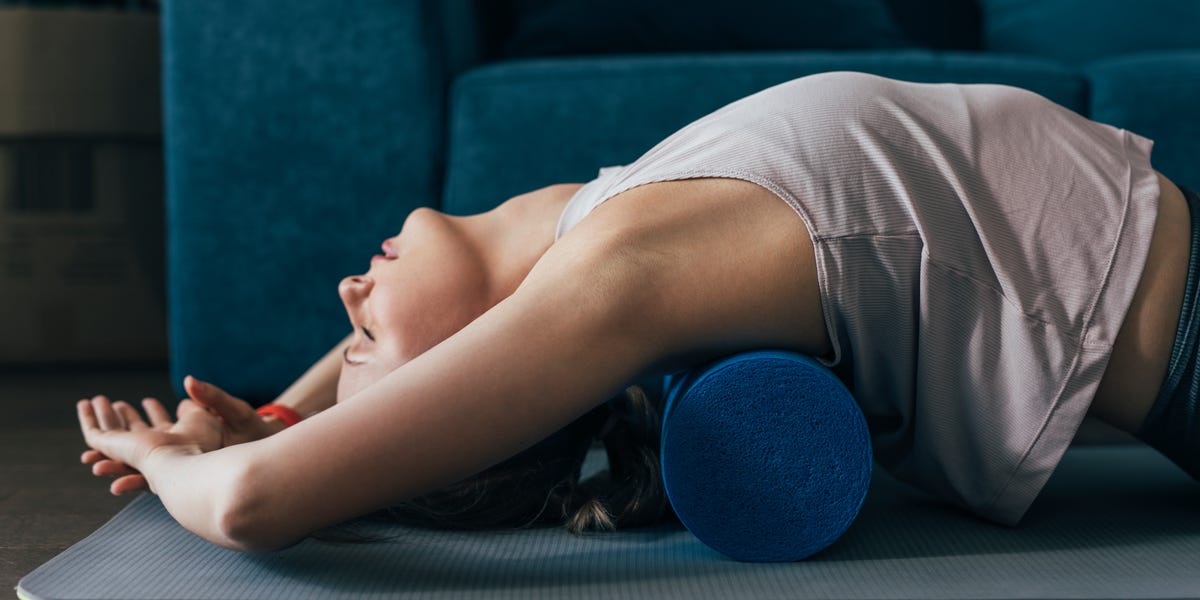
A foam roller is a helpful tool to keep around for alleviating soreness. “Foam rolling compresses and stretches soft tissue,” Wu explains. “This self-massage will help improve blood flow, tissue extensibility, and reduce muscle soreness.”
Heat or cold therapy
Depending on what kind of soreness you’re dealing with, a hot or cold compress may help take the edge off. “If the muscle is strained or inflamed, a cold pack can be applied to reduce swelling and provide temporary relief,” suggests Patricia Greaves, C.P.T., certified personal trainer, precision nutrition coach, and founder of StrongHer Personal Training. “For general soreness, heat may be used in the form of a heating pad, patch, or cream to increase blood flow to the affected area.”
Massage guns
Another helpful tool, “massage guns are great at increasing blood flow quickly due to their rapid percussive nature,” Wu says. “This will help stretch the tissues, improve blood flow, and reduce pain from sore muscles.”
Hydration and protein
What we put into our bodies can also have a serious effect on our ability to recover from exercise, which is why it’s important to incorporate the best foods for muscle recovery into your diet when you’re pushing yourself at the gym. “Eating protein and staying hydrated throughout your day help to facilitate muscle repair and growth while alleviating muscle soreness,” Greaves explains.

Add Prevention as a preferred source in your Google search results.
Use your Google account to add this to your settings.


Epsom salt baths
Baths are already a relaxing ritual, but when you sprinkle in some Epsom salt, they can also promote muscle recovery. “Epsom salt baths can help relax the tissues, and the heat from the bath water can promote relaxation of tight muscles, improving fluid movement to help reduce muscle soreness,” according to Wu.
Rest
Finally, sometimes the best remedy for soreness is to get some rest. “When a muscle is overworked and sore, allowing a day of rest for that muscle group supports muscle repair and prevents injury,” Greaves says. That can mean alternating between working out different parts of your body or taking a break from working out altogether.
What causes sore muscles?
“When muscles have been under tension from resistance or a challenging exercise, the muscle fibers tear and the rebuilding process can result in delayed onset muscle soreness,” explains Greaves. The inflammation that’s triggered contributes to that tight, achy feeling, which generally develops within 12 to 24 hours after exercise.
This tearing-and-rebuilding process is normal—in fact, it’s what’s responsible for your muscles getting stronger with exercise. But there are some factors that can make DOMS more likely to occur. “Muscle soreness can result from using muscles you haven’t used in a while or using them with greater intensity than they are accustomed to,” says Greaves.
Other things may up the intensity of the soreness, too. “Overdoing it is also a common cause of muscle soreness,” Wu explains. “Not enough rest and recovery and too much back-to-back exercise on a muscle can cause soreness due to the strain of having the muscle continue to perform.” Neglecting proper hydration and nutrition can also worsen muscle tightness and soreness, she adds.
Is it safe to work out when your muscles are sore?
When you’re dealing with DOMS, it’s fair to wonder if it’s safe to keep working out. Generally, it is—as long as you make some tweaks. “Gentle movement and mobility work (walking, dynamic stretching, light cycling, swimming) are recommended to help ease soreness and decrease stiffness,” says Greaves.
So if you had a tough workout on the schedule, you might want to postpone it or sub in another one that allows your achy areas to recover. “Any strenuous movement to the affected muscles should be avoided to allow proper rest and repair,” Greaves says. “For example, if your leg muscles are sore from the previous workout, doing an upper body workout gives your leg muscles time to rest while still being active.”
Know your body—and recognize your limits. “Work within your limits and do not force any range of motion in stretching or significant effort when working out,” Wu suggests. “The point of doing these activities when the muscles are sore is to actively recover by improving fluid flow and promoting healing of tissues to reduce muscle soreness.”
When should you see a doctor for sore muscles?
“It’s important to know the difference between normal muscle soreness and acute pain,” Greaves explains. “When muscles are challenged with a new or strenuous workout, delayed soreness is normal and should naturally decrease over a few days. Everyday movement may be uncomfortable, but you should still be able to perform your daily activities.”
“Acute pain, on the other hand, often presents itself during the actual movement—for example, experiencing a sharp pain as you lower into the squat,” Greaves says. “If pain gets progressively worse, preventing you from using the affected muscle or is accompanied by swelling, I would recommend you see your medical care provider for evaluation.”
Read the full article here


