







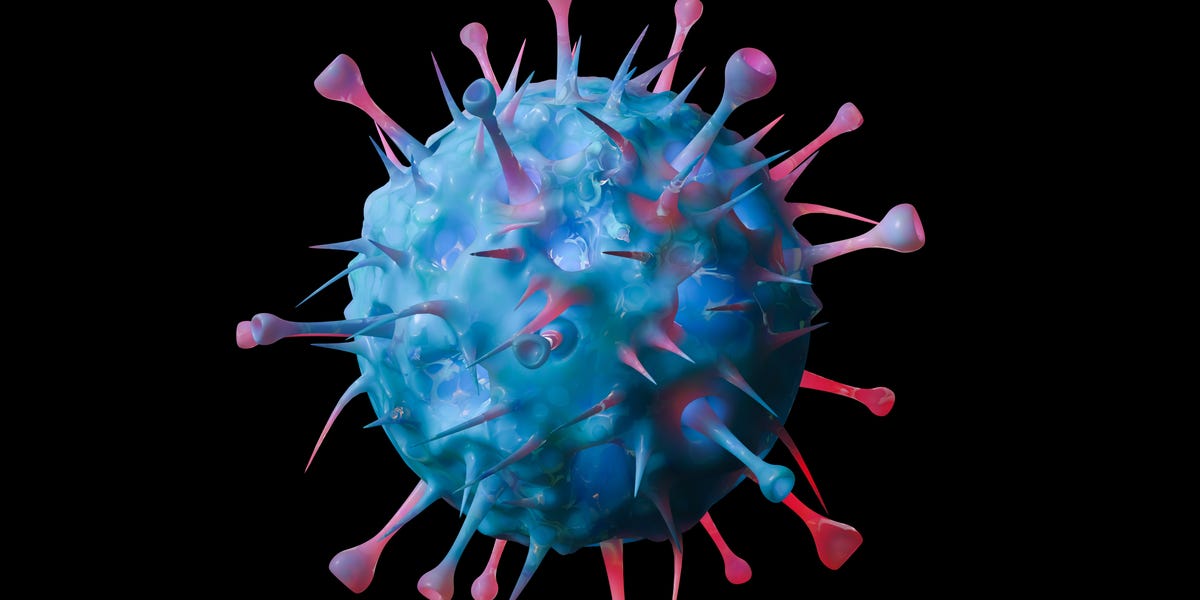
· The BA.3.2 COVID variant is getting a lot of attention.
· Nicknamed “cicada,” it’s back after simmering in the background for a while.
· This variant has a jaw-dropping number of mutations.
There hasn’t been much talk about COVID-19 over the past few months, and with good reason: Government wastewater testing data suggests that cases of the virus across the country are currently low. But the latest COVID-19 variant, BA.3.2, named cicada, is making waves.
The Centers for Disease Control and Prevention (CDC) flagged the variant in its Morbidity and Mortality Report (MMWR). BA.3.2 has the potential to evade protection from a previous COVID-19 infection or the vaccine, making it a variant that the infectious disease community is tracking.
Meet the experts: Amesh A. Adalja, M.D., is a senior scholar at the Johns Hopkins Center for Health Security; Thomas Russo, M.D., is a professor and chief of infectious diseases at the University at Buffalo in New York
“I’ve been keeping my eye on this one,” says Thomas Russo, M.D., a professor and chief of infectious diseases at the University at Buffalo in New York.
So, what is the cicada variant and why is it getting so much attention right now? Here’s what the data—and infectious disease physicians—suggest.
What is the cicada COVID variant?
The cicada COVID variant stems from Omicron, a highly transmissible strain of the virus that first appeared in 2021. “It is another variant of Omicron that has evolved several mutations that make it more difficult for the immune system to completely neutralize,” says Amesh A. Adalja, M.D., a senior scholar at the Johns Hopkins Center for Health Security.
The name “cicada” is in reference to its history. “It is a descendant of an early Omicron strain BA.3 that went quasi-dormant for some time and acquired these mutations and then came back as BA.3.2,” Dr. Adalja says.
Cicada “was described a few years ago, smoldered in other countries, and now is back,” Dr. Russo says.
Where has the cicada COVID variant been detected?
The cicada variant has been detected in 23 countries since 2024 and was first noticed in the U.S. in January 2025. Since then, it’s popped up in these 24 states, per the CDC:
- California
- Connecticut
- Florida
- Hawaii
- Idaho
- Louisiana
- Maine
- Maryland
- Massachusetts
- Michigan
- Missouri
- Nevada
- New Hampshire
- New Jersey
- New York
- Ohio
- Pennsylvania
- Rhode Island
- South Carolina
- Texas
- Utah
- Vermont
- Virginia
- Wyoming
Cicada COVID variant symptoms
The cicada COVID variant doesn’t seem to cause symptoms that are any different from previous COVID variants, according to Dr. Adalja. Per the CDC, those symptoms include:
· Fever or chills
· Cough
· Shortness of breath or difficulty breathing
· Sore throat
· Congestion or runny nose
· New loss of taste or smell
· Fatigue
· Muscle or body aches
· Headache
· Nausea or vomiting
· Diarrhea
Does the cicada COVID variant cause more severe illness?
It’s not clear at this point. The cicada COVID variant has 70 to 75 substitutions on its spike protein, which is what the virus uses to latch onto your cells and infect you. “That’s a lot,” Dr. Russo says. “The concern is that it will become more immune-evasive.” Meaning, immunity that you’ve built up in the past may not be as effective against this strain of the virus as it has been against others.
“Immunity wanes over time, fewer people are getting vaccinated, and the prior immunity that was developed will not be optimally protective against such a variant,” Dr. Adalja says.
That doesn’t automatically mean it will cause more severe disease, though—it’s just that people may be more likely to get infected, Dr. Russo says. One thing to point out, per Dr. Adalja: “Some of the mutations, however, decrease binding to human cells.” That means that some of the mutations cicada carries may make it less infectious. But all of those alterations to the spike protein may override those.
Does the vaccine protect against the cicada COVID variant?
The latest COVID-19 vaccines are based on other Omicron variants, although they’re not a perfect match for the cicada variant.
“The existing vaccine is likely to protect against what matters most: serious illness,” Dr. Adalja says. “The ability to stave off infection may be limited.” Dr. Russo agrees. “The best way to protect yourself is vaccination, but our present vaccines are imperfect,” he says.
How concerned should you be about the cicada COVID variant?
There aren’t a ton of cases fueled by the cicada variant in the U.S. right now. (The XFG variant is the dominant variant in the country at the moment, based on CDC surveillance data.)
“The concern is that this is going to potentially drive an increased number of cases,” Dr. Russo says. “With this one popping up, the concern is that it might drive an increased number of cases again.”
But Dr. Adalja says people shouldn’t freak out over the cicada variant. “There is no major reason for concern at this point,” he says. “There will always be variants rising and falling.”
Read the full article here


