
Close Menu
OMG Healthy
  • Home
  • News & Trends
  • Food & Nutrition
  • Health & Wellness
  • Fitness
  • Beauty
  • Apparel & Gear
  • More Articles
Trending Now

What Does a Tick Bite Look Like?

August 14, 2026

Best Protein Bars for Energy, Cravings, and Muscle Support

August 14, 2026

5 Best PEMF Mats for Pain Relief and Recovery, per Experts and Testing

August 14, 2026
Facebook X (Twitter) Instagram
OMG Healthy Saturday, August 15
  • Privacy
  • Terms
  • For Advertisers
  • Contact
Facebook X (Twitter) Instagram
Newsletter
  • Home
  • News & Trends
  • Food & Nutrition
  • Health & Wellness
  • Fitness
  • Beauty
  • Apparel & Gear
  • More Articles
OMG Healthy
Home » What Does a Tick Bite Look Like?
Health & Wellness

What Does a Tick Bite Look Like?

News RoomBy News RoomAugust 14, 2026No Comments11 Mins Read
Facebook Twitter Pinterest Telegram LinkedIn Tumblr Copy Link Email
Follow Us
Google News Flipboard
8 min read

This year, many areas of the country experienced a higher than usual number of emergency room visits related to tick bites, per the Centers for Disease Control and Prevention (CDC). And we can only guess that many of those patients went in search of tick bite pictures ahead of making the ER trip—after all, the images can help discern between a potentially serious tickborne illness and a simple pesky mosquito bite.

Meet the Experts: Griffin Dill, Ph.D., coordinator of the Cooperative Extension: Tick Lab at The University of Maine; Gary Goldenberg, M.D., a board-certified dermatologist in New York City; Thomas Mather, Ph.D., director of the University of Rhode Island’s Center for Vector-Borne Disease and Tick Encounter Resource Center; Ife J. Rodney, M.D., board-certified dermatologist and founding director of Eternal Dermatology + Aesthetics; Joshua Zeichner, M.D., director of Cosmetic & Clinical Research in Dermatology at Mount Sinai Hospital; and Lyle Buss, Ph.D., senior biological scientist in the Insect Identification Lab and the University of Florida Department of Entomology and Nematology.

If a tick is still attached after feasting, you have your culprit. But it can be harder to know what you’re dealing with if it’s already fallen off. That’s why we’ve broken down what a tick bite looks like, along with pictures, to help you get a better sense of what you’re dealing with. We also asked entomologists and dermatologists to share the biggest symptoms of tick bites and tickborne illness, as well as what to do if you suspect you’ve been bitten by a tick.

What does a tick bite look like?

Tick bite

Smileus//Getty Images

An attached tick that has not grown bigger from feeding yet.

Tick bites can look different from person to person because everyone’s immune system reacts differently to them, explains Thomas Mather, Ph.D., director of the University of Rhode Island’s Center for Vector-Borne Disease and Tick Encounter Resource Center. One person may have a small, red bump after a tick detaches, and another may develop a circular rash and itchiness.

Ticks can bite you anywhere. However, “there are certain body parts they more commonly move toward, like the hairline, or in tucked-away places, like the armpits, groin, and behind knees,” says Griffin Dill, Ph.D., coordinator of the Cooperative Extension: Tick Lab at The University of Maine. That’s because ticks have heat sensors that allow them to seek out warm, moist places.

up close image of tick bite right after tick was pulled

Flickr Creative Commons / KitAy
A tick bite right after a tick was pulled from the skin, with some still stuck inside. CREDIT: KitAy / Flickr

If you’ve been previously bitten, there’s a greater chance you will have an allergic reaction to the tick saliva within 20 to 40 hours of the bite, says Mather. After a bite, the area may appear as a small red spot that doesn’t expand to be larger than a dime. However, more severe reactions can occur, and bigger, bullseye-shaped rashes can develop, which are a symptom of Lyme disease (more on that below).

How to confirm a tick bite

Obviously, ticks aren’t the only bugs that can bite you and leave a mark. “Tick bites are difficult to detect compared to mosquito bites since the reaction from a bite can vary,” says Ife J. Rodney, M.D., board-certified dermatologist and founding director of Eternal Dermatology + Aesthetics. Tick bites may “have a tiny, deep red circle with a lighter red patch around the edges,” Dr. Rodney says. And, she points out, “ticks can remain on the skin and site, making it easy to tell if you have a tick bite.”

If the bug has left the premises, Dr. Rodney says that these are signs you’re dealing with a mosquito bite, not a tick bite:

  • It looks red or white
  • It gets puffy
  • It has a raised bump or a dark spot that looks like a bruise

Another thing to keep in mind, per Joshua Zeichner, M.D., director of Cosmetic & Clinical Research in Dermatology at Mount Sinai Hospital: Mosquitoes tend to bite more than once or in groups, “while a tick bite usually is a single lesion,” he says.

Then there’s the consideration of a spider bite. But according to Gary Goldenberg, M.D., a board-certified dermatologist in New York City, spider bites are rare. Meaning, if you’ve been bitten by something, odds are higher that it was a mosquito or tick vs. a spider.

That said, a spider bite has a certain look. “[They] are more distinct and leave two equally spaced dots,” Dr. Rodney says. “These bites also tend to be more round and have some redness and irritation.” And, since there are different types of spiders out there, the bites can look slightly different depending on the eight-legged perpetrator.

Do tick bites itch?

Many people do find tick bites to be itchy. If you continue to scratch at a certain spot on your body, Mather encourages you to take a look to see what’s bothering you. That is one common way people find ticks.

Generally, tick bites don’t hurt, though. You might feel a bite—or you may have no idea when it happens. Both are possible. “Early in the process of biting, ticks inject a pain mediator via their saliva,” says Mather. Because it’s more likely that subsequent bites will elicit a reaction, the first bite can often go unnoticed, he says.

What does a concerning tick bite look like?

Lyme disease, Borreliosis or Borrelia, typical lyme rash, spot.

anakopa//Getty Images

You’ve probably heard of the classic “bullseye” rash, which is one of the most distinct symptoms of Lyme disease. This circular rash is dark in the center and expands outward, like a bullseye, and usually appears about a week after the bite occurs on any part of the body.

Lyme can also cause a crusty spot with a splotch of redness around it that gets bigger, bluish rashes, or a red, oval plaque, per the CDC. But it’s important to note that with Lyme, a distinctive rash only appears 70 to 80% of the time, per the CDC.

There are also other types of rashes associated with other tick-borne illnesses. For instance, Rocky Mountain spotted fever can cause a red, speckled rash that appears first on wrists and ankles.

Rocky Mountain spotted fever

Smith Collection/Gado//Getty Images

Child’s right hand and wrist displaying the characteristic spotted rash of Rocky Mountain spotted fever.

Just keep in mind that rashes can be tough to distinguish from one another. The CDC has a whole page dedicated to rashes that resemble the bullseye associated with Lyme, but aren’t in fact it (i.e. ringworm, hives). If you’re concerned about any rash or are worried you may have been bitten by a tick, call your doctor. In certain circumstances, they can prescribe a course of preventive antibiotics if Lyme disease is suspected or you live in a state with a high risk of Lyme.

Do tick bites always cause a reaction?

No, tick bites do not always cause a reaction, but in most cases, they do, says Lyle Buss, Ph.D., senior biological scientist in the Insect Identification Lab and the University of Florida Department of Entomology and Nematology. Again, the reaction depends on your individual body’s immune response to the bite.

How to remove a tick

First and foremost: Don’t panic if you find a tick attached to your skin. However, you’ll want to remove it quickly to lower the odds of tickborne illness.

The best way to go about tick removal is to simply pull it off, according to the CDC. That means taking these steps:

Google

Add Prevention as a preferred source in your Google search results.

Use your Google account to add this to your settings.

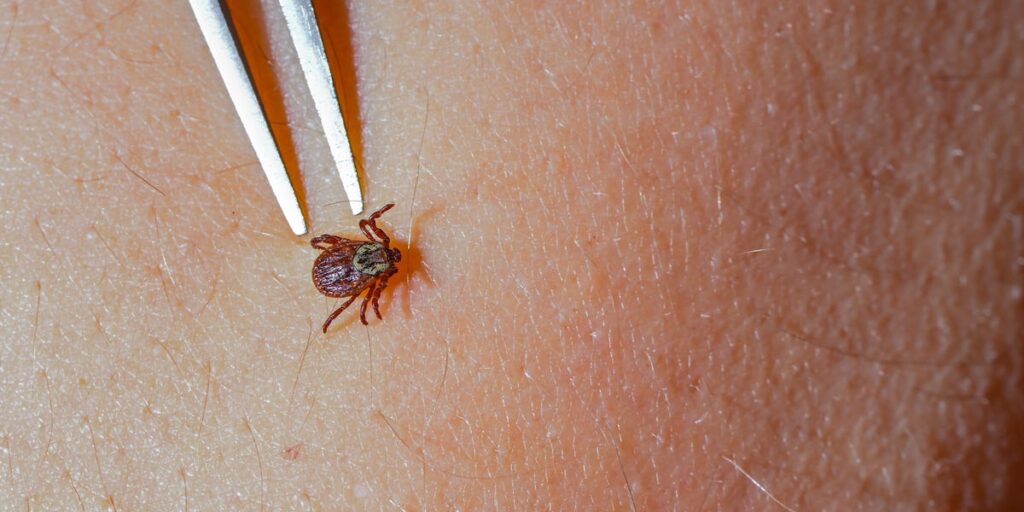
  • Use fine-tipped tweezers to grab the tick as close to the skin’s surface as possible. (If you don’t have any tweezers, a tissue or paper towel can also help you get a grip.)
  • Pull upward with steady pressure, but don’t twist or jerk the tick. That could cause the tick’s mouth-parts to break off and stay in your skin.
  • If the mouth-parts are still in your skin after the tick is removed, try to remove them with tweezers. If you can’t get them out easily, leave it alone and let your skin heal.
  • Wash your hands with soap and water.
  • Get rid of the tick by flushing it down the toilet, placing it in alcohol, or putting it in a sealed bag or container that’s wrapped tightly with tape.

How to treat a tick bite

After the tick is removed, the best way to treat a tick bite is to clean the area with soap and water or rubbing alcohol. If the bite becomes further inflamed or crusted, applying an antibiotic cream may help lower the risk of infection and tamp down lingering inflammation, says Dr. Goldenberg. Or, if your bite becomes itchy, try an anti-itch cream to reduce the urge to scratch and further irritate the area.

Just be aware that it may take a little while for your bite to fully clear up. “Bites can take as long as 30 days to heal,” Dr. Rodney says. And if you have signs of infection, like swelling, skin that’s hot to the touch, and crustiness, she recommends contacting your medical provider about next steps.

Signs of a tickborne illness

Ticks can carry a range of illnesses, and some have the potential to make you really sick. While the symptoms of each can vary, the CDC recommends being on the lookout for these general signs of a tickborne illness:

  • Fever
  • Chills
  • Muscle and joint aches
  • Headache
  • Fatigue
  • Rash

When to see a doctor for your tick bite

Keep tabs on the bite after a tick has bitten you. “If the area of the bite becomes red or swollen for days or you develop flu-like symptoms, this may be a sign of tick-related disease,” Dr. Rodney says. “You should call your doctor or visit the nearest emergency room.”

Common tick myths

There are a lot of myths about ticks and tick bites that have circulated for so long that it’s hard to know what’s true and false. Buss explains the most common ones:

  • Ticks fall from trees. Ticks don’t fly or jump. As a result “they stay pretty close to the ground,” Buss says. So, you should not expect a tick to fall from a tree and bite you. Instead, many ticks will do something called “questing,” where they sit on the top of grass or shrubs and wait to climb onto a host that brushes against them.
  • Ticks accidentally find a host. Ticks are surprisingly good at finding a meal. They can detect breath, body odor, heat, moisture, and vibrations, according to the CDC. Some can even recognize a shadow.
  • You should remove a tick with a match or petroleum jelly. A lot of online advice suggests that putting petroleum jelly, a hot match, or nail polish on a tick will cause them to detach from your skin. But the CDC stresses that this will likely agitate a tick and cause even more fluid to be injected from the tick into your skin.

What diseases could you get from a tick bite?

Like we mentioned, ticks can spread a range of potentially serious infections. These are tickborne illnesses to have on your radar in the U.S., per the CDC:

  • Alpha-gal syndrome
  • Anaplasmosis
  • Babesiosis
  • Bourbon virus
  • Colorado tick fever
  • Ehrlichiosis
  • Hard tick relapsing fever
  • Heartland virus
  • Lyme disease
  • Powassan virus
  • Rickettsia parkeri rickettsiosis
  • Rocky Mountain spotted fever
  • Soft tick relapsing fever
  • STARI
  • Tularemia
  • 364D rickettsiosis

How to prevent tick bites

In a perfect world, you’d avoid a tick bite in the first place. While that’s not always possible, there are a few steps you can take to lower your risk. The U.S. National Library of Medicine recommends taking certain precautions when you’re outdoors and after you get home.

When you’re in tick-prone areas like the woods or brushy spots, wear long pants and long sleeves. Pull your socks over the outside of your pants to keep ticks from crawling up your leg. It’s also a good idea to keep your shirt tucked into your pants to protect your torso.

If you can, wear light-colored clothes so that you can spot ticks easily, and spray your clothes with insect repellent before you head out. Frequent checks of your clothes and skin can be helpful, too.

Ticks can be tiny (sometimes no bigger than a poppy seed!) and easily missed, so it’s important to do a thorough body check after you’ve spent time outdoors. Be sure to look carefully under your arms, around your ears, inside your belly button, behind your knees, between your legs, and in your hair. “Checking yourself, kids, and pets can go a long way in minimizing contact with these critters,” says Dill.

Read the full article here

Share. Facebook Twitter Pinterest LinkedIn Telegram Email Copy Link

Related Articles

5 Best PEMF Mats for Pain Relief and Recovery, per Experts and Testing

August 14, 2026

Doctors Explain the Surprising Reason Your Nose Runs After Eating

August 14, 2026

9 Surprising Causes of Tongue Bumps, According to Dentists

August 14, 2026
Add A Comment
Leave A Reply Cancel Reply

Demo

Top News

Doctors Explain 10 Possible Reasons Your Hands Are Shaking

June 16, 2026

Dietitians Reveal Which Is a Better Breakfast

June 16, 2026

Amazon Prime Day Walking Pad Deals 2026: Save on Top-Rated Models

June 16, 2026

Doctors Explain 13 Possible Causes of Lower Back Pain

June 16, 2026

Don't Miss

9 Surprising Causes of Tongue Bumps, According to Dentists

August 14, 20265 Mins Read

4 min readOut of all possible aches and pains, injuries and sores in the mouth…

Scientists Find 3 Lifestyle Factors That May Delay Dementia by Up to 12 Years

August 14, 2026

The Number-1 Food Cardiologists Recommend to Lower Blood Pressure

August 14, 2026

Scientists Reveal 1 Supplement That May Improve Muscle Health

August 14, 2026
About Us
About Us

OMG Healthy is your one-stop website for the latest health, fitness and wellness news and guides, follow us now for the articles you love.

Facebook X (Twitter) Pinterest YouTube WhatsApp
Our Picks

What Does a Tick Bite Look Like?

August 14, 2026

Best Protein Bars for Energy, Cravings, and Muscle Support

August 14, 2026

5 Best PEMF Mats for Pain Relief and Recovery, per Experts and Testing

August 14, 2026
Most Popular

Amazon Prime Day Walking Pad Deals 2026: Save on Top-Rated Models

June 16, 2026

Doctors Explain 13 Possible Causes of Lower Back Pain

June 16, 2026

Which Should You Take? Magnesium Glycinate Vs. Citrate for Sleep

June 16, 2026
  • Home
  • Privacy Policy
  • Terms of use
  • Contact
2026 © Prices.com LLC. All Rights Reserved.

Type above and press Enter to search. Press Esc to cancel.