

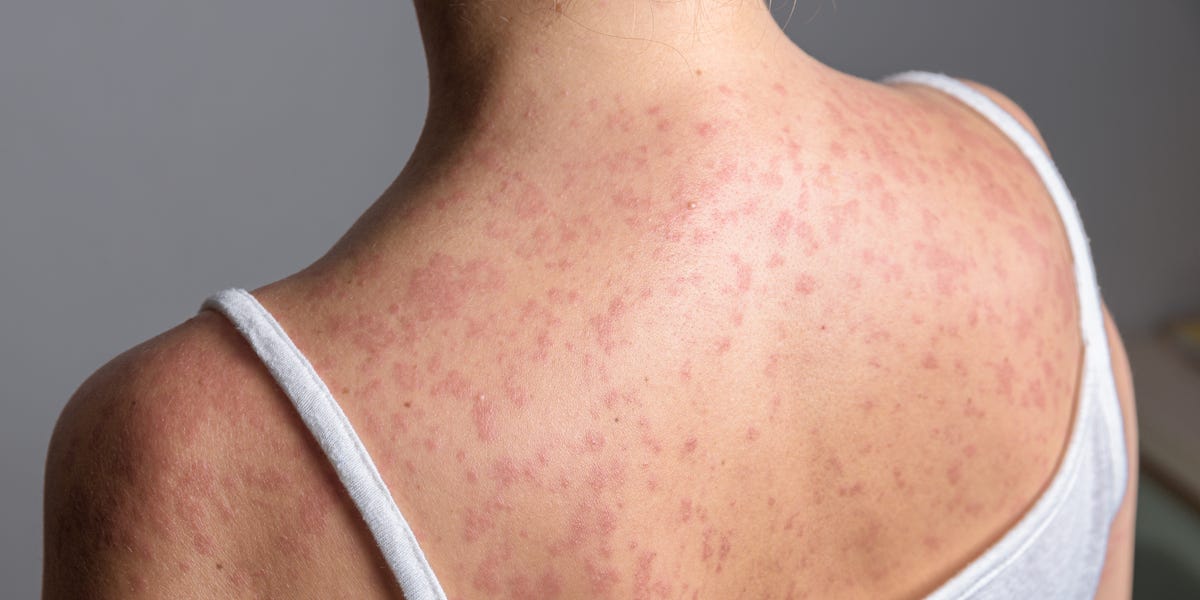
- The measles outbreak continues to grow in the U.S.
- Some groups are more vulnerable than others, according to doctors.
- The vaccine can quickly offer protection if you’re unvaccinated.
The measles situation in the U.S. continues to get worse, with 3,294 confirmed cases across 47 states and jurisdictions in 2026 alone, per data from the Centers for Disease Control and Prevention (CDC) that was updated on September 11. The vast majority of them have been associated with outbreaks—there have been 38 new ones reported this year, with Pennsylvania emerging as a hotbed for the highly contagious disease.
Health officials in the state shared on Wednesday that Pennsylvania has seen 731 cases; out of 67 counties, 38 have reported at least one case of the virus. Four people have died so far in the outbreak, and 141 have been hospitalized, according to the Pennsylvania Department of Health. Of those infected, four—or less than 1%—were vaccinated against the virus.
State public health officials have reportedly started the process to request emergency assistance from the CDC, per a report from Reuters. However, Pennsylvania Governor Josh Shapiro and U.S. Health Secretary Robert F. Kennedy Jr. have been in a public stand-off over whether the deaths reported in the state were due to measles or another cause.
Measles has dominated the news as cases creep up. But there has been a lot of public conversation over who is the most vulnerable to the virus right now. Infectious disease physicians say there’s a clear answer.
Meet the experts: William Schaffner, M.D., an infectious disease specialist and professor at the Vanderbilt University School of Medicine; Amesh A. Adalja, M.D., infectious disease expert and senior scholar at the Johns Hopkins Center for Health Security; Mark Hicar, M.D., Ph.D., chief of pediatric infectious diseases at the University at Buffalo Jacobs School of Medicine and Biomedical Sciences in New York
Who should be the most concerned about measles right now?
There are a few groups that should be especially cautious about measles right now, according to doctors. And it all comes down to immunity and vaccination status.
“Anyone with an infant under 12 months should be most concerned,” says Amesh A. Adalja, M.D., infectious disease expert and senior scholar at the Johns Hopkins Center for Health Security, who practices in Pennsylvania. “Those babies are too young for the routine first MMR dose and have limited protection against a virus.” (Two of Pennsylvania’s four measles-related deaths were infants, he points out.)
Unvaccinated pregnant people should also be concerned, both because they’re more vulnerable to serious complications of the virus and because they can’t receive the MMR during pregnancy, Dr. Adalja explains. That’s because the MMR is a live vaccine, so there is a potential risk that the weakened virus could cross the placenta and infect the fetus, says William Schaffner, M.D., an infectious disease specialist and professor at the Vanderbilt University School of Medicine.
People who are immunocompromised and unvaccinated are also at similar risk; they generally shouldn’t receive the MMR vaccine because their immune systems may not be able to respond properly. “Because the MMR vaccine is a live vaccine, the vaccine itself might make them sick,” Dr. Schaffner says.
Ultimately, “those who are not vaccinated or lacking prior infection should be concerned,” says Mark Hicar, M.D., Ph.D., chief of pediatric infectious diseases at the University at Buffalo Jacobs School of Medicine and Biomedical Sciences in New York.
Is there anyone who shouldn’t be concerned about measles right now?
One dose of the MMR vaccine is 93% effective against measles, while two doses—which has been standard since 1989—are 97% effective, according to the CDC. The MMR vaccine is recommended as part of the childhood vaccine schedule starting at 12 months.

Add Prevention as a preferred source in your Google search results.
Use your Google account to add this to your settings.

“As long as one is vaccinated or has had natural measles, they should generally not be worried,” Dr. Hicar says. Measles was once so prevalent that people born before 1957 are considered immune, he points out.
While the MMR vaccine is typically not recommended until 12 months, “in a location with an outbreak, children can be vaccinated down to six months of age and the second dose can be given earlier than pre-kindergarten to help protect children,” Dr. Hicar says.
The measles vaccine still isn’t perfect. “There are a few vaccinated people who can get ‘breakthrough infections,’ but the good news is that those infections are invariably much milder than if people had been completely susceptible,” Dr. Schaffner says.
Why are some people minimizing measles?
There’s been a lot of talk, both online and in public, about how measles isn’t that big of a deal. But doctors stress that measles is, in fact, very serious.
“This has been very frustrating for my colleagues in infectious diseases and public health,” Dr. Hicar says. “One contributor is that we have collectively forgotten how bad measles can be.”
Measles can lead to complications like pneumonia, brain inflammation called encephalitis, and even death. “Measles kills,” Dr. Hicar says.
“Even if it’s an uncomplicated infection, measles can make a child or adult miserable for a week and a half,” Dr. Schaffner says. In addition to a persistent cough, fever, and feeling poorly, the virus often causes light sensitivity so that patients want to stay in the dark, he says.
Measles also erases immunity to other infections in a phenomenon known as “immune amnesia,” Dr. Adalja says. That makes a patient “hypersusceptible” to other infections, including ones they’ve already been vaccinated against, he says.
“Measles was eliminated from this country for so long that most parents, and many clinicians, have never seen a child with measles pneumonia or measles-related brain inflammation,” Dr. Adalja says. “The disease is abstract to them.”
Doctors want the general public to keep this in mind.
If you’re not vaccinated against measles, it’s crucial to get the vaccine, Dr. Schaffner says. And, if you’re unsure about your status, it’s important to get the vaccine as well.
“If you can’t confirm two MMR doses, get vaccinated,” Dr. Adalja says. “An extra dose does no harm if you’re already immune.” One dose of the MMR vaccine can prevent measles within 72 hours, Dr. Adalja says.
If you, a family member, or other loved one develop symptoms of measles, Dr. Adalja says it’s important to take precautions to protect others while seeking care. “Call your doctor’s office or the ER before walking in,” he says. “Measles is airborne and contagious before the rash appears, and a heads-up lets staff protect their waiting room.”
Read the full article here