

I spent most of my life as a dancer, with several hours a week in the studio serving as my primary mode of exercise. But since my dance “career” came to an abrupt halt a few years ago, I’m always looking for ways to rebuild the strength and flexibility I lost in what felt like the blink of an eye. A regular Pilates practice and return to the studio via low-stakes open-level ballet classes have brought me a long way in the past two years, but what would happen to my body if I actually committed to doing core exercises daily? I tried it in the name of science to find out.
Meet the experts: Patricia Greaves, C.P.T., certified fitness trainer, precision nutrition coach, and founder of StrongHer Personal Training; Anna Di, D.C., C.E.S., corrective exercise specialist, chiropractor, and owner of UNITY Chiropractic Wellness in New York, NY.
Core strength gets a lot of buzz in fitness circles, but what actually makes it so important? Patricia Greaves, C.P.T., a certified fitness trainer, precision nutrition coach, and founder of StrongHer Personal Training, puts it perfectly. “A strong core is the foundation of your body’s strength and stability. Think of it like the trunk of a tree,” she explains. “When you train your core regularly, you strengthen the muscles that support your body’s frame and improve posture, coordination, and balance. Core exercises support your everyday movements that involve standing, lifting, bending, walking, or climbing stairs.”
So was my body magically transformed after two weeks of daily core exercises? Here’s what happened.
First, what is a core exercise?
Before we get to the core of it (pun intended), let’s dispel some myths. What immediately comes to mind for many of us as classic core exercises—think crunches, sit-ups, and Russian twists—are only scratching the surface. So what does it actually take to strengthen your core? “I always tell patients that core strength is not about how well you can crunch your body forward. It is about how strong you are in a neutral position,” says Anna Di, D.C., C.E.S., a corrective exercise specialist, chiropractor, and owner of UNITY Chiropractic Wellness in New York, NY.
Maintaining a neutral spine position looks a little different for everyone, but it essentially means that your back isn’t excessively rounded forward or arched back, even as you move through an exercise. “A neutral spine is the safest position to be doing things in because there is an even distribution of weight on your discs, and you’re not straining your ligaments holding your body up,” Di explains.
Another common mistake is thinking that core strength starts and ends with ab work. “Some people think that doing endless crunches is necessary to strengthen your core or that attaining a ‘six-pack’ is the result of a strong core,” says Greaves. In reality, “your core involves more than your abs; it includes all the muscles from below your shoulder down to your pelvis. If a leaner, tighter midsection is desired, nutrition also needs to be considered alongside core-strengthening exercises.”
Finally, it isn’t just the exercises you do that build core strength, but how you do them. According to Greaves, another common mistake “is rushing through your reps instead of controlling the movement, breathing through the exercise, and creating a mind-body connection.”
Based on recommendations from Greaves and Di, I settled on the following exercises for my daily core routine during this experiment, which took me about 15 minutes in total:
- Dead bugs (alternating 10 reps per side): “This move helps you build deep core stability with control using the mind-muscle connection,” Greaves explains.
- Glute bridges (three sets of 10 reps, with a 30-second rest in between each set): “I love this exercise because it not only supports your core muscles, but also strengthens your pelvic floor and glute muscles,” Greaves says.
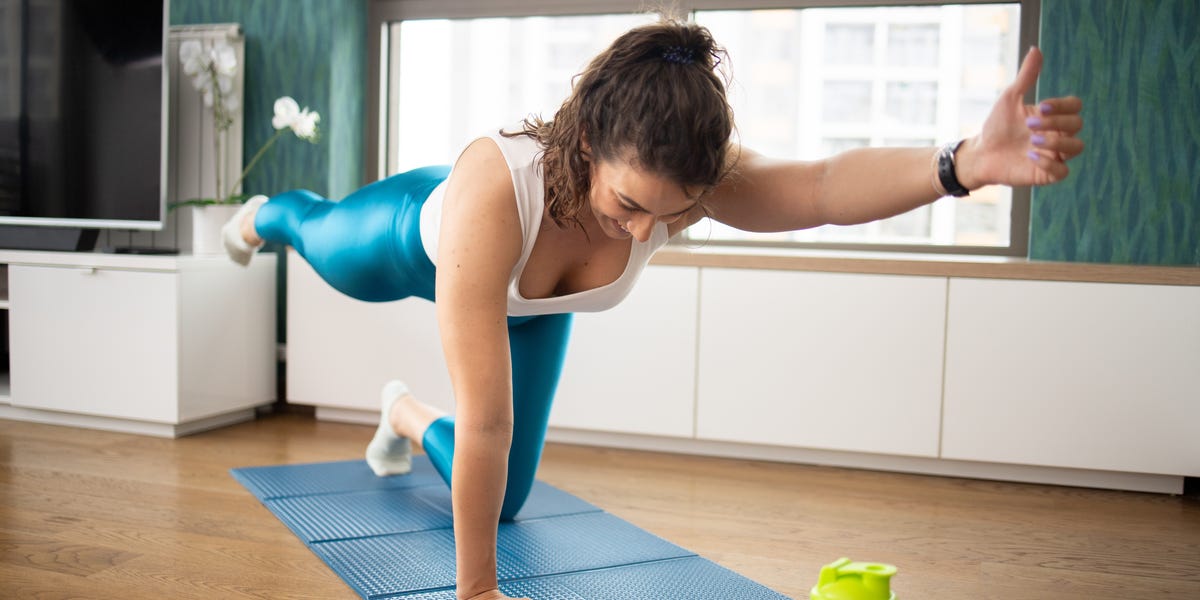
- Bird dogs (alternating 10 reps per side): “Bird dogs teach you how to maintain that [neutral] position while your arms and legs are moving, which is how your body actually functions in real life,” according to Di.
- Forearm planks (three 30 to 45-second planks, with a 30-second rest in between each): “Planks teach you how to hold that neutral position and build strength there,” Di explains.
What happened when I did core exercises daily
At this point, no one should be surprised to learn that I didn’t suddenly grow a six-pack in my two weeks of core exercises. But I did notice some subtle yet significant changes, the most obvious being that the core routine felt easier and easier as my experiment went on.
The results were clear in how my forearm planks progressed throughout the two weeks. Per Greaves’ suggestion, I started with a 30-second plank, which was doable but challenging. By a few days in, upping my planks to 45 seconds each felt natural. The same went for the other exercises in my routine; I felt my limits expanding as the days went on, and adding more reps didn’t feel like much of a struggle.
While I can’t say I observed a major difference in my posture—a long day at the office still always ends with me slouching à la question mark, alas—I did find the daily movement curbed some of the stiffness in my back. I have scoliosis, and I’ll be the first to admit that I often slack on the back stretches recommended by my orthopedist, a bad habit that doesn’t do my lower back pain any favors (got to love the consequences of my own actions).
Weekly Pilates has made me more generally aware of how to keep my spine in a neutral position and avoid flaring my ribs, but the daily core exercises took things a step further. Working on my core more often made me subconsciously focus more on my spine position as I went about my day, and I found myself complaining less about back pain.
Benefits of doing core exercises
As my experiment reveals, it only takes two to three weeks of consistent core exercises (at least three times a week) for most people to start to feel the benefits of a stronger core.
Improved balance, posture, and stability
Strengthening your core has ripple effects that impact your entire body. “Within a couple of weeks, you will feel your posture improve, and be able to stand and sit straighter without thinking about it,” Di explains. “You will also become more aware of how to brace your core during daily activities.”
Better mobility
You’d be surprised by how many mobility issues in other areas of your body can be traced back to poor core strength. “Your core needs to feel strong before you do anything else. Sometimes, even hesitation/weakness in moving your arms or legs might come from a weak core,” according to Di. “Your core balances your body, and your body will not be willing to move if it doesn’t feel balanced. There is a saying: ‘You cannot fire a cannon off a canoe,’ in that if your core/base does not feel strong, supported, and anchored, you might not be able to do a lot of movements.”
Less back pain
It’s a common misconception that core exercises can worsen lower back pain, but that’s not actually the case. “In reality, it is often the opposite, because if your body does not have the strength or endurance to handle your daily activities, then those same activities will keep irritating your system,” Di explains. “If you feel pain carrying a 20-pound backpack, that doesn’t mean you should never carry a 20-pound backpack. It means you should work on your neutral spine activation, strength, and endurance by doing core exercises. Then, start with lighter backpacks, gradually working your way up to 20lbs. Then eventually you won’t feel any pain doing that.”
Maintaining strength as we age
As we age, we may lose some of the strength we once had when we were younger. While we all can benefit from rebuilding that strength, Greaves especially recommends core-strengthening exercises for women “who have lost strength in their midsection due to childbirth, menopause, or a sedentary lifestyle.”
Should anyone avoid core exercises?
Anyone can benefit from strengthening their core, but some people should proceed with caution. Both Greaves and Di stress the importance of proper form and listening to your body as you exercise. “It’s important to start at a level that’s comfortable for you to perform each move with correct form to feel results and not experience injury,” Greaves explains.
“If you have disc issues, you may notice symptoms like pain that feels different from normal soreness, weakness in certain movements, or numbness and tingling that travels down the leg,” Di adds. “Sometimes it is very specific, like only behind the knee, in the foot, or in the glute. If you have those symptoms, exercises that round your spine should be avoided.”
Di also cautions against intense core exercises if you have spinal stenosis, “which you can think of as a narrowing of the tunnel where your spinal cord runs,” she says. For people with this condition, “backward bending exercises may need to be limited or modified.”
In short, if you’re dealing with a back fracture or other spinal condition, confirm which moves you’re cleared for with a professional first.
The bottom line
If you think daily core exercises will instantly flatten your stomach or define your abs, you may need to adjust your expectations. That said, I did reap some significant benefits from just two weeks of focusing more seriously on my core strength, so much so that I plan to keep the habit up at a more sustainable three days a week long-term. Not only that, but the pros of a stronger core bled into multiple aspects of my daily life—not just my performance in the gym or studio. I can safely say that all the hype about core strength is more than just, well, hype.
Read the full article here