







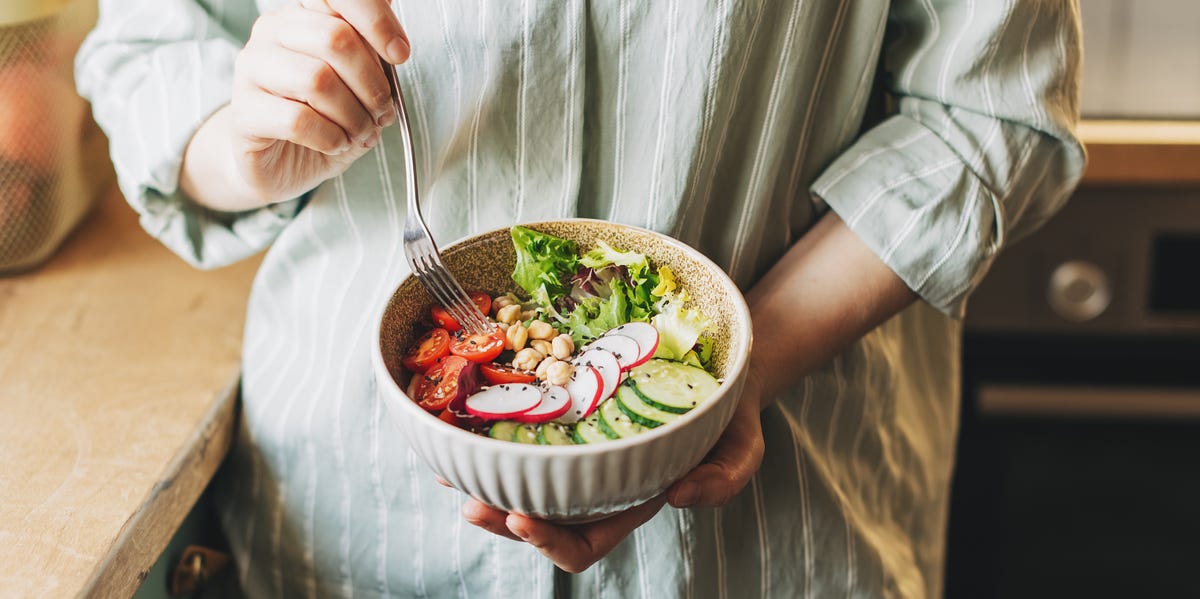
If you’ve recently added more beans, berries, or whole grains to your plate, your gut probably let you know. Maybe you noticed you were more regular. Or maybe, if you jumped in too fast, you dealt with a day or two of gas. That’s all normal. Eating more fiber is one of the simplest diet shifts you can make, and your digestive system tends to respond quickly and noticeably. As a registered dietitian, here’s what actually happens to your gut when you eat more fiber, starting with what you’ll feel first and then moving into the science underneath it.
What happens to your gut when you eat more fiber?
You may poop more regularly
The most common change people notice is simple: they go more often, and more predictably. That’s largely thanks to insoluble fiber, which is the kind found in whole grains, wheat bran, nuts, and the skins of many fruits and vegetables.
Insoluble fiber doesn’t dissolve in water. Instead, it adds bulk to your stool and helps move waste through your intestines more efficiently. A bulkier stool gently stimulates the muscles of your colon, which can help speed up “transit time,” meaning how long it takes food to travel through your system. For anyone who’s dealt with sluggish, irregular bathroom trips, more fiber is often one of the first and most effective steps to try.
Stools may get softer and easier to pass
Regularity is one thing. Comfort is another. This is where soluble fiber earns its keep. You’ll find it in oats, beans, lentils, apples, citrus, and psyllium.
Soluble fiber dissolves in water and forms a gel-like substance in your gut. That gel helps hold water in your stool, keeping it softer and easier to pass. If you’ve ever struggled with hard, dry, pebble-like stools, this is exactly the kind of fiber that can help, provided you’re also drinking enough fluid. Fiber and water work as a team here. Without adequate water, more fiber can actually make things feel worse, not better, so keep your glass close by.
You might get gassy or bloated at first
Let’s be honest about the less glamorous part. When you ramp up fiber, especially quickly, you may notice more gas, bloating, or mild cramping. It’s frustrating, but it’s usually temporary and not a sign that something is wrong.
Here’s why it happens: some fibers are fermented by the bacteria in your large intestine, and that fermentation produces gas as a byproduct. When your gut isn’t used to a higher fiber load, the adjustment can feel a little bumpy. The good news is that your digestive system typically adapts over a few days to a few weeks as your gut bacteria settle into the new normal. Going slowly makes a real difference, which we’ll get to below.
Your gut microbiome will thank you
Beyond what you can feel, fiber is doing quieter work further down. Much of the fiber you eat isn’t broken down by your body directly. Instead, it travels to your large intestine, where it becomes food for the trillions of bacteria living there.

Add Prevention as a preferred source in your Google search results.
Use your Google account to add this to your settings.


When those bacteria ferment fiber, they produce compounds called short-chain fatty acids, mainly acetate, propionate, and butyrate. Butyrate is especially notable because it serves as a preferred fuel source for the cells lining your colon, helping keep that tissue healthy. Research also suggests that diets richer in fiber are associated with more diverse gut bacteria, and that greater diversity tends to reflect a more resilient gut environment.
In short, the fiber on your plate helps feed a system that does more than just move waste along.
Why does fiber matter for long-term health?
Fiber’s appeal goes beyond daily comfort. A number of studies link higher fiber intake with a lower risk of several conditions that tend to matter more as we age, though it’s worth noting these are associations, not guarantees.
Research associates greater fiber consumption with a reduced risk of colorectal cancer, while lower-fiber diets are linked with higher risk. Fiber intake has also been connected to better outcomes in type 2 diabetes and to more stable blood sugar, partly because soluble fiber can slow how quickly sugar is absorbed. People who eat more fiber also tend to gain less weight over time, likely because fiber-rich foods are more filling. None of this makes fiber a cure-all. But the pattern across the research is consistent enough that eating more fiber is a sensible, low-risk habit for long-term health.
How to eat more fiber without the discomfort
If you want the benefits without the bloat, how you add fiber matters as much as how much you add. A few simple habits smooth the transition:
- Go slow. Add a little more fiber every few days rather than overhauling your diet overnight. This gives your gut time to adjust and keeps gas to a minimum.
- Drink more water. Fiber needs fluid to do its job, especially the kind that softens and bulks up stool.
- Spread it out. Include fiber-rich foods across your meals instead of front-loading one big serving.
- Mix it up. Vegetables, fruit, beans, whole grains, nuts, and seeds each offer different types of fiber, so variety supports both regularity and a healthier gut.
If you have a digestive condition such as irritable bowel syndrome, certain fibers may bother you more than others, so it’s worth talking with your doctor or a registered dietitian before making big changes.
The bottom line
Eating more fiber usually shows up first in the bathroom, with more regular, easier-to-pass bowel movements. Beneath the surface, it’s also feeding the bacteria that support your gut and, over time, may contribute to better long-term health. Few habits offer so much for so little effort. Just remember to start slow and drink your water!
Read the full article here


