

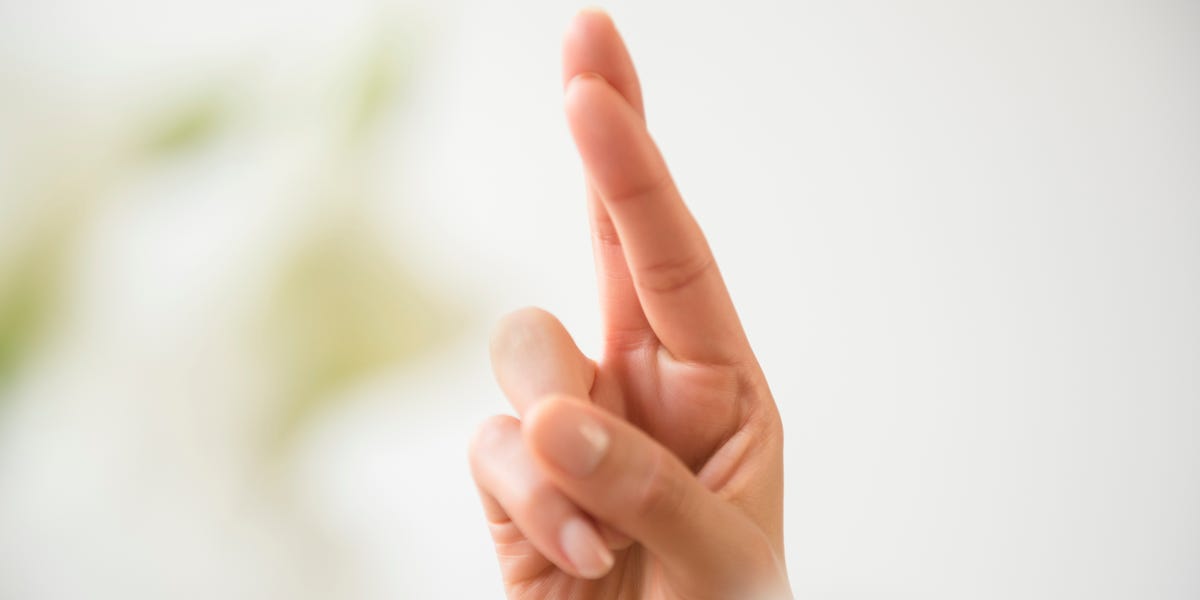
- On TikTok, the latest health trend involves creators doing a specific pinky exercise.
- Creators claim the “pinky time” exercise boosts brain health and prevents dementia.
- Here, neurologists explain whether the trend has any scientific backing.
If you’re looking to implement some simple habits for better brain health into your life, wiggling your pinky probably isn’t the first thing that comes to mind. But many TikTok creators beg to differ. In fact, the claim that a very specific and seemingly inconsequential finger exercise could boost brain health and even prevent cognitive decline is the basis of the latest wellness trend to be popularized on the app: “Pinky time.”
Meet the experts: David Perlmutter, M.D., F.A.C.N., A.B.I.H.M., board-certified neurologist and author of Brain Defenders; Jeremy M. Liff, M.D., board-certified neurologist in New York City
But as with all health trends, “pinky time” has attracted plenty of skeptics. Is there actually any scientific basis behind wiggling your pinky for better brain health? Ahead, neurologists settle the debate once and for all.
What is the “pinky time” TikTok trend?
First of all, what exactly is the “pinky time” trend? Essentially, creators on the app are posting videos of themselves doing a specific finger exercise and—unlike what the name suggests—it involves more than just your pinky. To demonstrate, creators cross their index and middle fingers, pinch together their thumb and ring finger, and wiggle their pinky up and down while holding that position for 30 seconds on each hand.
The idea is that being able to do the exercise on both hands is an indicator of good brain health, and that doing it regularly may even prevent dementia and other symptoms of cognitive decline. Some creators even go so far as to claim the exercise can “protect against Alzheimer’s.”
Is wiggling your pinky an indicator of brain health?
So, is there any merit to the “pinky time” trend? Neurologists say yes and no. “I appreciate anything that gets people thinking about protecting their brain. If a simple hand exercise motivates someone to become more interested in brain health, that’s certainly a positive,” says David Perlmutter, M.D., F.A.C.N., A.B.I.H.M., a board-certified neurologist. “But it’s important to distinguish between something that’s entertaining or intriguing and what’s actually been shown to reduce the risk of dementia.”
The specific “pinky time” exercise hasn’t been extensively researched, but the idea that exercises like it could be linked—if subtly—with brain health isn’t a new one. “It’s true that repetitive fine finger movements can help us rewire our brain in a certain way to make things better,” explains Jeremy M. Liff, M.D., a board-certified neurologist in New York City. He says it speaks to two common principles of neuroscience: “Neurons that fire together wire together” and “use it or lose it.” Essentially, “if you repeat tasks (including fine finger movements) over and over, you can kind of prune and strengthen certain neural connections.”
That being said, both Dr. Liff and Dr. Perlmutter caution against taking TikTok’s “pinky time” claims at face value. “There’s a small grain of truth here, but, as is so often the case, it’s been grossly overstated on social media,” Dr. Perlmutter explains. “Hand dexterity, finger coordination, grip strength, and fine motor control all depend on healthy communication between the brain, spinal cord, nerves, and muscles. Studies have shown that poorer hand function and weaker grip strength are sometimes associated with an increased risk of cognitive decline. But that’s very different from saying that practicing a specific finger movement prevents dementia.”
Can “pinky time” prevent dementia?
Dr. Liff puts it plainly: “No, it cannot prevent dementia [or Alzheimer’s]. We currently still don’t even have a good grasp on why it is that people develop Alzheimer’s. We have a much better grasp on what happens in their brain, but we don’t exactly know why some people suffer from it, and others don’t.”
Dr. Liff does note that a reduction in fine finger movements can be a somewhat common consequence of having a cognitive disease. “But just practicing this, without any other context, is not going to help your brain health,” he reiterates.
Dr. Perlmutter agrees. “At this point, there is no credible evidence that performing viral finger or pinky exercises reduces the risk of Alzheimer’s disease or slows cognitive decline,” he says. “These movements may reflect aspects of neurological function, but they have not been validated as screening tools or treatments. In other words, they’re interesting demonstrations of coordination, not proven brain therapies.”
What does it mean if you can’t do the “pinky time” exercise?
If you aren’t able to do the “pinky time” exercise, should you be concerned? Probably not. “Many perfectly healthy people simply have differences in anatomy, tendon connections, flexibility, or nerve control that make certain isolated finger movements difficult,” Dr. Perlmutter explains. “Some people have been unable to perform these movements their entire lives.”
“It’s way too general to make any specific diagnosis or conclusion about what your issue is,” Dr. Liff adds. “Because if you think about what it takes to coordinate the muscles of your finger, it takes a lot of different things starting from the top of your brain all the way down to the muscles in your finger, and there are about a million things in between. So you can’t say definitively.”
Still, Dr. Perlmutter points out that there are some situations in which a loss of movement in your fingers could signal something bigger. “If someone notices a new loss of finger coordination, weakness, numbness, or declining dexterity—particularly if it develops suddenly or progressively—that deserves medical evaluation because it could reflect a neurological or orthopedic condition unrelated to dementia.”
What can you do to boost brain health?
While “pinky time” probably isn’t the secret to better brain health, there are several cognitive-boosting habits you can adopt that keep your brain engaged throughout the day.
- Go on a walk. A brisk, 10-minute walk, especially after meals, is great for your brain, per Dr. Perlmutter. “Physical activity is one of the most powerful ways to improve blood flow to the brain and support healthy metabolism,” he says.
- Learn something new. Even after you’ve left school, continuing to challenge yourself is key. Dr. Perlmutter suggests keeping it simple, “like a few new words in another language, a musical phrase, or even taking a different route on your daily walk. Novelty helps strengthen brain networks.”
- Cultivate your social network. “A meaningful conversation or social interaction may be one of the most underappreciated brain health strategies we have, and strong social connections are consistently associated with healthier cognitive aging,” Dr. Perlmutter explains. “For people who live the longest and have the best brain health, the only thing we do know for sure is that they have the best social networks,” Dr. Liff adds. “Meeting actual people in person: Making eye contact, talking to people, getting out, laughing with people. That’s the best thing you could do.”
- Get some shut-eye. “During deep sleep, the brain clears metabolic waste products and restores itself,” Dr. Perlmutter explains. “You simply can’t out-exercise or out-supplement chronically poor sleep.”
The bottom line
Long story short, you shouldn’t go out of your way to fit “pinky time” into your schedule. While hand dexterity and coordination aren’t completely isolated from brain health, they also aren’t likely to make a meaningful difference on their own. Dr. Liff also points out that the “pinky time” exercise is far from the only way to practice hand mobility. “There are other things you can do in your day that involve things like this, like practicing an instrument or playing a sport, that aren’t just isolated tasks.”
Still, Dr. Perlmutter maintains that hand exercises can’t single-handedly (pun intended) protect your brain. “The evidence is overwhelmingly clear that the most powerful ways to protect the brain are much more comprehensive,” and include the physical, mental, and social activities listed above. “These lifestyle choices influence inflammation, mitochondrial function, and the activity of the brain’s immune cells, the microglia, which are recognized as central players in Alzheimer’s disease and other forms of brain degeneration. So while these hand exercises are harmless and may even be fun, they shouldn’t distract us from the interventions that have been repeatedly shown to make a meaningful difference.”
Read the full article here