

When Maria Shriver’s father, Sargent Shriver, was diagnosed with Alzheimer’s disease over two decades ago, she had more questions than answers. “This was the most intelligent human being I had ever met,” she said of her late father, a former U.S. ambassador to France, during a panel with Women’s Health Executive Editor Abigail Cuffey at the Women’s Health Lab. “So, the idea that this brain had come up with all of these things and now couldn’t decide what a fork was, or who I was, was extraordinary to me. I approached it like a journalist and said: ‘What is this? What is this thing called Alzheimer’s? Where does it start? How does it happen to a brain like that?’”
That line of questioning ultimately led the former First Lady of California to a sobering reality: “Two-thirds of [people who get diagnosed with Alzheimer’s] are women,” she said. “And since we have done no research on women, we have no idea why that is.” Shriver later continued the conversation with Prevention to share exactly what she’s doing to change that as the founder of the Women’s Alzheimer’s Movement at Cleveland Clinic—the first and only Alzheimer’s prevention organization designed specifically for women.
“As someone who has spent their life in media, I’m a storyteller at heart. So I always look at what [the story is] that I’m trying to tell. What is the story I’m being told?… Is it accurate? If not, where are the holes in the story? What should the story be?” she tells me. “The women’s health story has changed dramatically in the last couple of years…[Now,] how do we continue to reframe that story in a way that includes the brain?”
Shriver believes it starts with early detection, and that means taking steps to protect your brain health during every chapter of life. “You don’t just wake up to an aging brain…It happens over time,” she says, emphasizing the changes the brain goes through at every stage, from in utero to puberty to pregnancy to menopause and beyond. “It’s an evolving organ, [but it] controls everything. And without it, you’re nothing.”

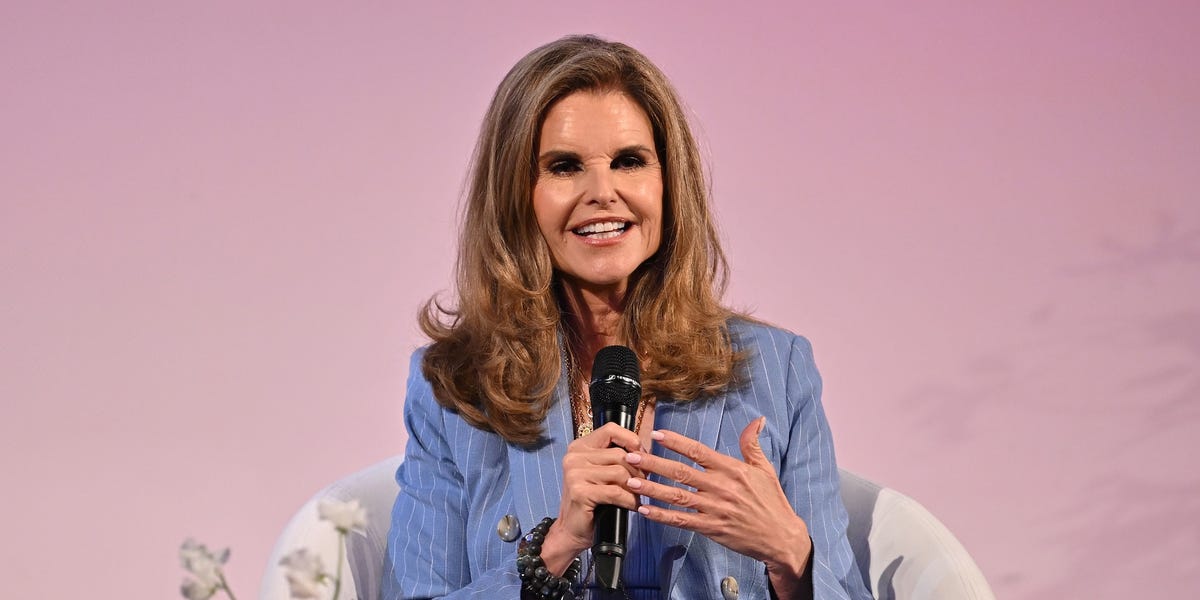
Maria Shriver in conversation with Abigail Cuffey at the Women’s Health Lab.
That speaks to one of the central misunderstandings about Alzheimer’s disease that prevents many people from getting an early diagnosis, according to Beth Battaglino, R.N., C.E.O. of HealthyWomen. “I think the biggest misconception is that Alzheimer’s disease is an older person’s disease when it’s not,” she tells me. “Normal aging may involve occasionally forgetting names or appointments, maybe remembering them later. But early Alzheimer’s disease typically involves persistent changes that interfere with everyday functioning…and Alzheimer’s is not just memory loss. Early symptoms can also include changes in judgment, language, mood, planning, or even problem-solving.”
Understanding that distinction is key to catching Alzheimer’s early, but more research reveals that you don’t have to wait for symptoms to manifest to take action. “Alzheimer’s disease research is continuing to expand our understanding of the disease in important ways, including what may be possible before symptoms appear,” explains Jennifer Oleksiw, Group Vice President and U.S. Neuroscience and Global Commercial Innovation Officer of Eli Lilly and Company, with which Shriver has partnered in her brain health advocacy. “At Lilly, we’re studying the earliest stages of Alzheimer’s disease and exploring whether intervention before symptoms develop may help reduce the risk of progression. Knowledge about brain health and risk factors can help people have more informed conversations with their doctors and may support earlier detection, accurate diagnosis, and more personalized care planning.”
Oleksiw encourages adults over 55 years old to proactively speak with their doctors about preventative cognitive assessments and “healthy habits that may support lifelong brain health.” But Shriver urges women to seize control of their brain health even earlier. “[It’s important to tell women that] their health is critical,” Shriver says. “[If they] want to age with strength, independence, and a viable brain, they have to make choices as young women [to get that] end result.”
Battaglino agrees. “Many people dismiss cognitive concerns because they think nothing can be done. And that’s the furthest thing from the truth right now. In reality, early evaluation can identify treatable issues and help people access support earlier,” she says. “When families and communities speak openly about brain health, people are more likely to recognize symptoms earlier and seek support sooner.”
Battaglino encourages people not to give in to the fear that might hinder them from seeking help, and instead focus on how getting answers could be empowering. “There’s so much research being done right now in the brain health space, and the fact that they can actually test for Alzheimer’s now is exciting in a way, right? Because now that we know earlier, it gives people the time and the opportunity to map out the rest of their lives,” she says. “No one wants a diagnosis of Alzheimer’s. No one wants a diagnosis of cancer. But once you have that diagnosis, you can understand that there are options, and actually [having] a healthcare team that can help navigate those options with you is important because it does give you back time.”
As for Shriver, when she looks to the future, she hopes preventative brain health care will be normalized to the point that seeking support won’t feel like such a big step. “I’m hopeful that when women go in [to the doctor], when they think about their health, they don’t just think [about getting] a mammogram or a pap smear, but they think of a cognitive assessment, too,” she says.
In the meantime, Shriver urges women to take matters into their own hands. “Some of this is preventable. It’s not just inevitable, and [you don’t have to sit back] and wait for it to happen,” she says. “You can do things today that will help you tomorrow. And that’s exciting, [or] at least, empowering. So, I’m trying to pull every lever that’s available to me. I don’t know if it’s going to help me or work for me. But [I know] that if I get Alzheimer’s [or] dementia, it won’t be because I did nothing.”
The 3rd annual Women’s Health Lab was hosted by Hearst Magazines in partnership with Northwell’s Katz Institute for Women’s Health. Lilly served as title sponsor, with additional sponsors including Altra, Bayer, Boehringer Ingelheim, Ipsen, L’Oreal Paris, Organic Valley, and WaterWipes.
Maria Shriver attended the Women’s Health Lab on behalf of Lilly.
To learn more about Alzheimer’s Disease, visit ThisIsAlz.com.
Read the full article here