

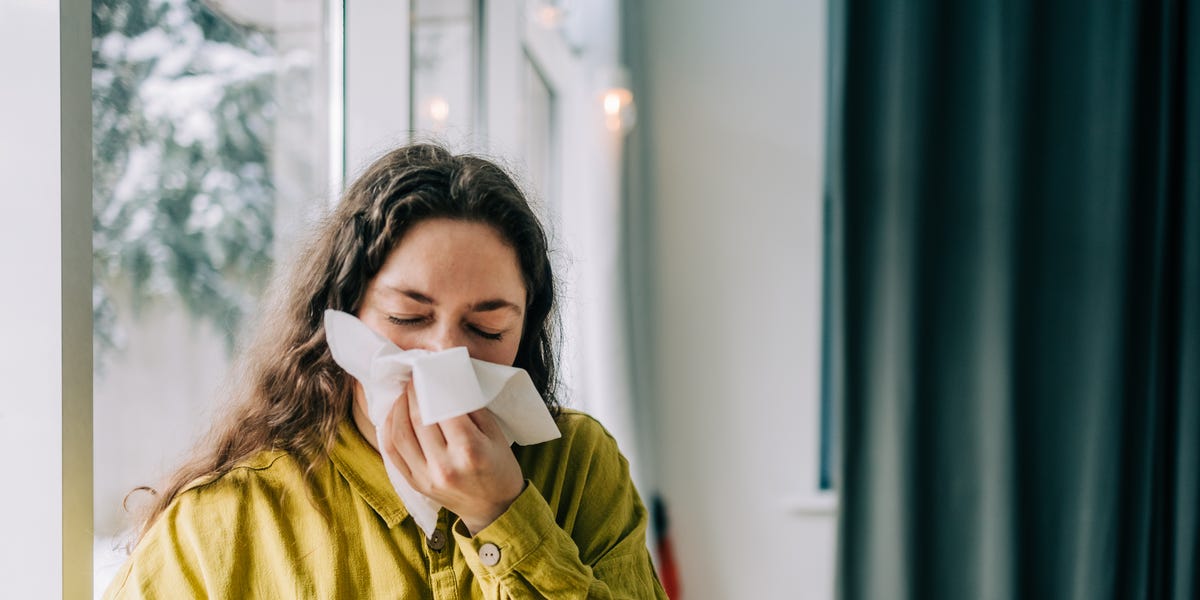
- New research suggests that you should “feed” a cold.
- Getting in enough nutrition boosts the activity of T cells, the “soldiers” of the immune system.
- Doctors say this may apply to vaccines and cancer care, too.
Struggling with a cold or respiratory virus can make food feel less appealing than usual. But new research suggests that the old wives’ tale of “feeding a cold” may be on to something.
The study, which was published in the journal Nature, discovered that your body’s T cells—considered the “soldiers” of the immune system—respond better to a threat when you’ve eaten something.
For the study, researchers analyzed data from humans and mice. For the human part of the study, the researchers drew blood from people before their first meal of the day and again after six hours. (During that time frame, people could eat whatever they wanted.)
When the researchers analyzed T cells in the participants’ blood, they discovered that these cells were better able to use sugars, and had more fats and more mitochondria—which produce energy for cells—after people had eaten compared to when they hadn’t eaten. As a result, the T cells were able to respond to threats like pathogens when people had eaten compared to when they hadn’t.
The mice experiments found that the T cells were able to thrive and provide protection against invaders when the mice had eaten.
“When you get sick, you have a tendency not to eat,” says Greg M. Delgoffe, Ph.D., study co-author and professor in the Department of Immunology at University of Pittsburgh. “That may be a trick that the virus or whatever pathogen is playing on you to get you to avoid eating.” But Delgoffe stresses that the immune system needs energy from food. “It’s important to make sure that you are supporting that immune system,” he says.
Meet the experts: Greg M. Delgoffe, Ph.D., study co-author and professor in the Department of Immunology at University of Pittsburgh; Thomas Russo, M.D., professor and chief of infectious disease at the University at Buffalo in New York; Amesh A. Adalja, M.D., a senior scholar at the Johns Hopkins Center for Health Security
Why might feeding a cold be important, and what does this look like in real life? Here’s the deal.
Why might feeding a cold help?
There are a few possible things behind this. On a basic level, food provides energy that can then fuel your body’s—and your immune system’s—ability to work well. “Eating may increase the availability of nutrients that are conducive to T cell function,” says Amesh A. Adalja, M.D., a senior scholar at the Johns Hopkins Center for Health Security.
Delgoffe points out that your immune system “is just waiting” most of the time to see if a foreign invader or abnormal cell that may be cancerous will surface. “When it finally does see it, it has a big job ahead of it—and it has to inform T cells,” Delgoffe says.
When the immune system springs into action, it’s a “huge energetic demand,” Delgoffe explains. “The presence of nutrients can actually help tell the T cells what to do,” he says.
Does this mean you should ‘starve’ a fever?
Definitely not. While you may not feel like eating when you have a fever, Delgoffe says there’s no value in starving yourself while dealing with a fever-causing illness.
“When you have a huge metabolic demand on your immune system, it will take calories and utilize quite a lot of your resources to find and eliminate an infection,” he says. “If you’re feeling ill, don’t just sit around and not eat.”
Thomas Russo, M.D., professor and chief of infectious disease at the University at Buffalo in New York, agrees. “Not starving yourself—under any circumstances—is best,” he says.
How much will feeding a cold help?
It’s hard to say at this point. The study didn’t find that being well-nourished will help you get rid of a cold any faster or ease symptoms of a cold. Instead, it found that T cells seem to work better when a person has eaten. It also didn’t dive into what kinds of foods are most supportive of T cell function.
“If someone has an infection or they get vaccinated, does the timing of a meal help? We’re not sure at this point,” Dr. Russo says. “In the short-term, I would recommend eating a meal when you’re sick if you feel up for it.” Dr. Adalja agrees. “When one is sick, it is important to make sure one is achieving adequate caloric intake,” he says.
Delgoffe echoes that. “The No.1 takeaway is that your immune system is very powerful and it needs energy when you get sick,” he says. “Maintaining a quality, balanced diet is important.”
From here, Delgoffe says the research team is looking into the role of diet to support immune response, whether it’s after getting a vaccine or during cancer care. “The sky’s the limit,” he says. “We’re super excited about this.”
Read the full article here