

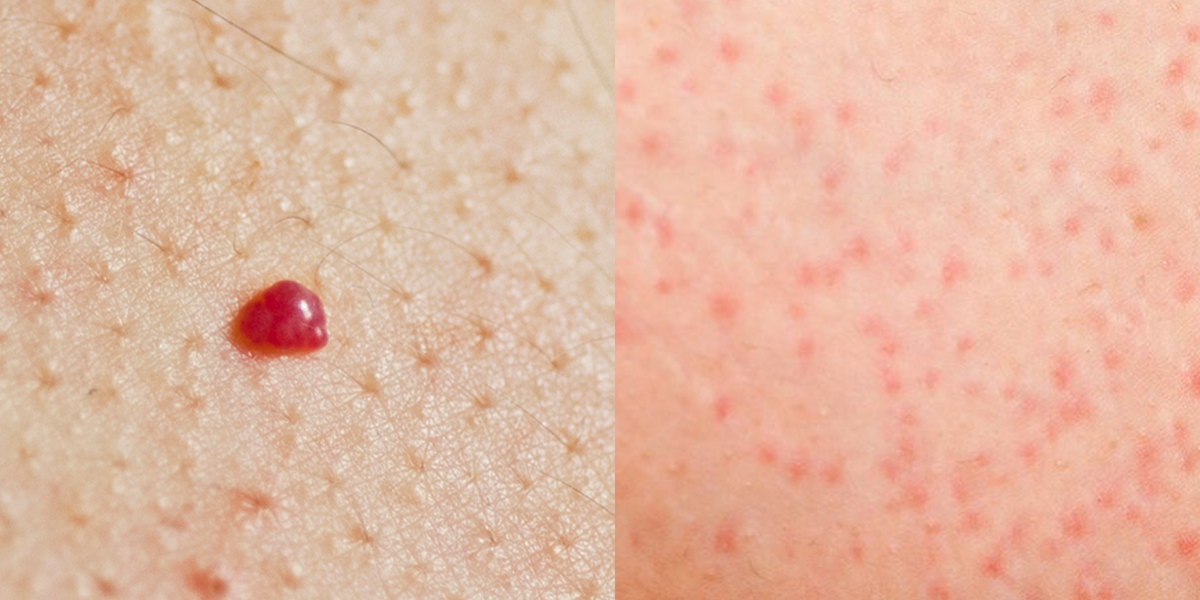
If you’re doing regular skin checks, you’re bound to come across a new spot here and there. But knowing what the spot is and whether it’s potentially concerning is important for your overall skin health.
As a whole, red, pink, and brown spots fall under the range of normal, according to Ife J. Rodney, M.D., F.A.A.D., founding director of Eternal Dermatology + Aesthetics. But changing spots are worth flagging to your healthcare provider, including any other spots you’re unsure about, Dr. Rodney says.
Meet the experts: Ife J. Rodney, M.D., F.A.A.D., founding director of Eternal Dermatology + Aesthetics; Gary Goldenberg, M.D., assistant clinical professor of dermatology at Icahn School of Medicine at Mount Sinai Hospital; Nada Elbuluk, M.D., assistant professor in the department of dermatology at NYU Langone Medical Center; Michelle Pelle, M.D., dermatologist and medical director at MedDerm Associates in San Diego.
Regular check-ups with a board-certified dermatologist are also important. “Your dermatologist would be able to spot both the obvious as well as the subtle skin findings in different skin types,” Dr. Rodney says.
Again, any new spot you’re unsure of should be checked out by a dermatologist. But it’s also understandable to want to have some clue of what you may be dealing with. While you wait to be seen, check out the most common types of spots dermatologists see below, plus details on each. Here’s what dermatologists want you to know.
1. Cherry angioma
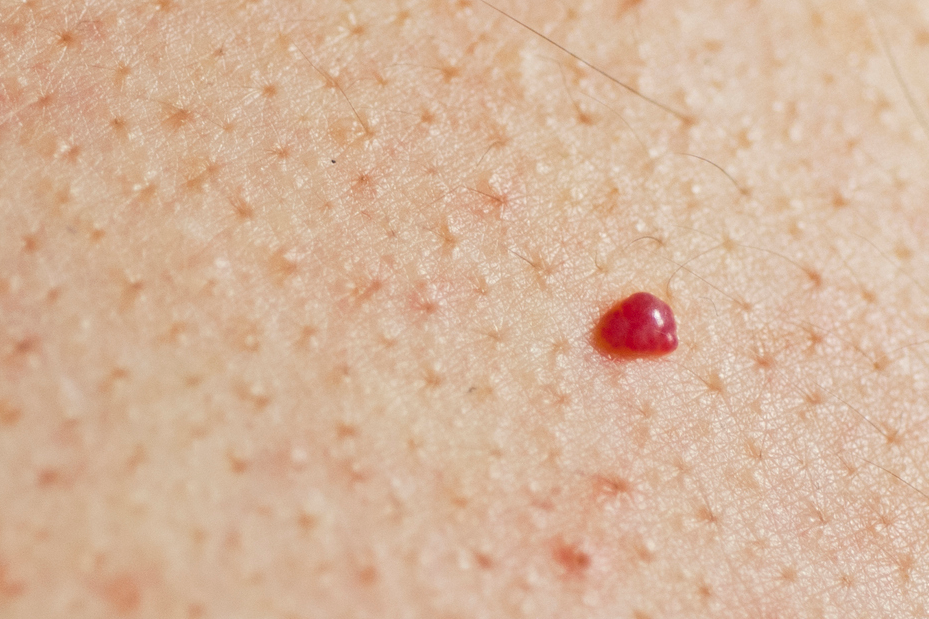
A cherry angioma can look like a little red bump, though it may lie completely flat on your skin. It’s actually just a cluster of dilated blood vessels.
“Patients will come in and say they keep getting more and more,” says Nada Elbuluk, M.D., assistant professor in the department of dermatology at NYU Langone Medical Center. “And it’s true, you get them as you age,” she says. They can also run in families—so if your older sister has some, chances are you will, too.
The good news: They’re totally benign. If you want them removed, your doc can treat them with intense pulsed light, a light therapy that is similar to a laser treatment, says Michelle Pelle, M.D., dermatologist and medical director at MedDerm Associates in San Diego.
2. Psoriasis
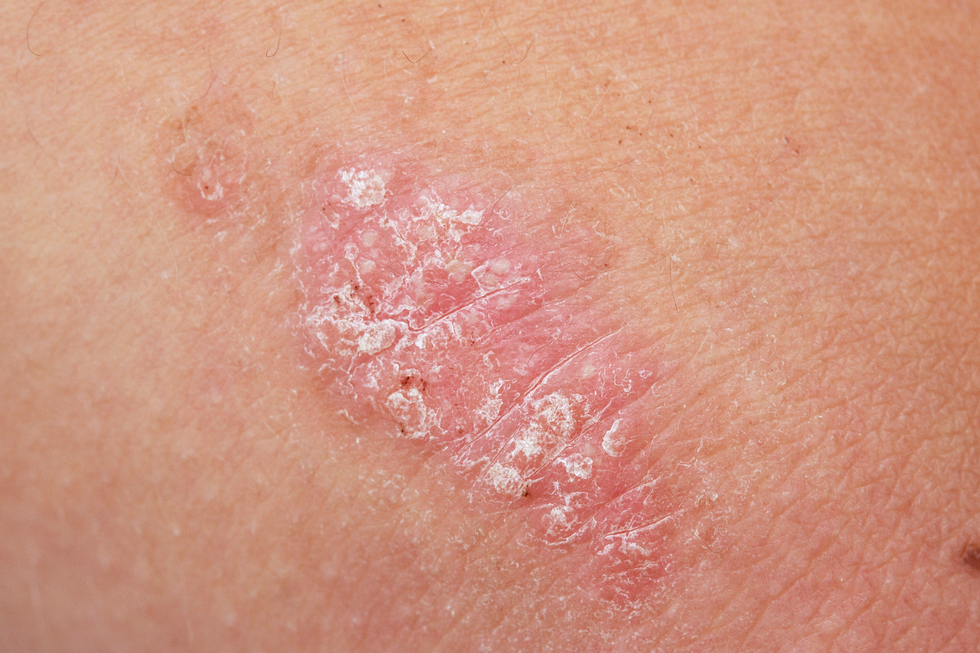
Psoriasis is a common autoimmune condition in which the body produces skin cells at a rapid pace, causing them to pile up on the surface. This can result in red spots, raised bumps, and crusty-looking patches of skin, but the exact symptoms can vary depending on your skin color. “Inflammatory skin conditions like psoriasis may appear different in Black patients,” Dr. Rodney says. “While psoriasis appears as red, scaly plaques in light skin, you may only see brown plaques in dark skin.”
While there are several types of psoriasis, 80 to 90% of people with the disease have plaque psoriasis, according to the National Psoriasis Foundation. These skin lesions can be red or pink in color, topped with white or silvery scales that feel itchy or sore. They most often show up on the elbows, knees, lower back, and scalp. If you think you may be dealing with psoriasis, be sure to talk to your doctor, as it typically requires prescribed medications and therapies, depending on the severity.
3. Keratosis pilaris (a.k.a. chicken skin)
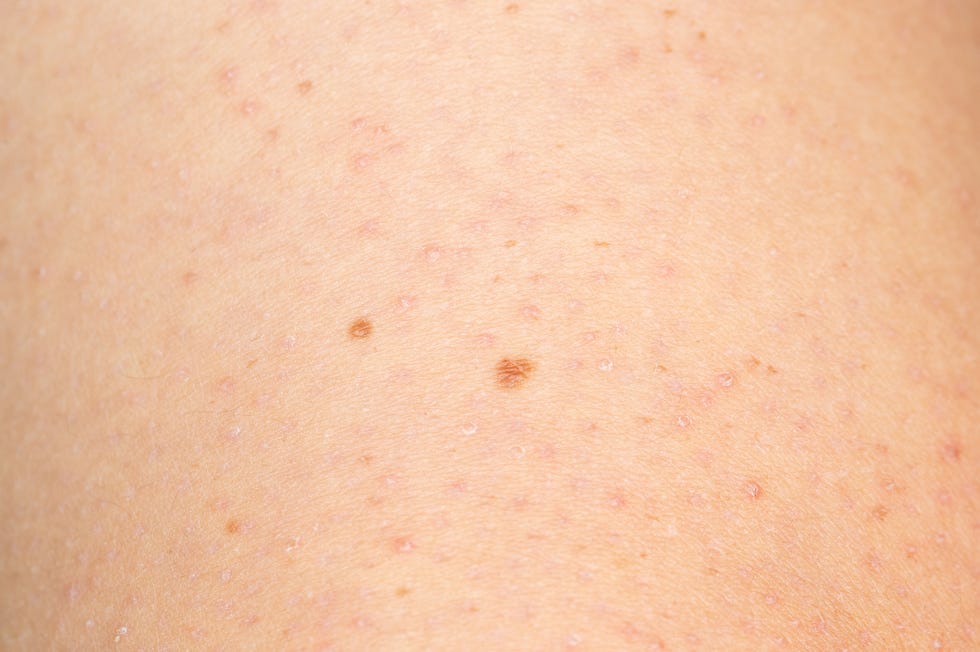
If you notice tiny, rough red spots on your skin—especially on your upper arms, thighs, cheeks, or buttocks—you may be dealing with keratosis pilaris, which are plugs of dead skin cells, according to the American Academy of Dermatology (AAD). The common condition is totally harmless, but can cause itching and dryness.
If the appearance of them bothers you, treating dry skin will be your best, the AAD says. These bumps often get worse in the winter, thanks to lower humidity in the air. Applying body lotions regularly, or even moisturizers that contain chemical exfoliants such as lactic or salicylic acids (we like this one from CeraVe) can help even out the skin’s texture. If general exfoliation and diligent moisturizing habits don’t seem to do the trick, talk to your dermatologist about prescription treatments.
4. Skin tags
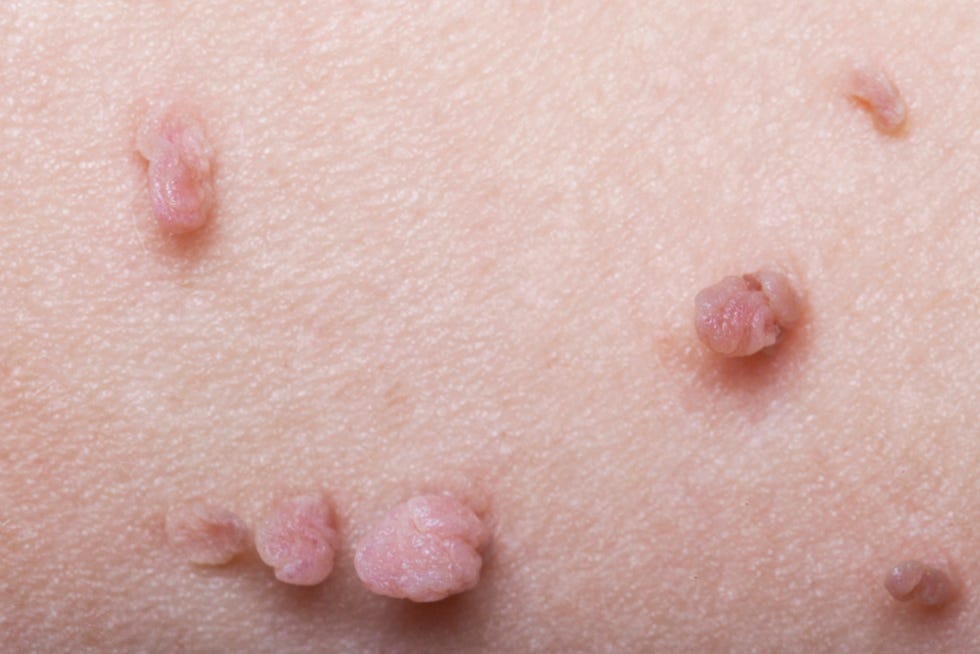
Skin tags are harmless fleshy growths that often pop up in clusters. They can be annoying, especially if they’re located around your bra strap or in a spot that your clothing tends to rub.
That constant friction can make them irritated and inflamed, but if your skin tag is not bothering you, you don’t have to remove it. And if they are? Don’t try to get rid of them yourself by cutting or scraping them off.
“People will use non-sterile tools and come in with inflamed, irritated, and infected skin,” Dr. Elbuluk says. The only safe course is to see your dermatologist, who will either freeze or numb it before snipping it off.
5. Folliculitis
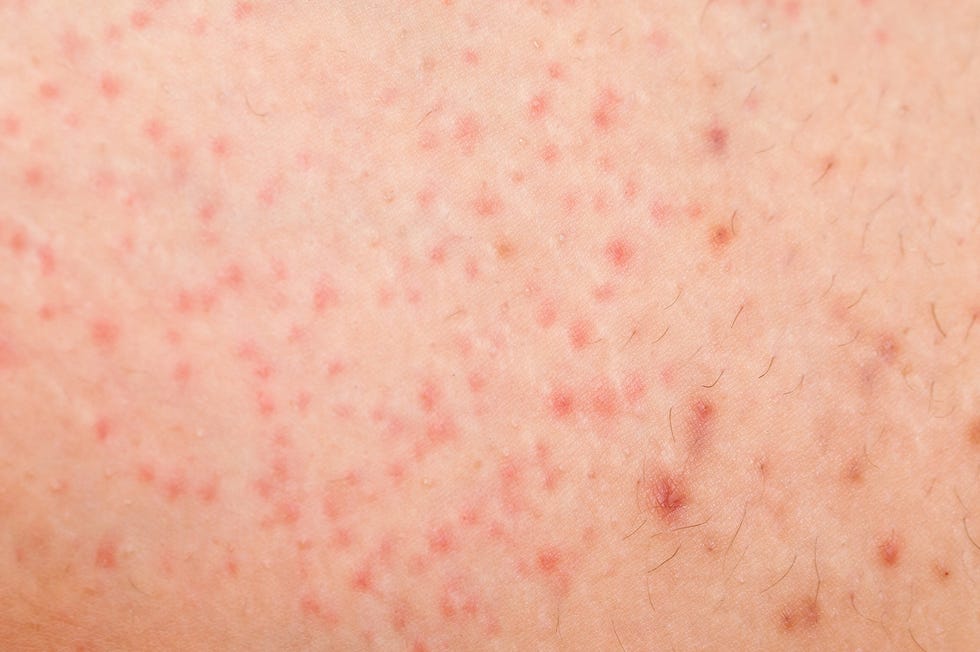
Folliculitis is an infection underneath your hair follicles, according to the AAD. It can look a lot like a sudden acne breakout, but each spot will have a red ring circling it. Unfortunately, the condition can be painful but also not feel like anything at all, as symptoms vary widely. The infection can also make the skin a bit more swollen and itchy.
Anything that damages your hair follicles—say, wearing tight clothing, rubbing your skin often, chafing, shaving, or even hanging out in a dirty hot tub—can make it easier for germs to set up shop and cause an infection, the AAD says.
Folliculitis will usually go away on its own if you stop doing whatever caused it. Applying warm compresses and wearing loose, breathable clothing can also help. But because it can look a lot like acne, talk to your doctor to ensure a proper diagnosis if your symptoms persist.
6. Eczema
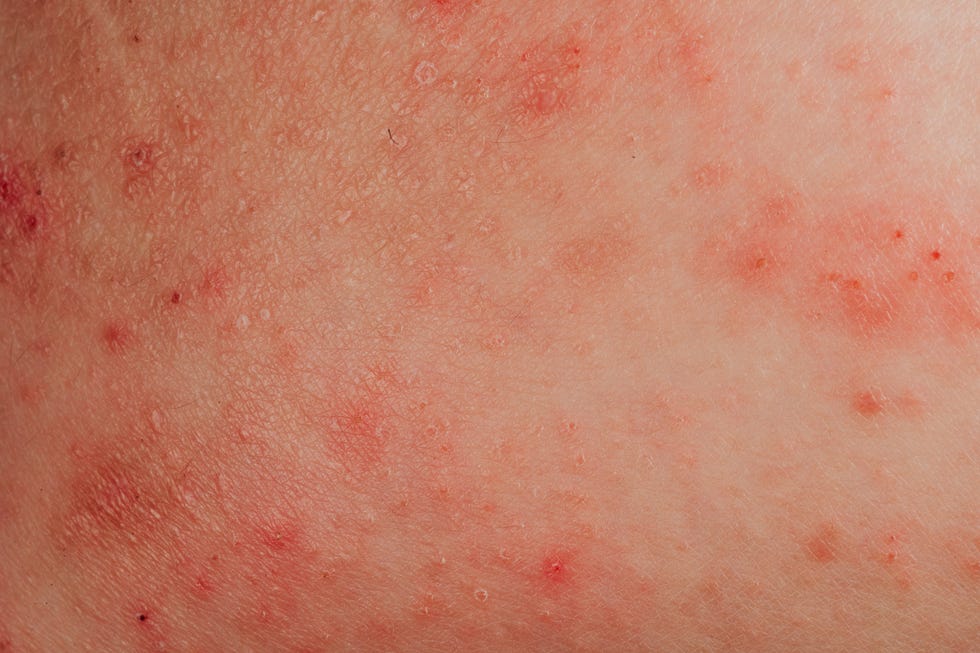
Eczema is an umbrella term for a cluster of skin conditions that cause red, itchy, dry, swollen patches anywhere on the body, but particularly the hands, feet, face, cheeks, or insides of the knees or elbows. Eczema can also make the skin look and feel rough and cracked, bumpy, thick or brittle, and blistered.
There are several types of eczema, and they’re all triggered by different things—everything from environmental factors to stress to genetics. Atopic dermatitis, the most common type of eczema, is linked to inflammation and the immune system, while contact dermatitis is caused by an allergen or irritant (like certain chemicals or acids—say, in your skincare or detergent).
After a proper diagnosis from your dermatologist (this is important, since eczema can look like other conditions), symptoms are often managed through OTC anti-inflammatory ointments and moisturizers or prescription drugs and injections.
7. Warts
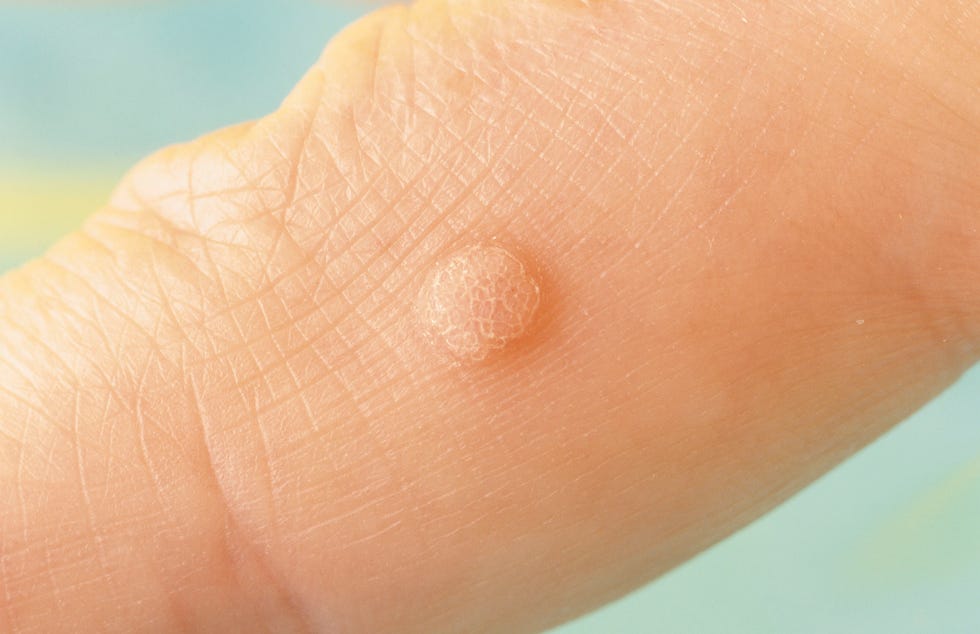
If you’ve ever dealt with a wart, you know just how stubborn they can be. Warts are actually caused by human papillomavirus, which consists of several strains that can affect various parts of your body (yep, including your genitals).
The good news is, they’re typically harmless and painless if they appear on other parts of your body, like your hands or face.
However, plantar warts can develop on the soles of your feet, which can become painful and interfere with running or walking, since you’re constantly putting pressure on it.
Resist the urge to yank it off yourself, because that just opens the gates for infection. Instead, talk to your derm, who will first perform a biopsy to make sure it’s not skin cancer. Then, he or she can remove it with prescription meds, laser treatment, or by freezing or burning it off. Then, make sure you take these steps to prevent another wart from popping up.
8. Dermatofibroma
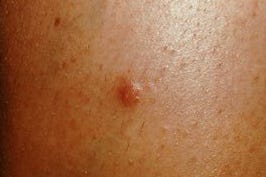
You’ll find a dermatofibroma most often on your arms and legs, and they can be pink or brown. The bump is made up of fibrous scar tissue, which can form as a reaction to something like a bug bite or ingrown hair.
“A patient will come in and tell me that she’s had this bump that’s been on her skin for years and it never goes away,” Dr. Elbuluk says.
Like a skin tag or cherry angioma, these are perfectly harmless. But because it can look like a mole, you’ll want a derm to take a look to determine which one it is, as “moles can change into melanoma, but a dermatofibroma does not,” says Dr. Pelle.
9. Solar lentigines

You know them by their more common name: sun spots (or age spots). They look like a cluster of moles that appear in sun-exposed areas like your arms, face, neck, upper chest, and legs. While they’re related to how much sun exposure you’ve gotten, they don’t develop into skin cancer, says Dr. Elbuluk.
Still, they’re hard to tell apart from moles that could turn cancerous. Also, having a lot of them makes it even harder for you to examine your skin yourself—all the more reason to get an annual skin check from a board-certified dermatologist. If they are simply sunspots and they bother you, here is how to get rid of them.
10. Seborrheic keratosis
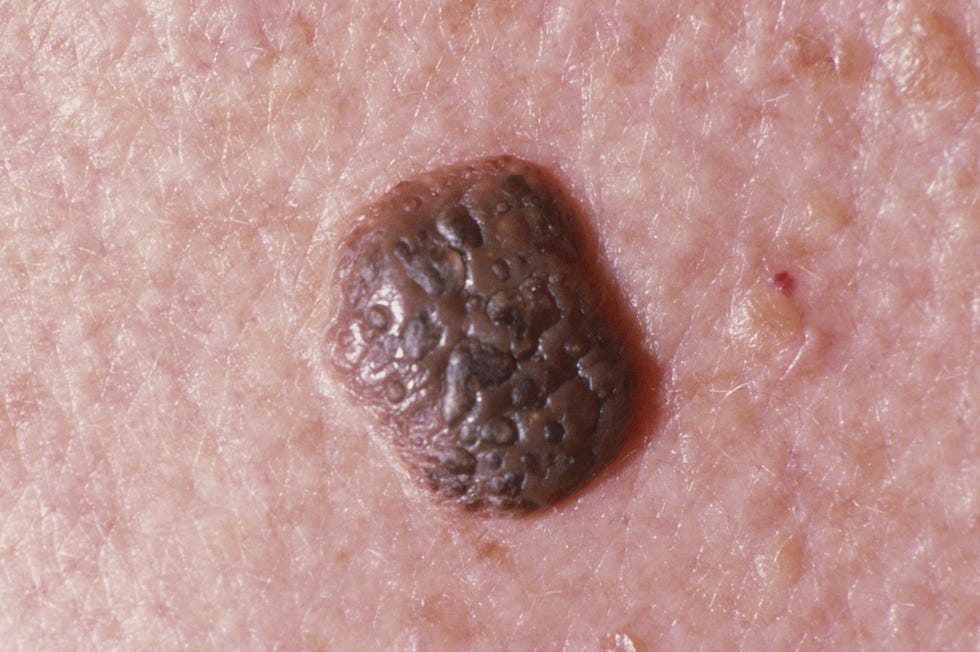
Seborrheic keratosis is a dark, scaly, benign crusty overgrowth of the top layer of your skin, explains Dr. Elbuluk. These are common as you reach middle age and beyond. Your derm can remove them by cutting them off, using liquid nitrogen, or treating them with a laser.
But it is important to note that “because it’s benign, insurance won’t cover it unless it’s in a bad spot, like on your collar and chronically irritated,” Dr. Elbuluk says.
11. Tinea infection
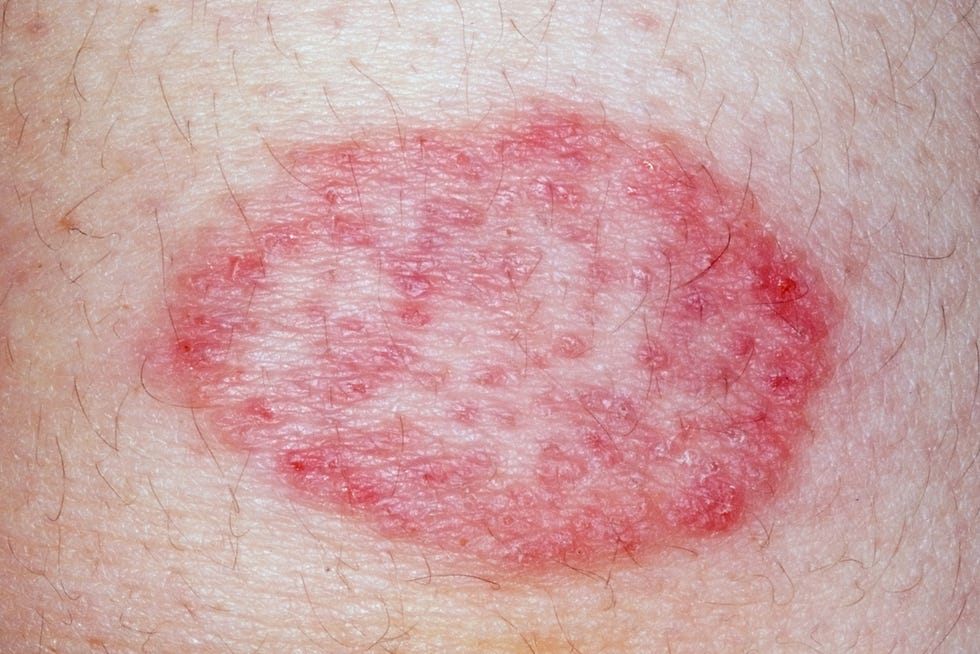
Tinea can look like a small red birthmark or discoloration—almost like a stain on your skin. But these spots are actually a kind of fungal infection, including ringworm and athlete’s foot, according to the National Institutes of Health. Tinea comes in various shapes and sizes, and the kind that infects your skin can spread (and infect other people) or become worse if not treated.
Fortunately, treatment is often as simple as washing the infected area with a prescription soap or shampoo, which your doctor can hook you up with.
12. Basal or squamous cell carcinoma
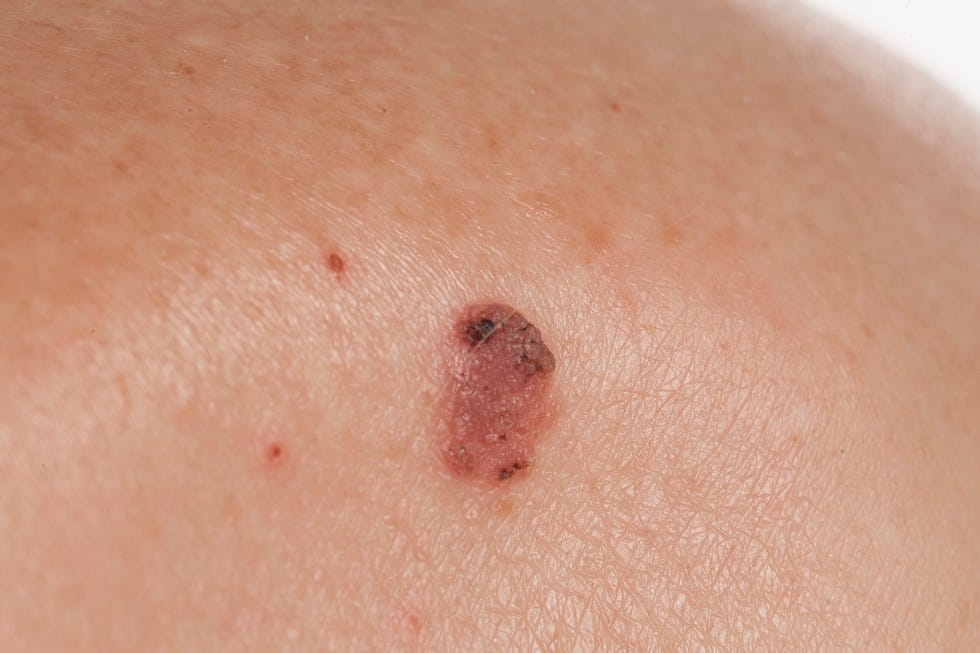
Yes, this is one of the bad ones—but many people don’t realize there are multiple types of skin cancer, Dr. Elbuluk says. “I’ll ask if someone has ever had skin cancer, and they will tell me, ‘No, just a basal cell.’”
Basal and squamous cell carcinomas are the most common types of skin cancer; more than 3 million people are diagnosed with them each year, according to the American Cancer Society. Unlike a benign mole, they often appear red, scaly, or pearly in appearance. While they’re not as deadly as melanoma, Dr. Elbuluk still recommends telling your dermatologist if a mole looks odd or is growing, changing, or starts to itch and bleed.
The best way to keep skin cancer away? Slather on the sunscreen with an SPF of at least 30. You can find a few derm-approved options below.
13. Melanoma
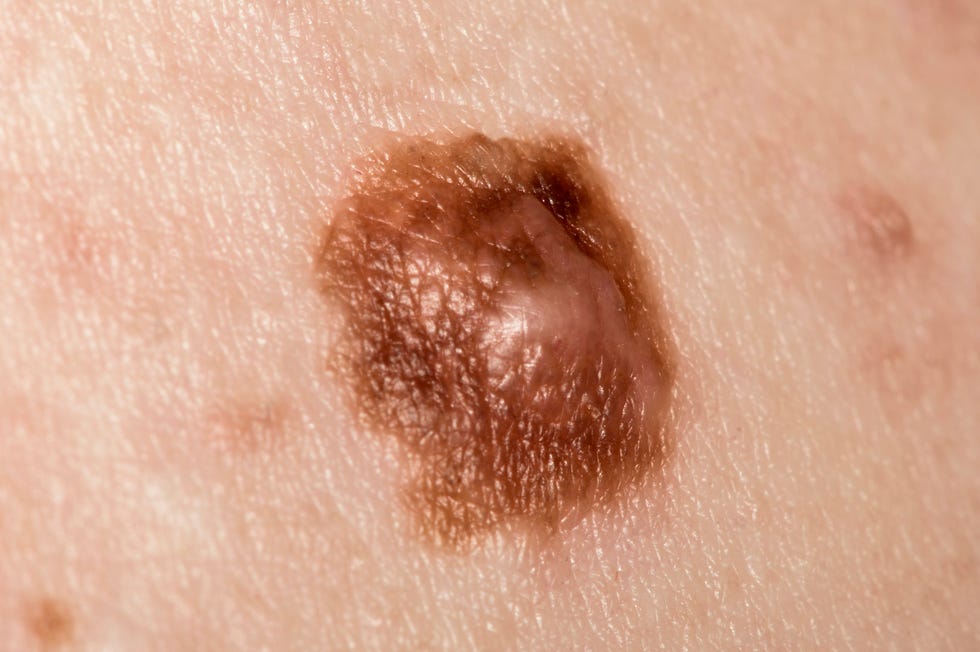
Melanoma isn’t as common as basal or squamous cell carcinomas—it only accounts for about 1% of skin cancers—but it’s far more deadly if you don’t catch it early, says the ACS.
To spot melanoma, use the ABCDE trick: Look for moles that are asymmetrical, have an irregular or less defined border, appear uneven in color, are greater than the size of a pea in diameter, and that evolve over time. (These melanoma pictures can help you visualize each of these changes.)
That’s why taking note of any new spots on your skin is so important. If you catch a suspicious mole early enough, your dermatologist can remove it and prevent the cancer from spreading to other parts of your body—which can save your life.
14. Heat rash

Also known as miliaria, heat rash is a type of skin irritation that happens when sweat gets trapped in your skin, according to the American Academy of Dermatology Association (AAD). That can cause red spots to appear.
Doing what you can to cool off and stop sweating should help to make these go away, Dr. Rodney says. The AAD also recommends doing what you can to stay cool by wearing lightweight, loose-fitting clothes; avoiding outdoor exercise when it’s really hot out; and using things like fans, air conditioning, and cold showers to cool off.
15. Contact dermatitis
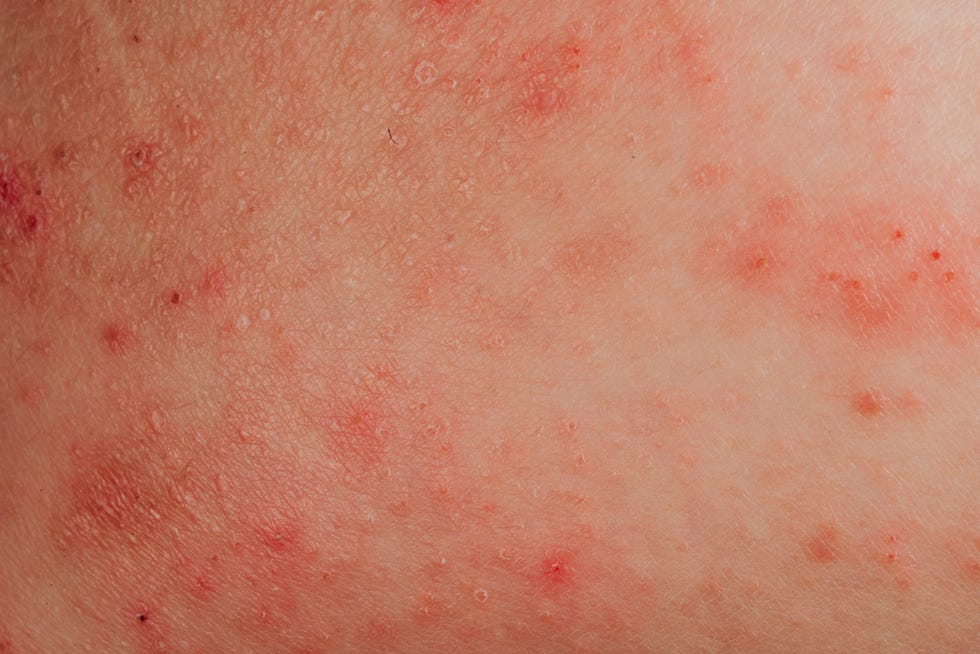
Contact dermatitis is an itchy, inflamed skin reaction that can happen after you come into contact with something that aggravates your skin or immune system, per the AAD. With contact dermatitis, your skin usually becomes itchy at first, followed by a red rash that can look like small bumps.
Contact dermatitis can be caused by a range of things, including products that you’ve been using for years, Dr. Rodney says. That can make it tough to pinpoint the reason why you suddenly developed red spots.
Sometimes, the spots will show up in the shape of whatever irritated your skin (like a ring or bracelet). But other times, it’s harder to tell. Ultimately, it’s a good idea to rope in a healthcare professional to get to the bottom of this one.
16. Acne

Sure, you’re probably no stranger to acne, but there are several types and each can cause different-looking spots, Dr. Rodney says. If you’ve developed acne in an area of your body you haven’t experienced it in the past or have form you’ve never dealt with before, it’s understandable for that spot to throw you for a loop.
Dr. Rodney says that you can try using common acne treatments on the spot, like washes and creams that contain benzoyl peroxide or salicylic acid to see if it does anything. But if the spot persists, it’s time to get it checked out.
17. Blister
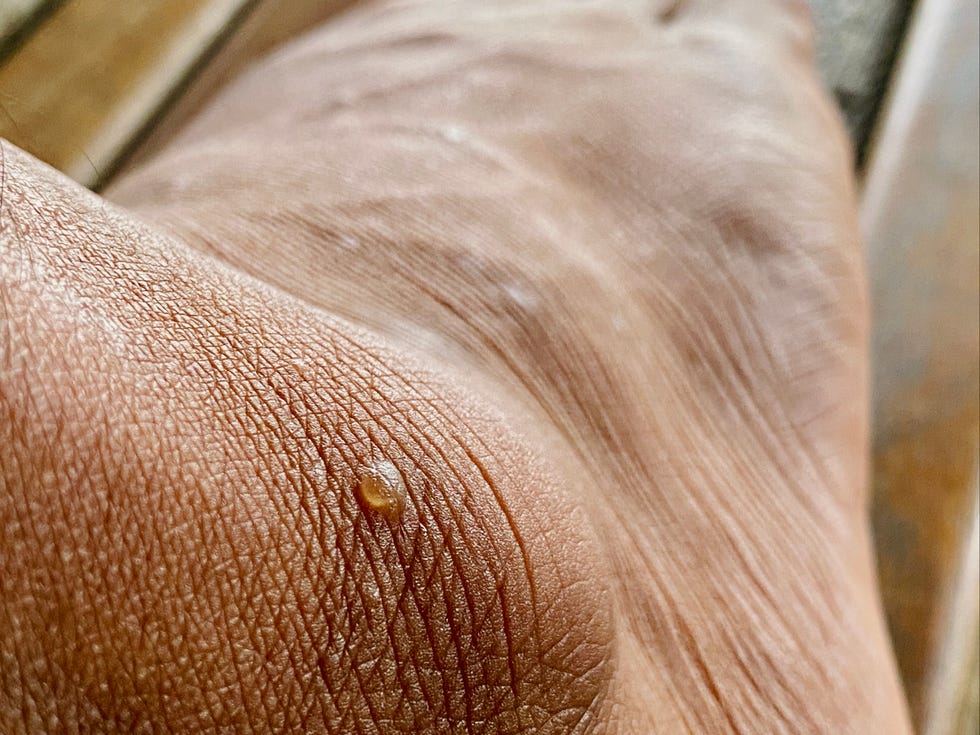
A blister is a fluid-filled bump on the outer layer of your skin, Dr. Rodney explains. These usually form because of rubbing, heat, or skin diseases, she says. (They’re also sometimes referred to as “vesicles” or “bulla.”)
You’ll typically know that you’re dealing with a blister over other types of spots due to its soft feel, according to Dr. Rodney says. You may even be able to spot fluid inside the blister. A blister will usually heal on its own, but you can put a disposable bandage on top to protect it, according to the U.S. National Library of Medicine.
18. Chickenpox
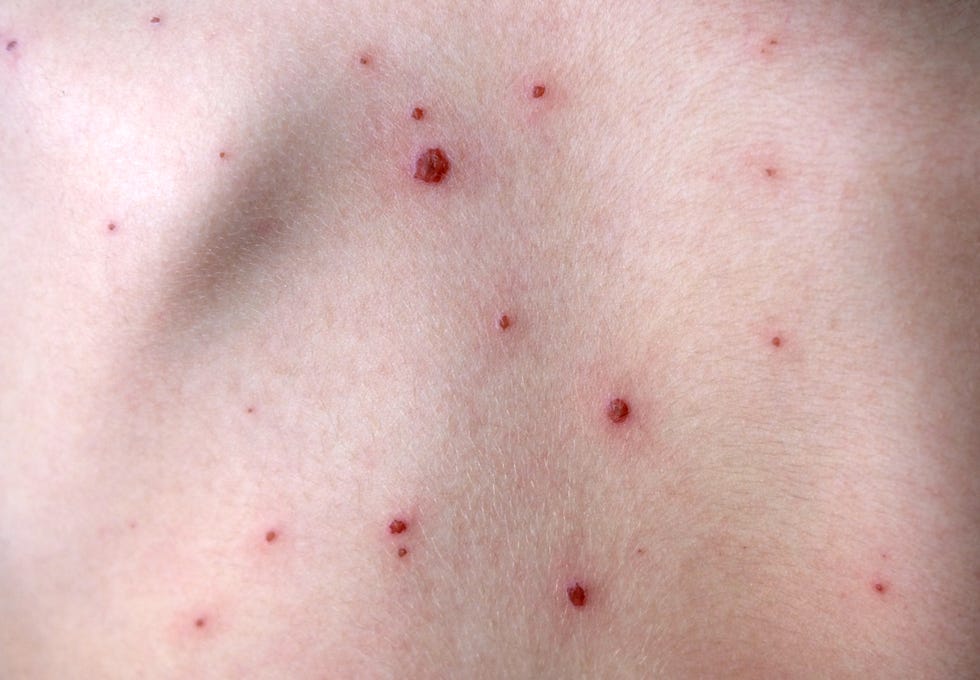
Chickenpox is an illness that’s caused by the varicella zoster virus, according to the Centers for Disease Control and Prevention (CDC). It causes a blister-like rash that’s itchy and usually shows up on the chest, back and face before spreading over the entire body.
Chickenpox used to be a common illness in the U.S., but the chickenpox vaccine has helped to drive down the number of cases, according to the CDC. Chickenpox can cause raised bumps called papules that break out over a few days. Those are followed by small fluid-filled blisters that form about a day before breaking. Finally, crusts and scabs form over the broken blisters.
19. Cold Sore
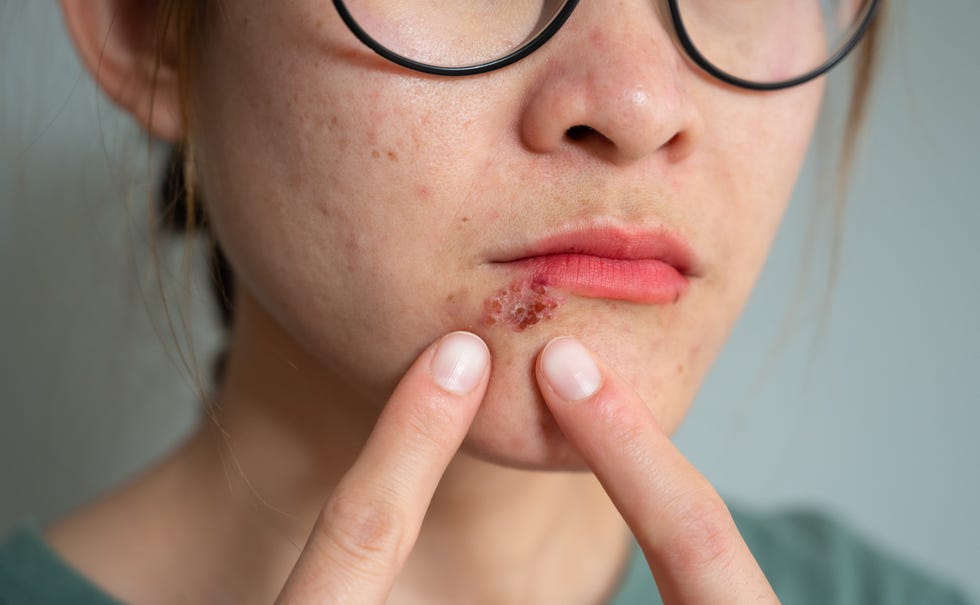
Cold sores are caused by herpes simplex virus type 1 (HSV-1), per the CDC. Also known as fever blisters, most people with cold sores develop them during childhood or young adulthood.
Anywhere from 50% to 80% of American adults have cold sores, according to Johns Hopkins Medicine. Cold sores start with redness, swelling, and itching, followed by fluid-filled blisters that tend to appear on the lips or under the nose. The blisters will leak and become sores, per Johns Hopkins Medicine. After four to six days, the sores will start to crust over and health.
How concerned should you be about new spots on your skin?
New spots can show up here and there, and these shouldn’t automatically be a reason for panic, says Gary Goldenberg, M.D., assistant clinical professor of dermatology at Icahn School of Medicine at Mount Sinai Hospital.
“It’s normal to develop new growths or spots on the skin,” he says. The big difference in how concerned you should be is if a new spot sticks around or increases in size, Dr. Goldenberg says. “It doesn’t necessarily mean that the spot is cancerous, but it’s certainly possible,” he says. “This is especially true for those with a history of UV/sun exposure.”
Signs to get a new spot checked out
The ABCDE criteria we mentioned above is important, but it’s not the only thing to have in mind with new spots, according to Dr. Goldenberg. He also recommends getting a spot checked out if it comes along with these symptoms:
- It’s not going away.
- It’s getting bigger.
- It’s painful or uncomfortable.
- It itches.
- It’s bleeding.
- It’s a change in a long-standing spot.
“All are important signs that the spot should be checked by your dermatologist,” Dr. Goldenberg says.
As for how long to give a new spot before having it evaluated, Dr. Goldenberg says you can wait a few weeks, unless you’re uncomfortable. (In that case, get it checked out sooner.)
What will a doctor do?
There are a few things your dermatologist will do during your appointment. “A visual exam is the first step,” Dr. Goldenberg says. That means physically looking at your spot, along with using a device called a dermatoscope to get a closer look. “Think of it as a special magnifier, which may give more accurate information,” Dr. Goldenberg says.
If the spot looks suspicious, your doctor may do a skin biopsy. “This involves gentle removal of some or all of the spot,” Dr. Goldenberg explains. (Your skin will be numbed up beforehand.) After that, the tissue is sent to a lab to be analyzed, and your doctor will receive the results in a week or two. You can discuss specific next steps from there, if they’re needed.
How to prevent new spots from forming
Each spot is slightly different, making prevention for each spot different as well. However, there are a few prevention strategies that may help, according to experts:
- Wear sunscreen, and reapply throughout the day.
- Make sure that your shoes and sports equipment fits properly.
- Stay up to date on recommended vaccinations.
- Try to avoid known skin irritants, like products with fragrances.
- Keep your skin clean and apply lotion, as needed.
Additional reporting by Alisa Hrustic

Mona Gohara, M.D. is a Yale-trained, board-certified dermatologist, Oberlin College-bred feminist, medical media expert, and member of the ELLE Beauty Advisory Board. Mona enjoys educating on skin health, skin cancer, skin of color, and sun protection. She has done this through writing, lecturing on the local, national, and international levels, and by engaging popular media. Mona is an active member of the American Academy of Dermatology, where she chaired the social media task force, The Women’s Dermatologic Society where she serves as president, and The American Society for Dermatologic Surgery, where she chairs the DEI Work Group.
Read the full article here