

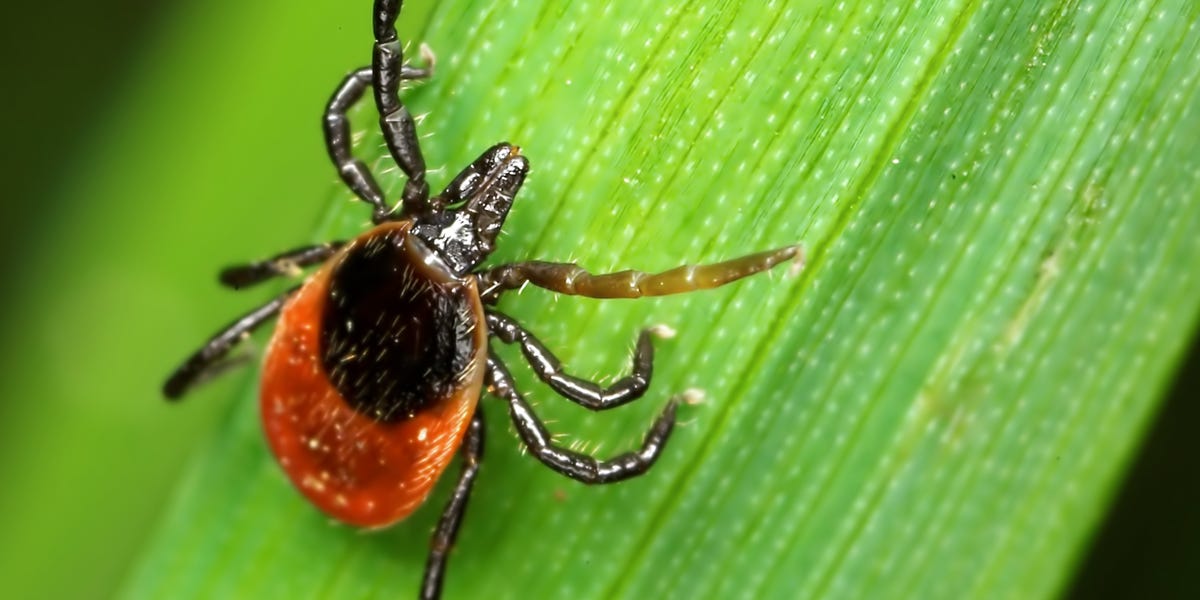
- A new at-home test allows you to test ticks for bacteria that cause Lyme disease.
- LymeAlert delivers results in 30 minutes or less.
- Doctors who treat patients with Lyme disease have some concerns.
About 476,000 Americans are diagnosed and treated for Lyme disease each year, making this tickborne infection relatively common in some areas of the country. But data suggests its reach is expanding, meaning more folks in other regions may get sick with Lyme, too.
Untreated Lyme disease can cause a fever, rash, facial paralysis, irregular heartbeat, and arthritis, and there’s a risk of experiencing drawn-out symptoms like fatigue, memory issues, and aches—sometimes even after you’ve been treated. So it’s understandable to want to have all the tools you can to lower your risk of getting sick and being able to act fast if you are infected.
Now, a new at-home test allows people to test ticks to see if they carry Borrelia burgdorferi, the bacteria that primarily causes Lyme disease in the U.S. LymeAlert is now taking preorders for a single-use kit that the company says can detect that bacteria in a removed tick within 30 minutes. But while the test is convenient, infectious disease doctors who treat people with Lyme disease have some concerns.
Meet the experts: William Schaffner, M.D., an infectious disease specialist and professor at the Vanderbilt University School of Medicine; Thomas Russo, M.D., professor and chief of infectious disease at the University at Buffalo in New York; Amesh A. Adalja, M.D., a senior scholar at the Johns Hopkins Center for Health Security
How does LymeAlert work?
LymeAlert tests the actual tick—not you. The company describes the testing process like this: Remove the tick safely if it’s attached to you, then place it in the test kit’s container and add the included solution. Put on the container’s lid and crush the tick by twisting the top at least 10 times.
After that, the company says you insert a test strip. After 30 minutes, LymeAlert says it should give you results to suggest if the tick carries Borrelia burgdorferi or not. After you receive them, the company says to contact your medical provider for next steps.
How accurate is LymeAlert?
That’s not clear. LymeAlert does not offer any data on its website about how accurate its test results are—it only states in an FAQ section that it has “lab-level accuracy.” But the company does not provide sensitivity, specificity, or validation data to support that claim, so Prevention couldn’t independently verify it.
LymeAlert also provides the following disclaimer on its site:
“No diagnostic test is 100% accurate under all conditions. LymeAlert products are intended to support early awareness and informed decision-making. False positives, false negatives, user error, environmental factors, sample quality, timing, storage conditions, and other variables may affect test performance and results.”
A representative for LymeAlert did not respond to Prevention’s request for comment by deadline.
Doctors say there are a few things to keep in mind
The test is not approved by the Food and Drug Administration (FDA), but it’s not marketed to diagnose Lyme disease in people—it’s analyzing the tick itself for the presence of Borrelia burgdorferi bacteria. Per the LymeAlert FAQ, screenings for ticks don’t require standard FDA approval.
More crucially, the Centers for Disease Control and Prevention (CDC) does not recommend getting ticks tested for several reasons, including:
- Labs that do tick testing aren’t required to have the high quality control standards used by diagnostic labs.
- Positive results don’t necessarily mean you’re infected.
- Negative tests may give you false assurance.

Add Prevention as a preferred source in your Google search results.
Use your Google account to add this to your settings.

Infectious disease doctors echo those concerns and add on a few more. “If you’ve got a tick that tests positive for Borrelia burgdorferi, what does that mean for you?” asks William Schaffner, M.D., an infectious disease specialist and professor at the Vanderbilt University School of Medicine.
The answer isn’t clear-cut. In most cases, an infected tick needs to be attached to you for more than 24 hours to transmit it to you, per the CDC. Even then, there’s no guarantee that being bitten by an infected tick will cause you to develop Lyme disease, Dr. Schaffner points out.
There are a lot of unknowns about the number of false positives and false negatives with this test, says Thomas Russo, M.D., professor and chief of infectious disease at the University at Buffalo in New York. “That’s a bit of a concern,” he says.
It’s also possible that you may have been bitten by more than one tick, Dr. Russo says. “You may find one tick and test it—which, again, is not recommended,” he says. “If it’s negative, that doesn’t mean you haven’t missed another tick that may have been positive.”
The black-legged tick, which causes Lyme disease, can also spread more than one disease, Dr. Russo says. So, even if your tick tested negative for Lyme, it’s possible that it could be carrying other pathogens that could make you sick.
Dr. Schaffner flags another potential issue: “A substantial portion of people who have Lyme disease or another tick-related illness do not remember getting a tick bite or spot the tick.” In many cases, the tick will bite you, get a blood meal, and drop off before you notice anything is wrong, he says. So you might not even have anything to test—or the inkling that something might have happened—and still end up getting sick.
How do the test results change what you do next?
The test doesn’t necessarily change your course of action, says Amesh A. Adalja, M.D., a senior scholar at the Johns Hopkins Center for Health Security. “It doesn’t tell you whether the tick was attached long enough to transmit it, and it doesn’t override the criteria doctors already use to decide on preventive antibiotics,” he says.
If you develop symptoms of Lyme disease, your doctor will typically recommend that you take a blood test that looks for antibodies to Borrelia burgdorferi, Dr. Russo points out. However, it can take several weeks after you’ve been infected for your immune system to make enough antibodies to be detected by the test, per the CDC.
So in some cases, your doctor may recommend preventive treatment—a single dose of the antibiotic doxycycline. These circumstances include:
- Living in an area where Lyme disease is common.
- If the tick was removed within the last 72 hours.
- Whether the tick was engorged (which suggests it had a full blood meal).
That means there are already some instances where preventive treatment may be warranted—and having a positive result from tick testing wouldn’t change that recommendation. “I’m not sure of the value of this,” Dr. Russo says.
Still, getting a positive test result with this could clue you in that Lyme disease is around and possibly even closer than you realized. Getting a positive test can be a good wake-up call to double down on tick bite prevention efforts, like wearing bug spray with EPA-approved ingredients and doing regular tick checks for you and your pets.
And if you do end up using the test, you should connect with your doctor for next steps after you get the results—but that’s something you would want to do anyway after a tick bite, per the CDC recs above, to see if preventive treatment might be right for you.
How can you get LymeAlert?
LymeAlert is $49.99 and currently available for preorder on the company’s website. Shipping is expected to begin this month, according to the website.
Read the full article here