

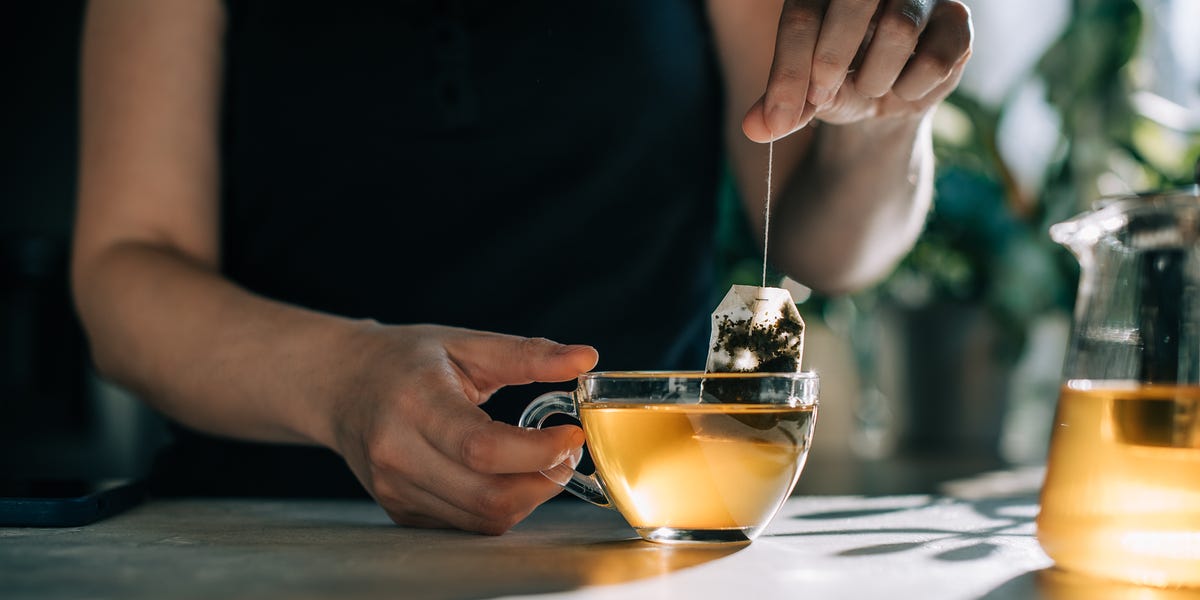
- Tea drinking may be part of a bone-healthy lifestyle, scientists find.
- A recent study linked tea drinking to higher bone density, while excessive coffee drinking was linked to lower bone density.
- Here, experts break down the findings.
Many of us start our mornings with a steaming cup—or a few—of coffee or tea. But it turns out your daily dose of caffeine could be a more important part of your morning routine than you may realize. In fact, new research reveals it could be affecting your bone health.
Meet the experts: Melissa Prest, D.C.N., R.D.N., spokesperson for the Academy of Nutrition and Dietetics; Daniel Wiznia, M.D., an associate professor of orthopaedics at Yale School of Medicine and co-director of Yale’s avascular necrosis & osteonecrosis program
That’s the takeaway from a recent study published in Nutrients, which set out to analyze the link between coffee and tea consumption and bone density in older women. The participants included 9,704 postmenopausal women over the age of 65 who self-reported their daily coffee or tea consumption to the researchers over the course of 10 years.
The results revealed that regular tea consumption was linked to higher bone density. As for coffee, it all depended on how much they drank. While light to moderate coffee consumption showed no significant association, drinking more than five cups of coffee per day was associated with lower bone density.
Before you unplug your coffee maker for good, experts break down what that actually means for you.
Why are the findings significant?
The results of the study are good news for tea drinkers, but not necessarily bad news for coffee enjoyers. “The biggest takeaway is that tea appears to be compatible with good bone health in older women, while moderate coffee consumption does not appear to be a major concern for bone mineral density,” explains Melissa Prest, D.C.N., R.D.N., spokesperson for the Academy of Nutrition and Dietetics.
That distinction is important. While the researchers did find a slight association between lower bone density and consuming more than five cups of coffee per day, general coffee consumption didn’t show any significant association either way. As for the five or more cups a day crowd, it’s still important to take the results with a grain of salt. “That finding should be considered a signal for further research rather than proof that high coffee intake causes bone loss,” Prest says.
What does this mean for you?
If you’re already a regular tea drinker, the study’s results suggest that sipping on your daily cup isn’t doing any harm to your bone health. “For someone who enjoys tea, this study provides another reason to feel good about including unsweetened tea as part of an overall healthy diet,” Prest says. “But I wouldn’t tell someone to drink tea as a substitute for the well-established strategies for protecting bone health.”
That means putting your energy into cultivating an overall bone-healthy lifestyle, rather than just drinking a certain amount of tea each day (and, importantly, the researchers didn’t actually specify one ideal amount of tea to drink for the best bone density). Getting “adequate calcium and vitamin D, sufficient protein, regular weight-bearing and resistance exercise, maintaining muscle strength, avoiding smoking and excessive alcohol, and getting appropriate screening for osteoporosis based on age and individual risk factors” can all help protect your bone density as you age, according to Prest.

Add Prevention as a preferred source in your Google search results.
Use your Google account to add this to your settings.

“Tea can be one small piece of that picture, rather than the centerpiece,” she says.
But if tea isn’t for you, or you prefer to drink coffee, you don’t have to force yourself to change your beverage of choice. “What the study shows is that there’s a very small positive association between tea drinking and bone density. But while statistically significant, it’s not necessarily a clinically meaningful improvement,” explains Daniel Wiznia, M.D., an associate professor of orthopaedics at Yale School of Medicine and co-director of Yale’s avascular necrosis & osteonecrosis program. “So I think the biggest thing is if you do drink tea, don’t change what you’re doing. If you don’t drink tea, I wouldn’t feel like you have to start drinking it because of the study.”
And again, coffee doesn’t seem to pose a risk to bone density unless you’re guzzling more than five cups a day. “I mean, that’s a lot of coffee,” Dr. Wiznia points out. “So, I don’t think this article should dissuade most people from drinking coffee either.”
Does diet play a big role in bone health?
While tea specifically may not be the sole secret to healthy bones as you get older, the bigger-picture takeaway from the study is that diet can play a significant role in our bone health. “A well-balanced diet where you’re having fruits and vegetables and calcium- and vitamin D-rich foods will definitely help you maintain your bone density,” Dr. Wiznia says.
The important caveat is that overall patterns tend to matter more than any single food or beverage when it comes to osteoporosis prevention. “Bones need adequate nutrients—including calcium, vitamin D, and protein—to maintain their structure and support normal bone remodeling, and a balanced eating pattern provides many of these nutrients along with other beneficial compounds,” Prest explains. She recommends incorporating the following foods into your diet when you can to make sure you’re getting those key nutrients:
- Calcium-rich foods: dairy or fortified plant milks, yogurt, and calcium-set tofu
- Vitamin-D-rich foods: sardines, eggs, fish, or supplements when needed
- Protein-rich foods: beans, lentils, soy foods, dairy, nuts, and seeds
If bone health is a concern for you, Prest points out that getting good weight-bearing and resistance exercise is just as important as good nutrition. “Bones respond to mechanical loading, and maintaining muscle helps reduce the risk of falls and fractures,” she explains.
The bottom line
The study reveals that regular tea drinking could be one piece of the bone health puzzle, but there’s still more to consider. Prest points out that the study was observational, which means that while it can identify associations between bone density and tea or coffee consumption, it can’t establish a cause-and-effect relationship. The study’s participants were also all women over the age of 65, so more research is needed to see if the same pattern holds true for other demographics.
It’s also difficult to isolate tea or coffee consumption as the factor that’s influencing bone density. “People who drink tea may differ from non-tea drinkers in other ways that influence bone health, even though the researchers adjusted for many factors including age, BMI, smoking, alcohol, calcium and protein intake, physical activity, medications, and other health conditions,” Prest points out. Still, she says there’s reason to be optimistic that sipping tea can support a bone-healthy lifestyle. “Don’t drink tea because you think it will prevent osteoporosis; drink it because you enjoy it and it can fit beautifully into a healthy dietary pattern.”
Read the full article here