

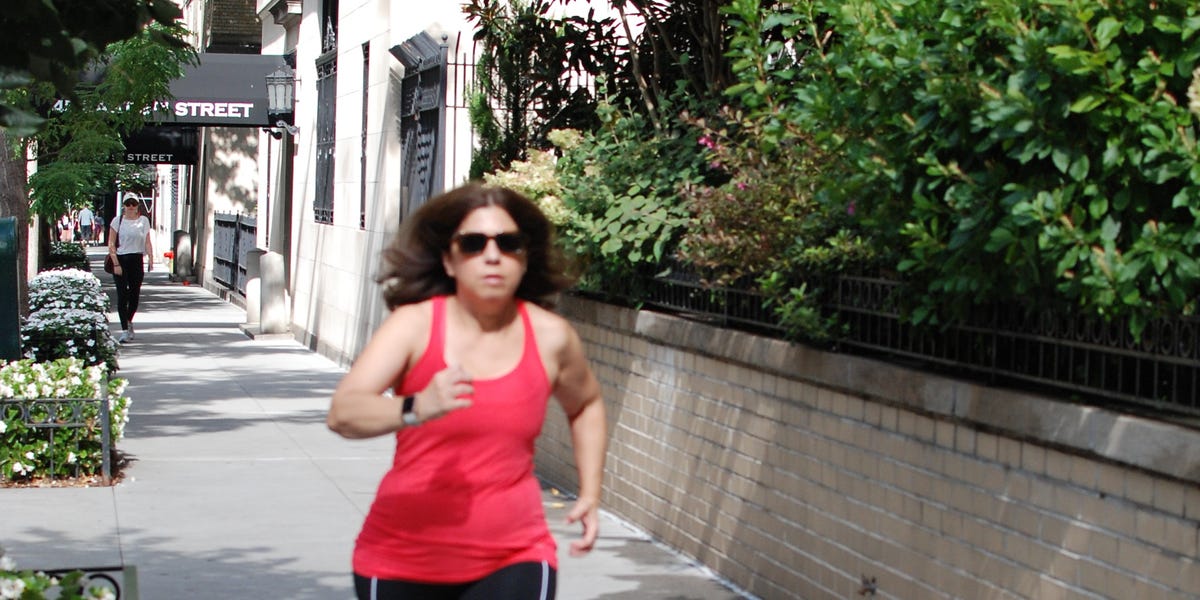
I have always been a very active walker—I walk 7,000 steps a day (at least!), and on many days I top 10,000. But over the past few months, I’ve noticed that some of the walking benefits I used to enjoy have plateaued a bit, such as feeling stronger when I’m finished and managing middle-aged weight gain. So I was eager to challenge myself in an attempt to keep the progress going, and so that I can continue to feel my best.
So when I discovered the viral Japanese Walking Method, it sounded like the ideal workout experiment for me, and I was excited to put it to the test. It’s basically interval walking, where you alternate between faster and slower paces, and it’s one way to walk for weight loss and build muscle strength—perfect!
“We tend to get into a very comfortable pace for walking, especially if you’re walking with a friend and talking, which doesn’t always give us the most benefits,” says Michele Stanten, an ACE-certified fitness instructor and walking coach.
I realized that during my typical long walks, I meander, stop to grab an iced coffee, or get caught up in a conversation with my walking partner. If the walk involves my dog, we make multiple stops to pee, sniff other dogs’ butts, or chat with the many people who stop to pet her. I was walking a lot, but I realized I wasn’t really pushing myself.
Meet the expert: Michele Stanten, an ACE-certified fitness instructor and walking coach.
With the Japanese Walking Method, however, I would have to spend at least half the walk going at a vigorous, heart-pumping pace. I was ready to try it! Here’s what happened to my body when I tried the Japanese Walking Method for a month.
What Is the Japanese Walking Method?
You walk at a normal pace for three minutes, then walk at a faster clip for three minutes—you should be hustling hard enough that you would have trouble carrying on a conversation. Switch between the slower and brisker paces every three minutes for 30 minutes total.
What Happened When I Did the Japanese Walking Method for 1 Month
The first day I tried the Japanese Walking Method, I noticed a few things. First, it felt weird to be walking so fast! Do you remember that Prancercise lady who went viral several years back? That’s what I felt like as I swung my arms and walked as quickly as I could around my neighborhood park. It was just my first walk, but I was already sweating more, breathing harder, and my heart was pumping faster. During my first interval, I experienced a strain on the top of my right foot, I assume from not stretching beforehand (something I never had to do with my more leisurely walks!).
I learned from my mistake and made sure to spend a few minutes doing some point-and-flex stretches before my next Japanese walking workout. I also quickly got used to the feel of sweating up a storm while not technically running, and I ceased to care how odd my workout might appear to any onlookers (and of course, I soon realized that nobody cared).
By the end of the second week, a surprising thing happened: As I was tapping my phone to start my second interval of fast walking, I broke into a jog instead. I realized that jogging felt more natural than the fast walking, and I just took off down the block. Now, this may not sound like a big deal, but I haven’t run in 15 years! My workouts tend to involve dancing or strength training, and the last time I ran a 5K with friends, I walked for at least half of it. That spontaneous jog wasn’t a fluke—on every interval walking workout since, I’ve added a little more jogging to each fast interval.
Interval walking also made the time pass by more quickly! Often, when I’m working out, I sneak peeks at my watch, waiting for the whole thing to be over. But the fact that this workout is broken up into 10 segments of three minutes each made it fly by. By the time I was exhausted from the fast walking, it was already time to switch back to a slower pace.
Benefits of the Japanese Walking Method
This particular version of interval walking was developed about 20 years ago by Hiroshi Nose, M.D., Ph.D., an exercise physiologist in Japan. In a small but intriguing study published in Mayo Clinic Proceedings, Dr. Nose and his team of researchers found that when older people tried this interval walking method, they experienced:
Reduced Systolic Blood Pressure
This is the top number and measures the force of blood against artery walls when your heart beats—Dr. Nose’s study found that participants who engaged in the Japanese Walking Method experienced a reduction in this number. Controlling blood pressure is one key to good heart health, as high blood pressure is a heart disease risk factor. Exercise, such as interval walking, is a heart-smart habit that can aid in blood pressure control.
Stronger Muscles and Bones
We know that walking builds muscle, so it makes sense that Dr. Nose’s study found that participants who did high-intensity interval walking had increases in thigh muscle strength at the end of the trial. Building muscle strength is one key to healthy aging, as it contributes to stronger bones and joints—and this helps you stay active and mobile and can reduce the risk for falls. (A separate, more recent PLOS One study showed that five months of interval walking was associated with an increase in bone density in postmenopausal women who started off the trial with lower bone density.)

Add Prevention as a preferred source in your Google search results.
Use your Google account to add this to your settings.

Increased Aerobic Capacity
This is just a scientific way of talking about how much oxygen your body can utilize during exercise—having better aerobic capacity boosts endurance so that you can work out harder and get stronger, and it also supports cardiovascular health.
Healthy Weight Management
I was also encouraged by the idea that speeding up my walks in this way would make the workout more efficient in weight management. “By increasing the speed of your walk, you can push it toward that higher intensity workout, which can burn the same number of calories in a shorter amount of time,” Stanten explained.
Better Long-Term Physical Fitness
The results appear to have a lasting effect when it comes to staying physically fit. A 2018 follow-up study showed that after 10 years, the adults who continued this walking routine maintained better aerobic capacity and knee strength—even those who had stopped doing the program had a slower decline in physical fitness than those who had never done it at all.
How to Get Started With the Japanese Walking Method
Stanten recommends trying the workout two to three times a week. Always warm up with a few walking stretches before setting out, and start at a pace that works for you: “Don’t feel bad if you can’t do three minutes fast right away,” she says. “You can start with 30 seconds fast, and then build up.”
She also points out that as you increase your speed and time on your fast intervals, you may notice your walking pace will pick up overall, and even your slow times will get a little faster.
As for technique, it’s heads-up, arms swinging: “A lot of people tend to look down at their feet, which can stress the neck and upper back,” Stanten says. “Instead, think about standing nice and tall, keeping your shoulders back and down.”
The only “equipment” you need for this workout is a comfortable and supportive pair of walking shoes and an efficient way to time your intervals. I wore the Hoka Clifton 11 walking shoes, which I absolutely love and made me feel like I was bouncing on a cushy gymnastics mat with each step. And when my daughter moved up to a new Apple Watch, she gave me her old one, which I used to time my three-minute intervals.
The Bottom Line
What started out as simply interval walking has morphed into interval walking/jogging, something I could not have imagined even one month ago. The workout is far more vigorous than any walk I have done in the past, with my heart rate going up, the sweat pouring off, and yes, I have even lost around three pounds in the month I have been doing this!
This is a workout you can modify as you go, and the research (and my experience!) shows that it can help keep your bones, muscles, and blood pressure in good shape—all keys to healthy aging. So what are you waiting for? Go ahead and give the Japanese Walking Method a try!
Read the full article here