

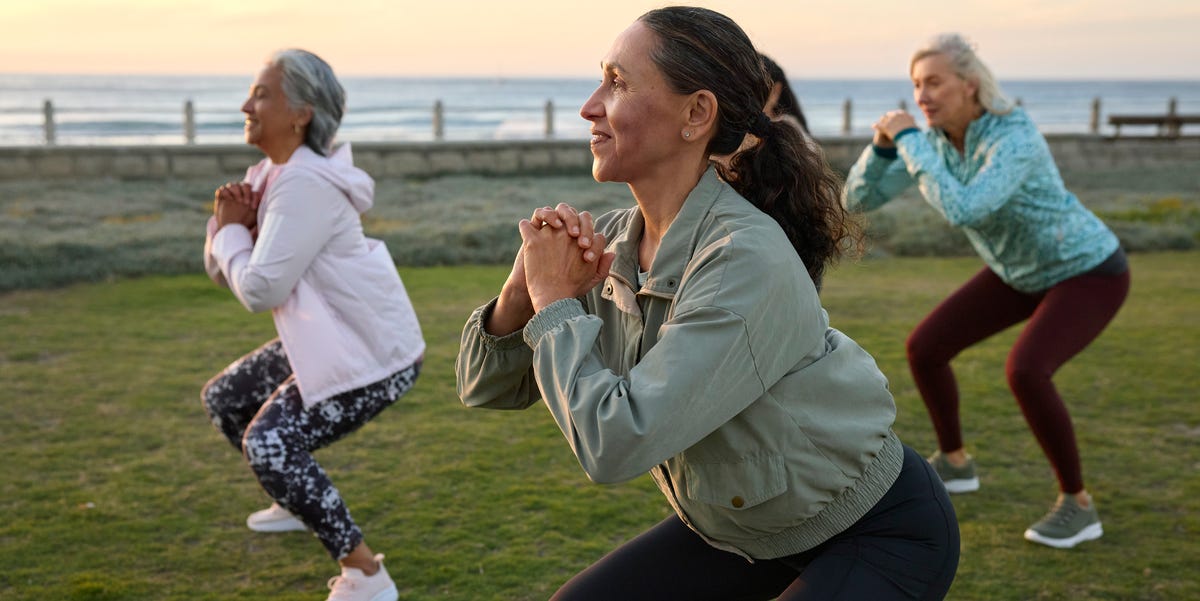
For optimal heart health benefits, the United States Department of Health and Human Services currently advises that adults get between 150 and 300 minutes of moderate intensity exercise (i.e. cycling, swimming, brisk walking) or 75 to 150 minutes of vigorous intensity exercise (i.e. running) per week. According to a new study, those recommendations may not be so universal. It all depends on your baseline fitness and the health goals you want to meet. For instance, if you’re looking to slash your cardiovascular-related risks by up to 30% (which is pretty significant), the findings say you’ll want to be up and moving a lot more often than the standard guidelines recommend.
Meet the xperts: Marwa Ahmed, NASM-CPT, a personal trainer, running coach, and CEO and founder of The BodyMind Coach; and Sirisha Vadali, M.D., a board-certified cardiologist and advanced lipidologist at HonorHealth.
Below, a personal trainer and cardiologist weigh in on the findings and share how to work more movement into your daily life for better heart health.
What did the study find?
For the study, published in the British Journal of Sports Medicine, researchers analyzed medical data and physical activity from more than 17,000 adults around 57 years old. Over a period of 7.8 years, they tracked the group’s health events and noted 1,233 cardiovascular events, including 874 cases of atrial fibrillation, 156 heart attacks, 111 cases of heart failure, and 92 strokes. Upon further analysis, researchers determined a strong association between weekly physical activity and better cardiovascular health. Specifically, the main contributor was better VO2 max, which is something that declines with age, notes Marwa Ahmed, NASM-CPT, a personal trainer, running coach, and CEO and founder of The BodyMind Coach—it’s the maximum amount of oxygen a person’s body can utilize during intense exercise. In other words, those with higher VO2 max numbers fared better physically.
Put simply, more exercise was linked to better heart health: The current guideline of 150 minutes of moderate-to-vigorous physical activity weekly was associated with a modest 8 to 9% reduction in cardiovascular risk, and the risk reduction grew much more significant, to 30% or higher, when weekly exercise increased to 560 to 610 minutes, which is three to four times the current recommendation.
Researchers also found that people with lower baseline fitness needed slightly more (around 30 to 50 minutes more) activity to reach the same cardiovascular benefits. “This suggests that the current recommendation of one-size-fits-all doesn’t work equally for everybody,” notes Ahmed.
Why exercise matters for heart health
There is plenty of research that shows the benefits of exercise for heart health. “The more you train your cardiovascular system, the more your body becomes better at adapting to the exercise stress applied to it,” explains Ahmed. That’s how you increase your VO2 max: “Your mitochondria, which are the energy factory in your cells, multiply and become more efficient at using oxygen,” she adds.
As a result, your heart can pump more blood per beat, and your blood vessels become more flexible and responsive, allowing more blood to flow through, which puts less of a strain on the vital organ, Ahmed explains. Over time, these changes can lower blood pressure, improve insulin sensitivity, reduce inflammation, and improve cholesterol, says Sirisha Vadali, M.D., a board-certified cardiologist and advanced lipidologist at HonorHealth.
How to fit more exercise into your day
We know what you’re thinking—610 minutes (or around 10 hours) of weekly exercise is a lot to squeeze into a busy schedule, which is probably why, in the study, only 12% of participants got at least 560 minutes in. Even so, Ahmed recommends not thinking about the time as structured workouts, but rather, bursts of movement naturally implemented throughout your days.
Anything that may raise your heart rate or labor your breathing, even if just for a few minutes, is worth doing, she notes, such as taking the stairs, walking or biking to work if you can, parking far away from your destination, or carrying groceries inside instead of getting them delivered. These, in addition to more structured moderate-to-vigorous workouts like brisk morning walks, hiking, swimming, and strength training, can get you far. And that’s what matters more than the actual number of minutes you manage to move.
The bottom line
“The goal is to accumulate movement throughout the week without feeling overwhelmed,” says Ahmed. “The most important thing is to choose activities you actually enjoy so you can become consistent at them.”
Dr. Vadali agrees. “The reality is that most adults struggle to achieve even the current recommendation of 150 minutes per week,” she says. “Instead, the takeaway is that the cardiovascular benefits continue to increase as activity increases.”
Read the full article here