

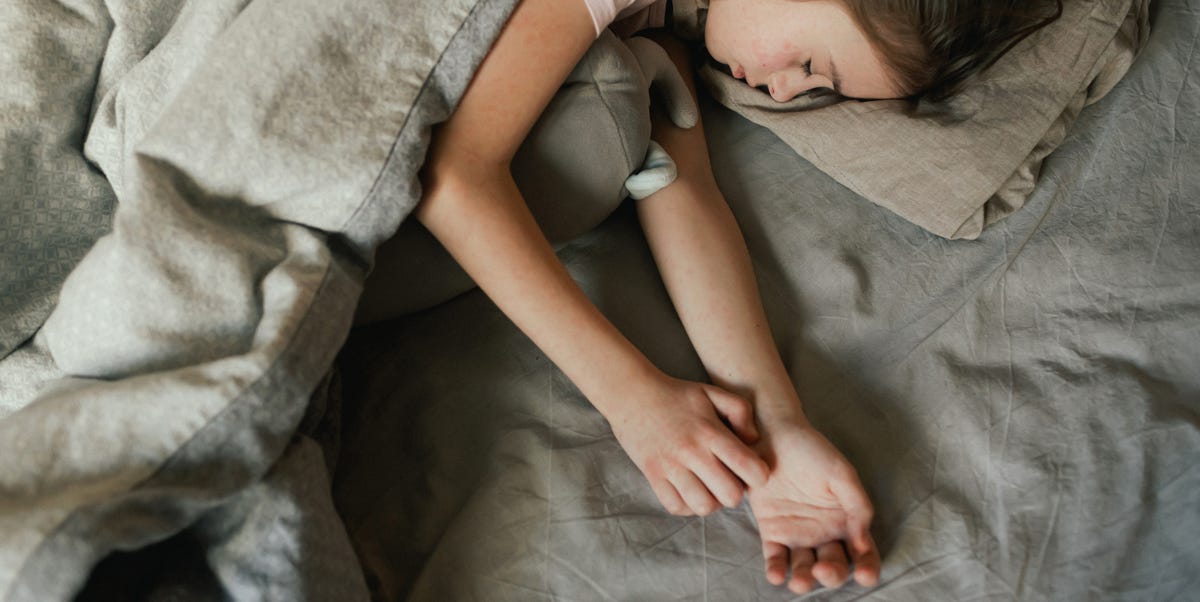
Sleep is a crucial part of wellbeing, but it can be especially challenging for children with eczema, also known as atopic dermatitis. The most common symptom that occurs during a flare is itchiness, which can feel more intense at night and make it difficult for kids to sleep.
Skin can become more inflamed at night because this is when “the body produces less cortisol, a hormone that can act as an anti-inflammatory,” explains Brittany Chan, M.D., a pediatrician with Texas Children’s Pediatrics. And unlike the day when kids are more active, there is nothing to help to distract them from how itchy their skin feels at night.
In addition to making falling asleep difficult, this itchiness can wake children up, which can disrupt a child’s healthy sleep cycles, says Joan Tamburro, D.O., a pediatric dermatologist at Cleveland Clinic Children’s Outpatient Center.
It’s easy to feel helpless when your child is up scratching in the middle of the night. But doctors say a few targeted changes to your kid’s bedtime routine, sleep environment, and skincare habits can make a big difference. Here’s what pediatricians and pediatric dermatologists suggest to reduce itching and help them sleep more comfortably.
Meet the experts: Brittany Chan, M.D., a pediatrician with Texas Children’s Pediatrics; Sheilagh Maguiness, M.D., division director for Pediatric Dermatology at the University of Minnesota and spokesperson for the Society for Pediatric Dermatology; Joan Tamburro, D.O., pediatric dermatologist at Cleveland Clinic Children’s Outpatient Center; Daniel Ganjian, M.D., pediatrician at Providence Saint John’s Health Center in Santa Monica, CA
Create an eczema-friendly bedtime routine
One of the best ways to soothe eczema-prone skin before bed is with what dermatologists call a “soak and smear” routine. “This is incredibly helpful and a great start to calming the skin for nighttime,” says Sheilagh Maguiness, M.D., division director for Pediatric Dermatology at the University of Minnesota and spokesperson for the Society for Pediatric Dermatology. According to the American Academy of Dermatology (AAD), the technique helps hydrate the skin, calm inflammation, and reduce overnight itching.
Here are the steps to follow for the soak and smear routine:
- Give your child a lukewarm bath. Use a hypoallergenic or gentle soap, per Dr. Chan. The water should be lukewarm (not hot) to avoid irritating your child’s skin, according to Daniel Ganjian, M.D., a pediatrician at Providence Saint John’s Health Center in Santa Monica, CA.
- Apply prescription creams or ointments. Not all children with eczema need to use topical medications, but some benefit from them. If your child has a prescribed cream or ointment, apply it to the affected areas before you put on their all-over moisturizer, Dr. Maguiness says.
- Slather on moisturizer. The AAD recommends applying a gentle, fragrance-free moisturizer while your child’s skin is still moist. “Creams and ointments are preferred over lotions, since lotions are more water based and evaporate more quickly,” Dr. Tamburro says.
- Keep your child’s hands busy before lights-out. Have your child help with a bedtime story by holding the book or a stuffed animal while you read. “This will keep the child’s hands occupied and decrease scratching,” Dr. Tamburro says.
If your child is in the middle of a flare, Dr. Maguiness recommends using the wet wrap technique after applying moisturizer. “Dampen a soft cotton long-sleeved or legged pajama set with warm water, wring it out, and then apply it to damp skin,” she says. “You can follow this with a dry set of pajamas or a sleep sack over the top if you’re using one.” This outer layer can help hold in moisture and keep your child more comfortable overnight. “This is very calming to inflamed and itchy skin,” Dr. Maguiness says.
Optimize your child’s sleep environment
Temperature, fabrics, and skincare are important elements to ensure your child is comfortable while they sleep. Dr. Chan recommends keeping your child’s room between 68 and 72 degrees Fahrenheit. “Hot and sweaty skin is more itchy,” she explains. “Keep the room cool and make sure your child is not overly bundled up.”
Pajama fabrics should be breathable and soft, like cotton. “Avoid fabrics that are rough or would cause a lot of friction, such as wool,” Dr. Chan says. Your child’s bedding should also be soft and breathable. Dr. Tamburro suggests using 100% cotton sheets and 100% cotton fabrics on your child “as much as possible.”
What to do when nighttime itching strikes
If nighttime itch persists despite your eczema-friendly bedtime routine antihistamines may help, Dr. Chan says. (Just check in with your child’s healthcare provider first.)
Dr. Tamburro recommends helping your child relax with a gentle massage, like a light back rub if there are no eczema patches in the area, to calm their body and make it easier to fall back asleep. And if early waking or difficulty falling to sleep becomes a regular occurrence, Dr. Tamburro suggests looking at your child’s activity during the day. More activities may help use up some of their seemingly neverending energy, which may help them settle down more easily at night because they might be more tired.
When to call the doctor
Eczema can be a finicky condition, and your child may still experience an uncomfortable flare even when you do everything right.
Check in with your pediatrician or pediatric dermatologist if your child’s eczema is spreading, covers a large portion of their body, or is uncomfortable, Dr. Chan says. “Sometimes eczema can get superinfected with bacteria,” she says. “If your child’s skin is extremely red or oozing, have your pediatrician check it out right away.”
Don’t hesitate to contact your child’s healthcare provider if your little one doesn’t seem to be getting relief. “The sooner you seek treatment for eczema, the better,” Dr. Tamburro says. “Eczema is easier to control and treat before a severe flare develops.”
Read the full article here