

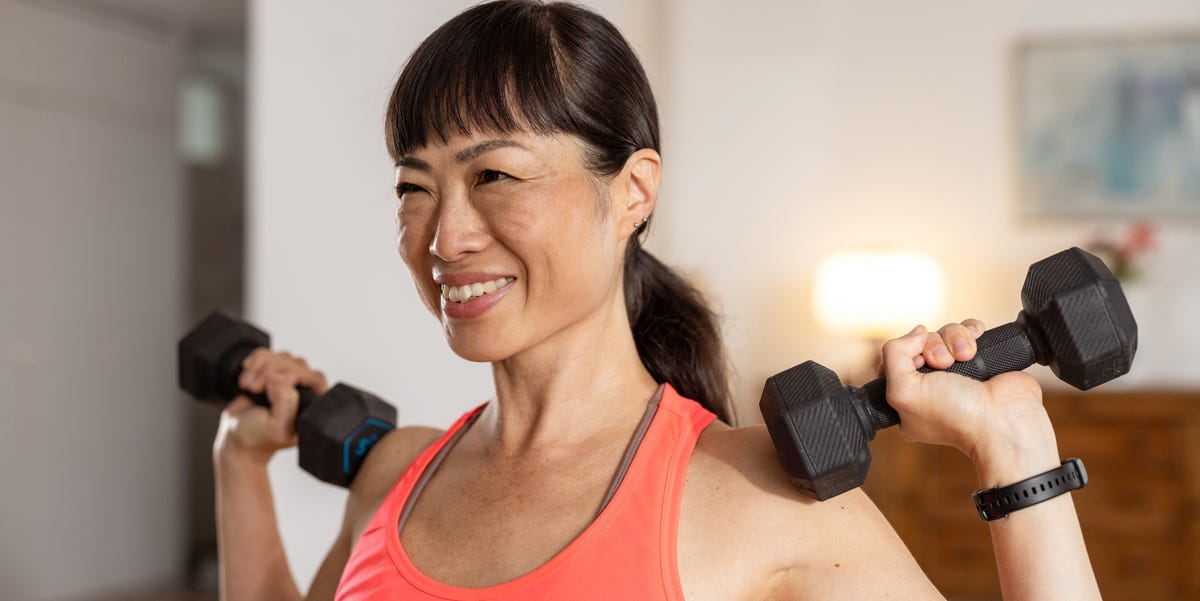
It’s a familiar rite of passage: You hit the big 5-0, and suddenly life feels a little harder. Maybe the grocery bags are starting to feel like lead, you’re a bit more winded after climbing the stairs, or you now let out a groan when getting up off the couch. These might all be normal changes that can happen with age, but that doesn’t mean that you have to accept them.
There’s one powerful healthy aging habit that can help you counteract the newfound creaks that come with getting older: regularly lifting weights. And it’s never too late to pick up a dumbbell for the first time. “There’s no age limit on the muscle’s ability to gain strength or muscle mass,” says Debra Atkinson, C.S.C.S., founder of Flipping 50.
When you lift weights at age 50 (or beyond!), that helps support bone and joint health, build muscle strength and lean muscle mass, and improve balance and mobility—all things that can start to decline with age but that are essential for staying active and healthy overall as you get older.
“If you want to be fit at 80, you must train with intention in your 50s,” adds Gabrielle Lyon, D.O., founder of the Center for Muscle-Centric Medicine and author of Forever Strong: A New, Science-Based Strategy for Aging Well. “The stronger you are now, the more resilient you’ll be later.”
Experts share exactly what happens to your body and health when you start strength-training at age 50, plus how to start lifting weights today.
Meet the experts: Debra Atkinson, C.S.C.S., the founder at Flipping 50; Gabrielle Lyon, D.O., the founder of the Institute for Muscle-Centric Medicine and author of Forever Strong: A New, Science-Based Strategy for Aging Well; Pooja Gidwani, M.D., a double board-certified physician in internal medicine and obesity medicine in California and Florida.
Benefits of Strength-Training at Age 50
Your body and health naturally start to change as you get older, and effects on your bones, muscles, joints, and brain can make healthy aging feel like a struggle. Happily, lifting weights over 50 can make a big positive difference in how you function and feel, and add up to big health benefits that will support all aspects of healthy aging.
Here are some body changes that can happen when you start strength-training at age 50.
Build Lean Muscle
Strength training helps counteract the natural decline in muscle mass and strength. “Resistance training creates micro-tears in muscle fibers, which then repair and rebuild stronger,” explains Pooja Gidwani, M.D., a double board-certified physician in internal medicine and obesity medicine in California and Florida.
After age 30, you naturally start to lose muscle mass, and that accelerates after 60. This age-related loss of muscle strength and function is known as sarcopenia, and “it’s one of the biggest predictors of functional decline in older adults,” says Dr. Lyon.
Reduce Osteoporosis Risk
Lifting weights puts mechanical stress on bones, which triggers osteoblast activity (aka the creation of new bone); this can help prevent or slow osteoporosis. “It’s one of the few natural ways to stimulate bone density without medication,” says Dr. Gidwani.
When you reach age 50, bone density takes a hit as your bones start breaking down faster than new bone is formed, and this process is even more pronounced after menopause when estrogen levels (which play a role in bone health) permanently dip.
Support Brain Health
Strength-training can lead to brain changes that support good cognitive function in older adults, research suggests, and it may also reduce symptoms of depression in adults ages 60 and older, found another recent review.
“Since strength training supports good sleep and can help reduce symptoms of anxiety and depression, that makes it a powerful tool to support mental sharpness and emotional resilience,” says Dr. Lyon.

Add Prevention as a preferred source in your Google search results.
Use your Google account to add this to your settings.

Maintain a Healthy Weight
Muscle is one of the most metabolically active tissues in your body—meaning it supports balanced blood sugar, improves insulin sensitivity, and burns calories—and that can all help you maintain a healthy weight. “As estrogen declines, there’s a natural shift toward increased fat storage, particularly around the midsection,” explains Dr. Gidwani, but “strength training is a potent antidote.”
Resistance training appeared to improve body fat levels and inflammation in postmenopausal women, according to a recent meta-analysis.
Improve Balance and Coordination
Falls are the leading cause of injury-related death in adults over 65, according to the Centers for Disease Control and Prevention (CDC).
Strength training targets the muscles that help keep us stable, such as the core, legs, hips, glutes, and ankles, and it also trains something called proprioception, or “your body’s awareness of where it is in space,” explains Dr. Lyon. That means you’re not just getting stronger, you’re also improving your body’s communication with the brain, and over time, this may lead to better balance and coordination, quicker reaction time, and a reduced risk of falls.
How to Start Strength-Training Over 50
You don’t need to hoist heavy dumbbells to reap the benefits of weightlifting. The following tips can help you ease into a sustainable routine.
For newbies, it can also be a smart idea to find a certified personal trainer or physical therapist to work with who understands age-related needs and can ensure you’re moving safely and efficiently. And don’t forget to get the all-clear from your doctor before starting strength-training exercises or any new workout routine.
Start Small
There’s no extra benefit to clocking five straight strength-training workouts in a row—in fact, that’s a good way to accidentally hurt yourself. So how often should you lift weights to see results? Start with just two weight-lifting sessions a week, then work your way up to three or four a week as you get stronger.
You can lift weights on back-to-back days as long as you are targeting different muscle groups (so if you work out your lower body on Monday, do upper body on Tuesday).
Don’t Skip Stretching
“Decreased estrogen means ligaments and tendons are less resilient,” says Atkinson, which could make you more prone to getting hurt. Always do dynamic stretches (meaning you only hold poses for a few seconds) and warm up your muscles before beginning a workout, and spend a few minutes stretching out your muscles when you finish exercising (you can do static stretching after the workout, holding poses for 30 seconds or more).
This will help you stay consistent with the weights, plus full-body stretches feel amazing.
Try Functional Fitness
“Lifting weights is all about staying capable,” says Dr. Lyon. Doing functional fitness workouts, or total-body routines that target all major muscle groups and mimic daily activities (like getting up from a chair or loading laundry), can help you avoid injury and maintain independence as you age.
Focus on Form, Not Weight
Atkinson recommends choosing weights that allow you to comfortably complete one to two sets of 15 to 20 repetitions for each move you do. If you can’t complete the exercise with proper form, lessen your weight.

Caitlin is a journalist based in New York City. In addition to Prevention, she writes for publications including The Wall Street Journal and Women’s Health. She’s completed 12 marathons, including the six World Marathon Majors, is semi-fluent in French, and volunteers as a greeter on The High Line. Follow her on Instagram or LinkedIn.
Read the full article here