

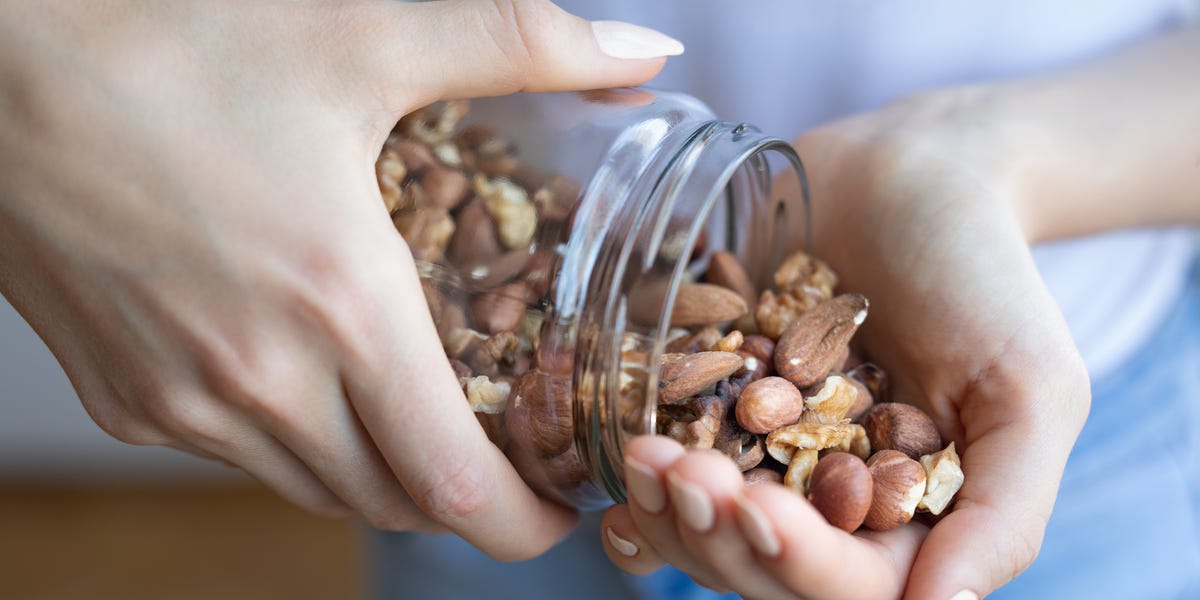
Nuts are one of the most snackable foods available; they’re so crunchy and savory and satisfying. Plus, they’re nutritional powerhouses, filled with protein, fiber, healthy fats, and other nutrients. But there are side effects of eating too many nuts that are worth considering if you’re continuously going back for more.
“The benefits of nuts definitely outweigh any other drawbacks or cons,” said Jerlyn Jones, R.D.N., L.D., a spokesperson for the Academy of Nutrition and Dietetics and owner of The Lifestyle Dietitian. Nuts can help lower blood pressure, improve brain health, reduce heart disease risk, curb inflammation, and more.
Meet the experts: Jerlyn Jones, R.D.N., L.D., a spokesperson for the Academy of Nutrition and Dietetics and owner of The Lifestyle Dietitian; Alan R. Gaby, M.D., the author of Nutritional Medicine; Lily Nichols, R.D.N., a registered dietitian nutritionist and certified diabetes educator.
Still, said Jones, “you want to be mindful of how many nuts you’re eating per day.” Most of us don’t stick to the recommended daily serving size, she said, which is about 1/4 cup or roughly one handful. If you’re concerned that you’re overdoing it in the nut department, consult a registered dietitian or your physician for a more catered approach.
It’s completely possible to include nuts in your healthy diet on a regular basis. But if you’re frequently eating too many, you may experience these side effects.
Difficulty losing weight
Because nuts are so filling, they can help aid your weight loss goals by curbing cravings for foods that you’re trying to avoid—but there’s a caveat: This only applies if you consume a moderate number of nuts. Eat more than the recommended handful, and you might actually start to gain weight.
That’s because nuts are calorie-dense, Jones said, meaning they contain more energy per ounce than many other foods (you can thank all the healthy fats for that!). For example, 1 ounce of almonds contains about 160 calories—so even if you just double your serving, you’re packing in 320 calories for a snack. That could result in weight gain if you don’t account for the extra calories eaten throughout your day, either by reconsidering what you eat at a later snack or lunch or working a little harder during your workout.
That said, if you love nuts and simply fit the extra handful into a balanced diet overall, you shouldn’t have too many issues. For example, if you’re having a salad loaded with vegetables and want to bulk it up with extra nuts because it won’t be filling otherwise, by all means add the almonds to round out your meal.

Add Prevention as a preferred source in your Google search results.
Use your Google account to add this to your settings.

GI discomfort like gas, bloating, and diarrhea
If you’ve ever experienced gas or bloating after munching on nuts, you’re not alone. It’s a common side effect, thanks to compounds in nuts called phytates and tannins, which make them difficult to digest. And eating too much fat, which is found abundantly in nuts, in a short period of time can even lead to diarrhea, said Alan R. Gaby, M.D., author of Nutritional Medicine.
But these side effects can be avoided if you stick to the recommended daily serving size, which will be easier for your digestive system to handle, or opt for sprouted nuts. These have already started to turn into plants, so they’ll be a little easier to break down, noted Lily Nichols, R.D.N., a registered dietitian nutritionist and certified diabetes educator. You can find sprouted nuts in the nut aisle at your local health food store or online.
Selenium poisoning—but only from Brazil nuts
You know those huge, oblong nuts often included in a can of mixed nuts? Those are Brazil nuts, the richest food source of selenium. In fact, a 1-ounce serving (six to eight nuts) contains nearly 10 times the recommended daily amount of selenium (55 micrograms). Selenium is an essential mineral that plays a key role in the function of your thyroid, immune system, and reproductive system, per the National Institutes of Health (NIH), but it is possible to get too much.
Selenium poisoning can make your nails brittle, cause your breath to smell, and even trigger aching muscles and joints, per the NIH. If you are continuously getting too much selenium over time, it can even cause more serious issues like stomach and nervous system problems, difficulty breathing, and lightheadedness.
An important note: Selenium overload is specific to Brazil nuts, so there’s no need to consider this possibility when eating other types of nuts.
“If you’re only eating a minimum amount of Brazil nuts, you don’t have to worry about too much selenium in your body,” Jones said. She recommended eating only up to four Brazil nuts a day, and possibly dropping that to four every other day to err on the side of caution.
The solution to all of these issues? Simply to watch the number of nuts you eat and try to stick to only a handful at a time. If you tend to graze mindlessly, Jones recommended choosing nuts with shells and creating a pile of shells so you can keep track of exactly how many you’ve had. You can also measure out a portion to keep your serving sizes in check.
—Additional reporting by Kasandra Brabaw
Read the full article here