

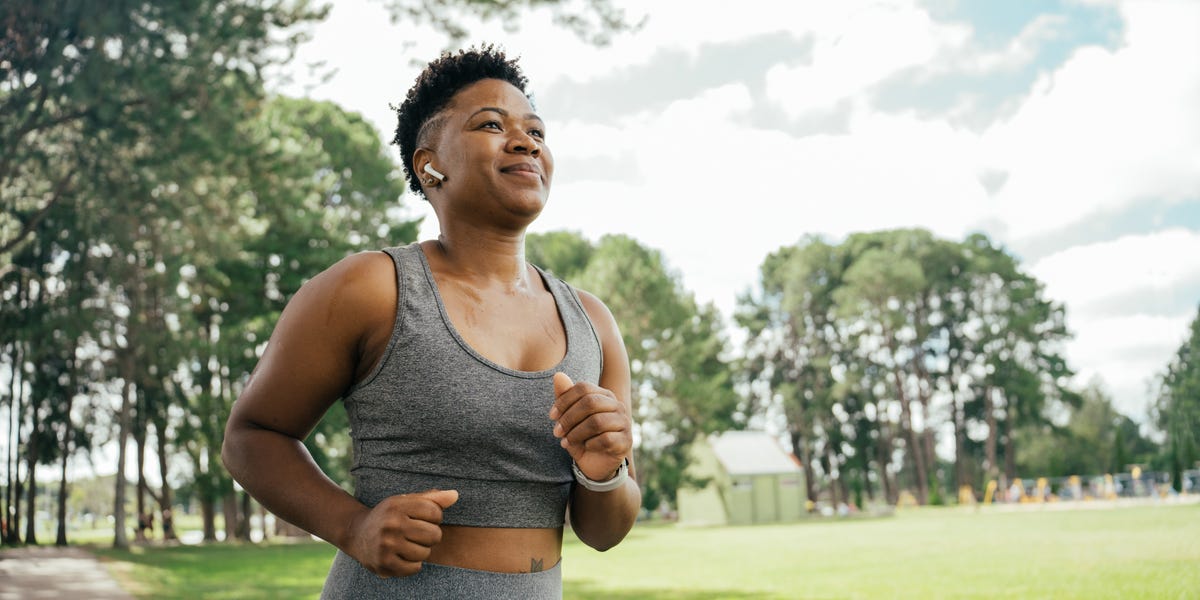
Incorporating more aerobic exercise, or cardio, into your fitness routine sounds easy enough. But how you do it makes all the difference when you’re trying to build a sustainable long-term habit, especially as we age. Luckily, fitness experts have plenty of aerobic exercise tips for women over 50 that can help you get started on the right foot.
Aerobic exercise actually includes a lot more activities than just running. According to the Cleveland Clinic, aerobic exercise is any activity that you do continuously that gets your heart rate up, such as walking, jogging, cycling, swimming, or dancing. “Regular aerobic activity helps mitigate risks like cardiovascular disease, insulin resistance, and bone density loss by improving heart health, managing body composition, enhancing insulin sensitivity, and reducing systemic inflammation,” explains Mark Kovacs, Ph.D., C.S.C.S., a human performance scientist and longevity expert.
Meet the experts: Mark Kovacs, Ph.D., C.S.C.S., is a human performance scientist and longevity expert. Brooke Bussard, M.D., is a certified personal trainer and owner of Brooke’s Balanced Blueprint, a lifestyle medicine health coaching practice in Baltimore, MD; Patricia Greaves, C.P.T., certified fitness trainer, precision nutrition coach, and founder of StrongHer Personal Training
Those benefits are also what make aerobic exercise particularly beneficial for women over 50, as the risk of developing osteoporosis and heart disease goes up after menopause. “Estrogen helps keep blood vessels flexible and cholesterol levels in check,” explains Brooke Bussard, M.D., a certified personal trainer and owner of Brooke’s Balanced Blueprint, a lifestyle medicine health coaching practice in Baltimore, MD. “When estrogen drops, regular aerobic exercise helps pick up the slack by keeping your circulatory system healthy.”
Whether you’re just getting started or looking for ways to mix up your exercise regimen, keep reading for expert-backed aerobic exercise tips for women over 50 that will help you feel better and healthier for years to come.
Aerobic exercise tips for women over 50
1. Aim for 150 minutes a week—but break it into small chunks.
The CDC recommends 150 minutes of moderate-intensity aerobic activity per week. But “this is a minimum recommendation,” says Kovacs: People who worked out two to four times above the moderate physical activity recommendations (about 300 to 599 minutes each week) saw the most benefit in a 2022 study published in Circulation.
Still, something is better than nothing. “The best plan is the one you can stick with,” says Dr. Bussard, who recommends walking for about 30 minutes five times a week. If three 10-minute dance breaks a day works better for you, that’s cool, too. It all adds up—and workouts of less than 10 minutes still count toward recommended weekly activity goals, according to the CDC.
2. Use the talk test to measure your intensity.
Not sure if you’re working hard enough for your activity to count as a workout? Try talking. “For heart-healthy aerobic exercise, you should be slightly breathless but still able to hold a conversation,” says Dr. Bussard.
You can also determine intensity using a scale from 1 to 10. “Moderate intensity (like a brisk walk or steady cycling) typically corresponds to a five or six out of 10 on the effort scale,” says Kovacs, “while vigorous aerobic exercise (fast walking uphill or jogging) should feel like a seven to eight out of 10, where talking becomes difficult.”
3. Don’t count out low-impact activities.
Cycling, elliptical training, swimming, or walking on an incline are all joint-friendly ways to raise your heart rate. “These options reduce joint stress, which is critical as cartilage, tendons, and ligaments may become less resilient with age,” says Kovacs.
But “low-impact doesn’t mean low-intensity,” says Dr. Bussard. “You can absolutely work up a sweat and challenge your heart and lungs without pounding your joints.” Just pay attention to the effort you’re exerting in the moment and aim to hit that five out of 10.
4. Work in short, quick bursts.
“Adding short bursts of faster-paced intervals to your aerobic routine boosts the benefits,” says Dr. Bussard, as long as you’re cleared by your doctor to work harder. Recent research in the journal Lipids in Health and Disease shows that high-intensity interval training (HIIT) can improve insulin sensitivity, blood pressure, and overall fitness—“all areas that can decline during menopause,” she adds.

Add Prevention as a preferred source in your Google search results.
Use your Google account to add this to your settings.

This kind of training is considered vigorous activity, so you don’t need as much of it: Just two HIIT sessions per week (with a total training time of 20 minutes per workout) improved working memory and lower-body muscle function more than moderate-intensity continuous cycling, and boosted cardiorespiratory fitness just as much, according to a 2023 study published in The Journals of Gerontology.
5. Mix up your workouts.
Boredom is the enemy of consistency. Try different types of cardio—like hiking, aqua aerobics, Zumba, or even pickleball. “Varying modalities challenges different muscle groups, reduces overuse injury risk, and improves neuromuscular coordination,” said Kovacs. “It also helps sustain motivation and supports functional aging by preparing the body for a wider range of physical challenges.”
6. Let your body recover.
As you age, your body may take longer to bounce back. “Recovery between workouts often takes longer due to a combination of physiological changes,” says Kovacs. “These include slower muscle protein synthesis, reduced hormone levels (like estrogen and growth hormone), and less efficient mitochondrial function—all of which contribute to slower tissue repair and reduced energy availability.”
Make sure to allow 48 to 72 hours of muscle recovery between higher-intensity sessions, and prioritize adequate sleep, sufficient nutrition, and active recovery, like gentle walking or mobility work. And listen to your body; if you feel wiped out for days, scale back and allow more rest between sessions.
7. Take the time to warm up.
Older muscles and joints need more prep. “As estrogen drops, tendons and ligaments get stiffer, so warming up is more important than ever to prevent injuries,” says Dr. Bussard. “A good warm-up should move your joints through a full range of motion and activate your major muscles.” Try inchworms, bodyweight squats with overhead reaches, and side-to-side lunges—just five to 10 minutes can prime your body for exercise.
8. Pair cardio with strength-training.
Women over 50 benefit most when they combine cardio and strength-training, as both play essential but distinct roles in healthy aging. “Aerobic exercise keeps your heart healthy, but you need strength training to keep your muscles and bones strong,” says Dr. Bussard. Putting them together is the real key. “Combined, they form the foundation of long-term healthspan and mobility,” says Kovacs.
9. Start where you are.
Even if you’re eager to incorporate more aerobic exercise into your routine, it’s important to start small to ensure the habit is sustainable over time. “So often, women believe they have to start at a high bar to see progress,” explains Patricia Greaves, C.P.T., certified fitness trainer, precision nutrition coach, and founder of StrongHer Personal Training. “If you’re new to exercise or getting back into a routine, start with 10 to 15 minutes of brisk walking. As you build consistency and stamina, you can increase to 30-minute cardio sessions. Starting at a comfortable level will reduce the risk of injury or burnout.”
10. Choose activities you enjoy.
Finally, no one’s going to want to keep up a part of their routine they dread actually doing. Greaves recommends choosing activities you enjoy that will help you stay consistent. “Dancing, swimming, cycling, Zumba, walking with a friend, or pickleball are all great ways to improve cardio health,” she says. “Choosing activities that you like will increase long-term adherence so it becomes a regular part of your lifestyle.”
Who should avoid aerobic exercise?
Despite the many benefits of aerobic exercise, high-intensity cardio workouts aren’t for everyone. Greaves always recommends checking with your doctor before starting a new exercise program. “Your doctor will ensure there are no contraindications such as unmanaged high blood pressure or diabetes, balance conditions (vertigo), or acute illness,” she says. “With medical clearance, aerobic exercise is encouraged to promote cardiovascular health and mobility.”
Read the full article here