

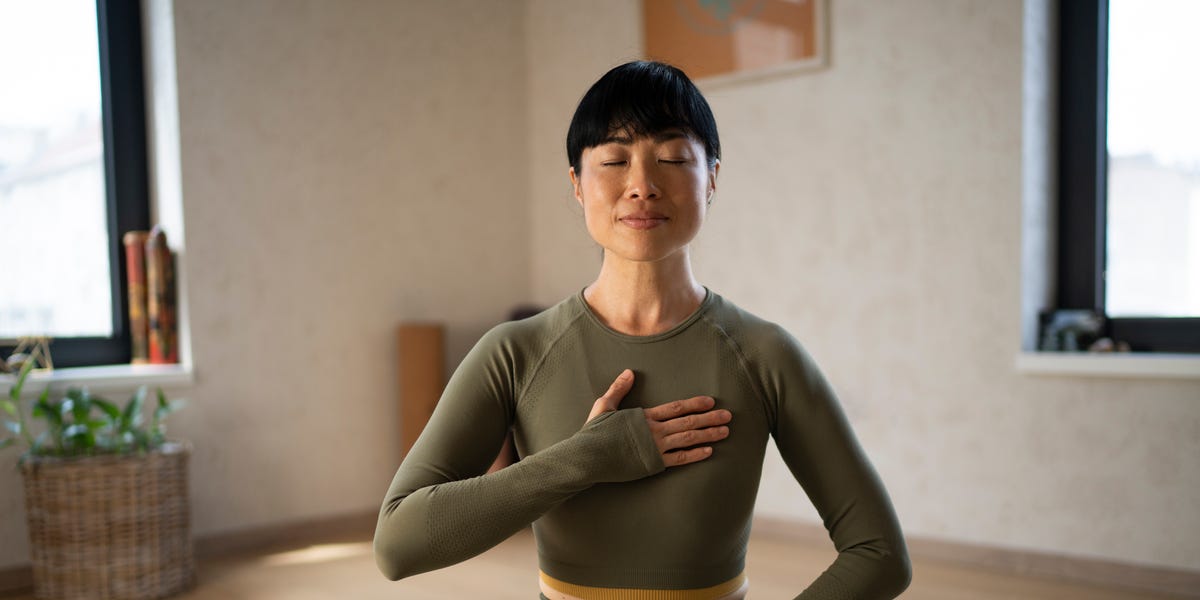
Stress may be uncomfortable, but it doesn’t always have to be a bad thing. In fact, it’s a natural, often useful, response to stimuli in the world around us. You might hate stress when it causes you to sweat through your shirt during an important job interview, but most of the time it actually comes in handy, helping you get things done and challenging your problem-solving skills. Still, while you can’t always avoid the things that stress you out, having some breathing techniques for stress in your back pocket can help make them more bearable.
Meet the experts: Jamie Ware, L.S.W., breathwork facilitator and therapist at Within Healing & Breathwork and at Voyage Healing; Brian P. Ramos, Ph.D., author of The Art of Stress-Free Living.
“We have this fight-or-flight response in our bodies that’s to help us run from tigers and stuff,” explains Jamie Ware, L.S.W., breathwork facilitator and therapist at Within Healing & Breathwork and at Voyage Healing. But Ware explains that modern life still leads many people to experience excessively heightened stress levels—no tiger necessary.
Since you can’t always remove stressors from your life, it’s important to know how to manage them. Ahead, experts share simple and effective breathing techniques for stress and why they actually help.
What does stress do to your body?
Stress isn’t just all in your head. “It has very tangible effects on your body,” explains Brian P. Ramos, Ph.D., author of The Art of Stress-Free Living. In fact, he believes that stress and inflammation are “the two silent killers of our generation.”
According to the Mayo Clinic, experiencing sustained levels of excessively elevated stress, often referred to as chronic stress, can weaken your body, leaving you more susceptible to illness and making it harder for you to recover. This type of prolonged stress can also cause headaches, digestive problems, muscle tension, and even increase your risk of heart disease and stroke.
When your head finally hits the pillow after a long, stressful day, things may not improve as you’d hope. Studies show that stress can cause you to get less or lower-quality sleep, stealing your body’s time to recover from the day. “This compounds the problem,” says Ramos. “Those sleeping issues then start to translate, the next day, into a higher baseline of stress hormone levels.”
For people living high-stress lives, this problem can snowball for years if no measures are taken to intervene. Ramos says that the bigger the effect is on the body, the more effort it will take to reverse, so the best time to start taking steps to manage your stress is now.
How does breathing help alleviate stress?
Breathing has a direct physiological link to stress. “When someone is stressed, they often don’t realize that they’re holding their breath, they’re breathing very shallow, or their breathing is very choppy,” says Ramos. Luckily, that physiological link goes both ways, making breathing techniques a great tool to reduce stress.
“Breathing is one of the best switches to engage your nervous system,” he explains. And, according to Ramos, the benefits are twofold. First, intentional breathing “breaks whatever mental pattern was creating the worry, whatever was feeding the fear, or the doubt that was causing you to activate stress,” he says. Second, breathing “activates a side of our nervous system that then causes you to relax and slow down.” That means it can be a great tool for grounding yourself in moments of acute stress or a helpful preventative practice to build resilience against chronic stress.
Simple and effective breathing techniques for stress
Box breathing
This technique has been used to keep people calm in some of the most high-stress situations imaginable. Ramos says it’s often taught to U.S. service members and law enforcement personnel to help them slow down and “lock into the present moment.” However, the same technique can be helpful in far less dire scenarios.
The name of this technique reflects that, like a box or square, all sides of this breath cycle should be equal. This means the inhales, exhales, and holds all take the same amount of time. Studies show that structured breathing techniques like this can reduce your heart rate and improve your mood.
To do:
Stand up straight or sit tall in your chair. Engaging good posture ensures that your lungs are able to expand to their full capacity. Slowly breathe in through your nose for about four seconds, then, once your lungs are filled and you have reached the top of your breath, hold it for another four counts. Then, slowly exhale through your mouth for four seconds and, at the full release of that breath, hold it for another four seconds. This set can be repeated as many times as needed.
Diaphragmatic breathing
“One of my favorite go-tos is diaphragmatic breathing,” says Ware. Your diaphragm is a dome-like muscle that sits underneath your lungs. It contracts and relaxes throughout the day, often involuntarily, to pull and push air into your lungs. It’s also one of the main drivers of the breath, but Ware says that most people often don’t use their lungs or their diaphragm to full capacity during their everyday breathing. Diaphragmatic breathing offers an easy way to fix that by intentionally engaging the muscle.

Add Prevention as a preferred source in your Google search results.
Use your Google account to add this to your settings.

To do: Lie down in a comfortable position on your back. Place one hand on your belly and the other on your upper chest, just above your rib cage. Breathe in deeply and slowly through your nose, feeling your lower hand rise as you fill with air. Focus on your upper hand and try not to let your chest move. Then, tighten your stomach muscles and breathe out slowly through your mouth. Focusing on your lower hand, feel how your belly moves inward as the air flows out. Continue to repeat this cycle.
Longer exhale breathing
This breathing technique for stress might take a bit of trial and error before you find the length of breath that feels most comfortable for you. While specific times, as recommended by Ware, are described below, this is a very flexible technique, so those do not need to be followed exactly. The main goal is simply to pay attention to your breathing, and to exhale for longer than you inhale. Ramos says exhaling longer “activates a side of our nervous system,” called the parasympathetic nervous system, “that then causes you to relax and slow down.”
To do:
Breathe slowly through your nose for five seconds. Then, at the top of your breath, exhale slowly from your mouth for seven seconds. Keep replicating this pattern for as long as you feel comfortable.
Lion’s breath
This breathing technique for stress looks a bit more strange than some of the others on this list, as it can make people look a bit “like a panting dog,” Ramos admits. But if you can find a private space, it can be highly effective.
To do:
Inhale deeply and slowly through your nose. When you’re ready to exhale, do so through your mouth and allow your tongue to hang towards your chin. Make a “ha” sound as you exhale air from the back of your throat. If done correctly, your exhaled breaths should be hot instead of cool. In between sets, breathe normally for a few counts, and then repeat.
Ujjayi breath
Ujjayi breath may take a bit more work to master, but it is well worth the effort. “Breathing through your nose is important because it brings in a little bit of nitric oxide to allow for more oxygen to come in to expand the blood vessels,” says Ramos. “It’s really good for the brain as well.”
To do:
This technique happens entirely by breathing through your nose, so the first step is to close your mouth. Constrict your throat as if you are going to whisper to someone. This should help your breath create an audible noise, similar to the “ha” sound made while practicing Lion’s breath. Some people describe this noise as similar to the sound of the ocean. Breathe in and out slowly through your nose for equal counts while continuing to create this sound.
Slow your breath to six cycles per minute
Breathing techniques for stress are highly personalized. What works for one person won’t work for someone else. If none of the previous methods work for you, it’s okay to create your own path. “If you look at the sweet spot, six breath cycles per minute is what people should shoot for [during breathwork sessions],” Ramos says. According to the American Lung Association, the normal respiratory rate ranges from 12 to 25 breath cycles per minute throughout the day. So while people should make sure they fall within that range during the day, in periods of stress, calming yourself down might require slowing your breathing down significantly.
Read the full article here